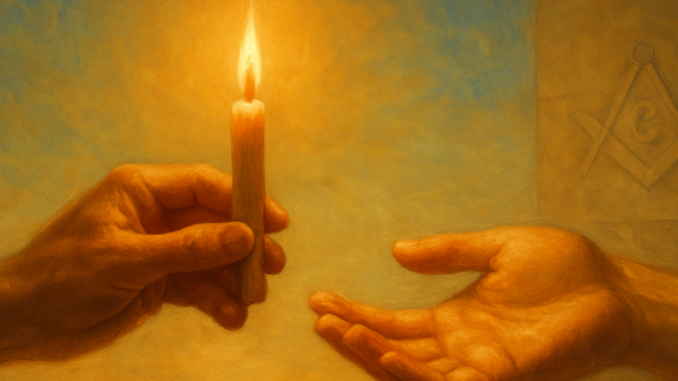
Zero-sum thinking quietly shapes many of our daily decisions. It whispers that one person’s gain must inevitably be another’s loss — that every blessing somewhere else must be a curse. But what if there is a fundamentally different way of seeing the world? In Freemasonry and many spiritual traditions, a radically different premise holds true: that growth, wisdom, and light are not finite resources but multiply when shared. Today, we place these two worldviews side by side.
What Zero-Sum Thinking Really Means
The term zero-sum thinking originates in game theory. In a zero-sum game, total gains and total losses are perfectly balanced: what one player wins, the other loses. Chess is a classic example. This logic works perfectly within the boundaries of a game board, but it becomes deeply problematic when we apply it to life as a whole.
In everyday life, zero-sum thinking manifests in thoughts like: “If my neighbor is successful, there’s less success left for me.” Or: “If I give something away, I have less for myself.” These beliefs create a world of constant competition, distrust, and fear. Philosophers like Thomas Hobbes described the natural state of humanity as a war of all against all — a worldview that rests precisely on this assumption.
The Spiritual Perspective: Abundance as a First Principle
Standing in stark contrast to this scarcity logic is a spiritual perspective that takes abundance as its starting point. Across virtually all great wisdom traditions, we find the conviction that the things of true value — love, knowledge, wisdom, and inner peace — do not diminish when shared. On the contrary, they grow.
Baruch Spinoza spoke of the human striving toward what he called the highest knowledge: insight into the unity of all existence. Whoever shares this knowledge does not lose it. It multiplies through the very act of exchange. In Stoic philosophy too, among thinkers like Marcus Aurelius and Seneca, we find this awareness. A person’s true wealth lies not in material possessions but in inner virtue — and that virtue can neither be stolen nor exhausted.
Beyond Zero-Sum: The Masonic Vision
Within Freemasonry, this theme plays a central role, even if it is seldom named in these exact terms. A Lodge meeting is not a competition in which one Brother or Sister must rise above another. The ritual and fraternal dialogue are designed around the principle that everyone can grow simultaneously. When a fellow Mason gains new insight, it is not acquired at anyone else’s expense. The light one Freemason kindles illuminates the entire room.
Spiritual growth is not a zero-sum game: one person’s light does not extinguish another’s candle — it adds clarity to the whole room.
This idea reaches far beyond symbolism alone. Freemasonry has historically produced important thinkers who brought this abundance mindset into society. Voltaire and other Enlightenment philosophers, often connected to the Lodges of their era, believed that knowledge and reason should be universally accessible. Not because they were naive about human conflict, but because they understood that shared wisdom increases the total sum.
What Both Perspectives Share
It would be too simplistic to dismiss zero-sum thinking entirely. There are genuine situations in which resources, time, or physical space are truly limited. The question is not whether scarcity exists, but how dominant we allow it to become in our thinking.
Both the scarcity perspective and the abundance perspective acknowledge that choices have consequences. The difference lies in where we direct our attention. Those who constantly think in terms of loss and competition create an inner reality that acts accordingly. Those who learn to think in terms of possibility and shared growth open entirely different paths.
A Practical Example
Imagine helping a colleague with a difficult project. From a zero-sum perspective, you might reason: “I’m investing my time, and he gets the credit.” From a spiritual or Masonic perspective, you might see it differently: “By helping, I grow myself, I deepen the relationship, and I contribute to something larger than either of us.” The factual situation is the same. The inner experience — and the long-term consequences — are radically different.
What We Can Learn
Comparing zero-sum thinking with the spiritual abundance perspective teaches us something essential about our own mental patterns. Much of what we consider objective reality turns out, upon closer examination, to be a learned framework of thought.
Freemasonry offers no ready-made answers, but it does offer a method: ongoing self-reflection, openness to other perspectives, and the willingness to question old certainties. In the stillness of the Lodge, during ritual, or in conversation with Brothers and Sisters, space arises to examine which beliefs serve us and which ones hold us back.
Consider these key takeaways:
Zero-sum thinking is useful in bounded situations but limiting as a life philosophy. Spiritual traditions offer a perspective of abundance and shared growth. Freemasonry invites us to explore both perspectives without judgment. And awareness of our own thought patterns is the first step toward inner freedom.
Ultimately, the choice between scarcity and abundance is not a matter of being right or wrong. It is a choice about how we want to stand in life and what kind of world we help create through our thinking.
Zero-sum thinking and spiritual abundance represent two fundamentally different ways of being in the world. Both have their place, but the question is which one we allow to dominate. Freemasonry, with its emphasis on brotherhood, shared light, and continuous self-improvement, points us in a direction that looks beyond scarcity. Not as naive optimism, but as a conscious choice for a richer inner life and a more generous way of engaging with the world around us.
Copyright text & image: devrijmetselaar.nl
Texts are based on the ideas and content of the author of devrijmetselaar.nl, reviewed, corrected, and supplemented with the assistance of OpenAI. Images are created based on the ideas of the author of devrijmetselaar.nl using OpenAI/DALL-E.

Be the first to comment