When readers first cracked open Dan Brown’s The Lost Symbol, they were swept into a Washington D.C. teeming with hidden symbols, underground chambers, and mysterious rituals. At the heart of the story lies what Brown presents as the Temple of Washington — a concept he frames as the beating heart of Masonic secrets in the American capital. But what exactly does the book claim? And how does this fictional vision compare to the way outsiders and initiated Freemasons actually view the same city?
The Book’s Claim: Washington as a Masonic Blueprint
In The Lost Symbol, Dan Brown advances the idea that Washington D.C. is not merely a city but a deliberately designed temple landscape. According to the novel’s premise, America’s Founding Fathers — many of whom were Freemasons — embedded symbolic patterns into the street plan and architecture. The Capitol, the Washington Monument, and numerous other buildings supposedly form a kind of sacred geometric whole. Brown suggests that this structure preserves hidden knowledge, a wisdom passed down through the ages by the initiated.
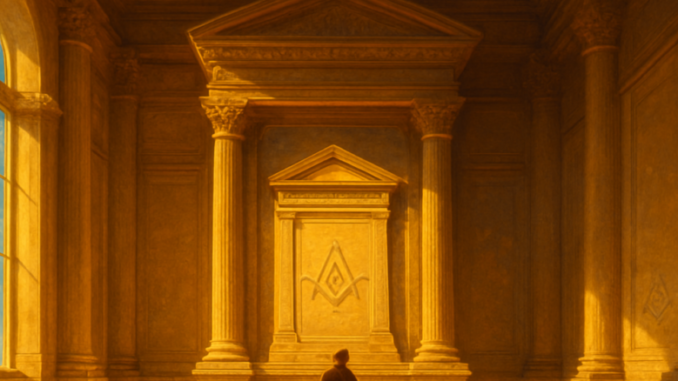
The book casts the House of the Temple, the headquarters of the Scottish Rite in Washington, in a central role within this alleged network. Brown portrays the building as a gateway to ancient mysteries, complete with a pyramid on its roof and a temple chamber where secret rituals take place. Protagonist Robert Langdon gradually discovers that the city itself functions as a vast treasury of symbolic meaning.
The Outsider’s Perspective: Sensation and Conspiracy
For readers unfamiliar with Freemasonry, The Lost Symbol conjures a world where every monument carries a coded message. The street layout of Washington supposedly contains pentagrams and other occult figures. The obelisk of the Washington Monument is said to reference Egyptian mystery traditions. The Capitol is presented not merely as a seat of government but as a modern-day Temple of Solomon.
This perspective fires the imagination — but it also fuels suspicion. Critics noted that Brown skillfully tapped into a cultural hunger for secret histories. After The Lost Symbol was published, thousands of tourists flocked to the locations described in the book, hoping to catch a glimpse of hidden chambers or secret passages. The outsider sees mystery where the insider recognizes tradition and symbolic language.
The Freemason’s Perspective: Symbolism as a Working Tool
From the Freemason’s own point of view, Washington looks quite different. Yes, George Washington was a Freemason, as were several other Founding Fathers. Yes, the House of the Temple is a real building and is open to visitors. But the symbols Brown presents as secret codes are, for Freemasons, not hidden messages at all — they are familiar tools for moral reflection.
Masonic symbols are not riddles to be solved but mirrors in which to see yourself.
The square and compasses, the rough and smooth ashlar, the temple itself — these are not puzzle pieces leading to buried treasure but metaphors for personal growth and self-knowledge. Where Brown generates tension through secrecy, the Freemason sees openness in veiled form. The rituals are not secret in order to conceal something; rather, they create an experience that is difficult to capture in words.
What Both Perspectives Share
Despite their differences, outsider and insider share a fundamental fascination. Both acknowledge that symbols are powerful. Both sense that architecture can be more than stone and mortar. Dan Brown’s The Lost Symbol touches on something universal: the human longing for meaning, for connection with something greater than everyday existence.
Benjamin Franklin, himself a Freemason, might well have smiled at the sensation surrounding the book. He understood that symbols work because people invest them with value. Whether that value lies in unraveling a fictional mystery or in living through a ritual experience, the essence remains the same: symbols invite reflection.
The Lesson Behind the Comparison
The Lost Symbol presents Washington as a city full of hidden meanings, where every building is part of a larger pattern. That claim is literary brilliance, but it is colored by the demands of the thriller genre. Real Freemasonry has never claimed that Washington is literally a temple — but it does hold that any space can become a temple when people gather there to work on themselves.
Consider some of the novel’s key claims: Brown asserts that Washington was geometrically designed according to Masonic principles. The House of the Temple is presented as a repository of ancient knowledge. Symbols scattered across the city supposedly lead to a lost truth. The Founding Fathers are portrayed as initiates in a secret society. Each of these ideas makes for gripping fiction, but they should be understood as literary constructions rather than historical facts.
What we can learn from this comparison is that the line between fiction and reality is not always sharp. Dan Brown created a story that made millions of people think about symbols, architecture, and tradition. Whether one seeks the thrill of the mystery or the quiet depth of the ritual, both paths lead to the same question: What does this mean for me?
Dan Brown’s The Lost Symbol invites us to look at Washington differently — as a city rich with hidden layers. The book’s claims are literary constructions, not historical facts. But the fascination they provoke is very real. Whether you observe as an outsider or recognize what you see as a Freemason, symbols speak to those who are willing to listen. The Temple of Washington may not exist in the way Brown describes it, but the search for meaning that his story embodies is as old as humanity itself.
Copyright text & image: devrijmetselaar.nl
Texts are based on the ideas and content of the author of devrijmetselaar.nl, reviewed, corrected, and supplemented with the assistance of OpenAI. Images are created based on the ideas of the author of devrijmetselaar.nl using OpenAI/DALL-E.




Be the first to comment