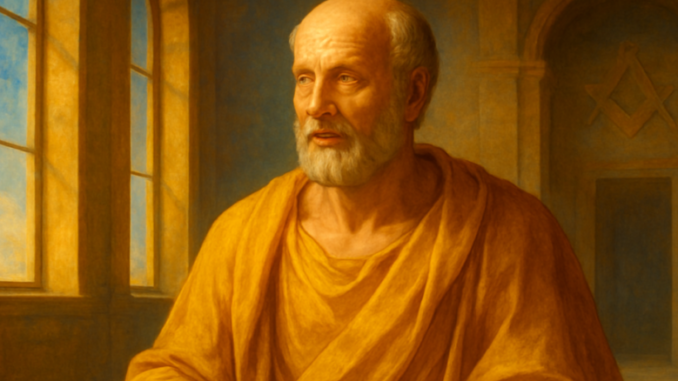
Perhaps you recognize the feeling: you have everything you need, yet something gnaws at you. A restlessness you can’t quite name. Not a dramatic crisis, but a quiet unease that prevents you from feeling truly content. It is precisely this feeling that Lucius Annaeus Seneca examined over two thousand years ago in his essay On the Tranquility of the Mind. What he wrote remains remarkably relevant today — and touches on a desire that also lies at the heart of Freemasonry: achieving inner peace through self-knowledge and intentional living.
The Starting Point: A Friend Wrestling with Himself
The essay doesn’t begin with Seneca himself, but with an extended letter from his friend Serenus. This Roman nobleman candidly describes how he has become stuck in a state of inner division. Serenus is not ill, but neither is he well. He feels like a ship no longer battered by a storm, yet still bobbing on the swell it left behind. He knows what the good life looks like, but he cannot live it consistently. He is distracted by luxury, by ambition, by the opinions of others.
Serenus identifies three areas where he wavers: his relationship with possessions and simplicity, his craving for fame and recognition, and his struggle between eloquence and plain speech. Each time he leans toward the right path, temptation pulls him back. It is an extraordinarily honest self-analysis that strikes a chord with any modern reader — because who doesn’t recognize that tension between who you want to be and how you actually behave?
Seneca’s Answer: The Path to Inner Stability
Seneca responds to Serenus’s cry for help with an extensive treatise on what he calls “tranquility of mind” — a concept he borrows from the Greek term euthymia, first used by the philosopher Democritus. This is not about emotional numbness or detachment from the world. It describes a state in which the soul is balanced: neither euphoric nor despondent, but stable and at ease. Seneca makes it clear that this state does not arise on its own. It requires active maintenance, like a garden that must be constantly weeded.
The core of his advice revolves around a series of practical guidelines. Choose work that suits your talents, so you don’t grow bitter living a life that doesn’t fit. Seek the right friends, because nothing disrupts peace of mind faster than toxic relationships. Be intentional with your possessions: enjoy them without becoming attached. And above all, learn to accept fate. Seneca points repeatedly to the unpredictability of existence. Wealth can vanish, health can fail, power can be stripped away. Anyone who ties their happiness to such impermanent things is, by definition, vulnerable.
Historical Examples as Mirrors
Seneca was a master at using concrete examples to drive home his philosophical points. In this essay, he draws richly from Roman and Greek history. He mentions Cato the Younger, the Roman statesman who took his own life when he could not bear the fall of the Republic, as an example of someone who clung too rigidly to his ideals. He references Socrates, who maintained his composure even in prison and accepted the hemlock cup as the logical consequence of his principles. And he invokes Diogenes of Sinope, the Cynic philosopher who voluntarily lived in poverty and found in it an unmatched freedom.
But Seneca is no naive idealist. He also warns against the opposite danger: complete withdrawal from the world. Those who isolate themselves entirely fall into idleness and lose their relevance. The wise person, Seneca argues, moves between engagement and distance. They serve their community when possible, but step back when circumstances demand it. It is a fluid balance, not a rigid formula.
The Connection to Freemasonry and Self-Knowledge
What makes this essay so remarkable is that Seneca does not preach from an ivory tower. He openly acknowledges that he struggles with the same restlessness. He is not a perfected sage, but a fellow human being who works on his own character every single day. That honesty makes his message both credible and accessible. It also connects seamlessly to a tradition we know well in Freemasonry: the continuous work on the rough ashlar — the unfinished self that is refined step by step.
Tranquility of mind is not a final destination but a daily exercise in self-knowledge, temperance, and accepting what lies beyond your control.
In Freemasonry, the development of the inner life is central — not as an end in itself, but as the foundation for an upright and meaningful existence. Seneca would have recognized himself in that idea. His essay reads as a guide for anyone who notices that outward success and inner peace do not automatically coincide. It takes courage to admit that, and it takes discipline to do something about it.
The Key Lessons Summarized
Seneca weaves a wealth of insights throughout this essay. Here are the most essential takeaways:
Choose activities that match your nature and talents, rather than striving for what the outside world expects of you. Surround yourself with people who uplift you instead of dragging you into restlessness and negativity. Enjoy your possessions without becoming enslaved by them; be prepared to lose everything. Accept the fickleness of fortune — the only thing you can truly control is your own response. Seek the middle ground between civic engagement and personal retreat. Be gentle with yourself when you fail, but never abandon the pursuit of improvement.
These are not spectacular revelations, but their power lies precisely in their simplicity. Seneca understood that most people do not suffer from a lack of knowledge, but from a lack of application. On the Tranquility of the Mind is therefore less of a lesson and more of an invitation — an invitation to begin today with the work that truly matters: the work on yourself.
Seneca’s essay remains a timeless companion for anyone walking the path of self-improvement — whether as a Stoic philosopher, a Freemason, or simply a thoughtful human being. The rough ashlar does not shape itself. Tranquility is not found; it is cultivated, day after day, through honest self-reflection and the courage to live according to your deepest values. In that sense, Seneca’s ancient wisdom and the Masonic tradition speak with one voice: the greatest work you will ever undertake is the work within.
Copyright text & image: devrijmetselaar.nl
Texts are based on the ideas and content of the author of devrijmetselaar.nl, reviewed, corrected, and supplemented with the assistance of OpenAI. Images are created based on the ideas of the author of devrijmetselaar.nl using OpenAI/DALL-E.
Frequently Asked Questions
What is 'tranquility of mind' according to Seneca, and how does it relate to Freemasonry?
Seneca's 'tranquility of mind' (euthymia) is a state of inner balance and stability—neither euphoric nor despondent, but calm and at ease. It is not emotional numbness but rather a condition achieved through self-knowledge and intentional living. This concept directly aligns with Freemasonry's core desire to help individuals achieve inner peace through personal development and self-awareness.
What does Serenus identify as his main struggles in Seneca's essay?
Serenus identifies three key areas where he struggles with inner division: his relationship with possessions and simplicity, his craving for fame and recognition, and his wavering between eloquence and plain speech. Despite knowing what the good life looks like, he finds himself repeatedly pulled back by temptation and distracted by luxury, ambition, and the opinions of others.
What practical guidelines does Seneca recommend to achieve tranquility of mind?
Seneca provides several practical guidelines: choose work that suits your talents to avoid bitterness, seek out the right friends as toxic relationships disrupt peace of mind, be intentional with your possessions by enjoying them without becoming attached, and learn to accept fate. He emphasizes that tranquility requires active, constant maintenance rather than occurring naturally.


Be the first to comment