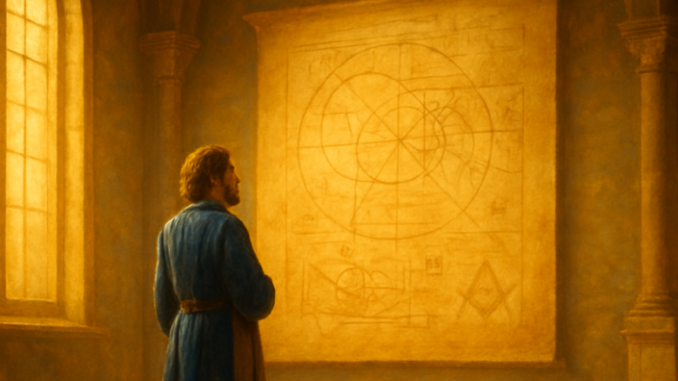
There is a glass bell jar in every laboratory, and there is an invisible one hovering over every great question humanity dares to ask itself. In Dan Brown’s novel Origin, that jar is lifted by a fictional character who claims to have answered two of the oldest questions in the world: where do we come from, and where are we going? Behind that claim lies more than a gripping thriller. It touches the very same questions that Freemasons have quietly contemplated for centuries each time they enter the temple.
The Two Questions That Change Everything
Origin, published in 2017, revolves around the fictional character Edmond Kirsch — a brilliant futurologist and former student of Robert Langdon. Kirsch announces that he has made a scientific discovery capable of shaking the very foundations of religion. His claim targets two fundamental questions: how did life on Earth begin, and where is human evolution heading?
According to the story, Kirsch has used computer simulations and the laws of physics to demonstrate that life can arise spontaneously from the right chemical conditions — without the intervention of a creator. But Dan Brown takes his character further than the question of origin alone. Kirsch also presents a prediction about humanity’s future: a fusion of biology and technology in which humans ultimately merge into an entirely new life form. These assertions are presented within the novel as revolutionary and irrefutable, though the book itself is emphatically a work of fiction.
The Bell Jar as Mirror: What Do We Hide From Ourselves?
Imagine a glass bell jar, the kind you might see in a museum, placed protectively over a precious artifact. The jar preserves and shields — but it also separates. It keeps the fragile intact while holding the observer at a safe distance. In a philosophical sense, we place such jars over our deepest questions. We admire them from afar but rarely dare to touch them. What Dan Brown does in Origin is pull that jar away with a fictional gesture, forcing the reader to handle the object beneath it with bare hands.
Within Freemasonry, this gesture is far from unfamiliar. The entire ritual experience of a Brother is designed to bring him step by step closer to hidden truths — not as imposed dogma, but as personal discovery that gradually unfolds. The rough ashlar that must be shaped is not merely a reference to moral refinement. It is also an invitation to lift the bell jar over one’s own questions and find the courage to look at what lies beneath.
Creation Without a Creator: The Book’s Central Thesis
At its core, Origin proposes that the origin of life can be explained through purely material processes. Dan Brown builds his narrative on genuinely existing scientific theories about self-organization and entropy. The book indirectly references the work of researchers who have demonstrated that certain chemical systems, under the right conditions, spontaneously form increasingly complex structures. The novel translates these scientific insights into a dramatic narrative in which religion as an explanatory framework appears to become superfluous.
At the same time, it is striking that Dan Brown does not position his story as anti-religious. In interviews around the publication of Origin, the author repeatedly emphasized that science and faith do not necessarily stand in opposition — they simply speak different languages about the same reality. That nuance is essential, and it resonates deeply with an attitude that lies at the very heart of Freemasonry.
The question of life’s origin is not a battle between science and faith, but an invitation to view both as complementary paths toward understanding.
The Future as Destination: Human and Machine
The second part of the claim in Origin may be even more provocative than the first. Kirsch predicts that within a few decades, humanity will merge with technology, and that this hybrid life form will represent the next step in evolution. Dan Brown draws on ideas that have long circulated in public discourse: the rise of artificial intelligence, genetic manipulation, and the exponential growth of computing power.
For those familiar with philosophical tradition, this evokes echoes of much older thinkers. Baruch Spinoza wrote in the seventeenth century about the relationship between body and mind as two expressions of the same substance. René Descartes wrestled with the question of whether human consciousness could be reduced to mechanical principles. The questions Dan Brown raises in Origin are essentially the same ones these philosophers formulated centuries ago — now simply dressed in the garments of silicon and algorithms.
The Sacred and the Measurable
What makes Origin particularly compelling from a Masonic perspective is the tension it creates between the measurable and the immeasurable. Freemasonry has always maintained a distinctive relationship with science. The Enlightenment — in which Brothers such as Voltaire and Isaac Newton were actively involved — celebrated reason as an instrument of liberation. But that same tradition also acknowledged that not everything of value can be captured in formulas and proofs.
The ritual within a lodge is a living example of this principle. The actions, the words, the silence — they point toward truths that need not be scientifically proven to be profoundly meaningful. The square and compasses are tools of precision, yet their deeper significance eludes every measurement. The same applies to the questions Origin raises. Even if science could one day explain precisely how the first life emerged, the question of the meaning of that life remains untouched.
Dan Brown wrote Origin as a book that compels the reader to take a position — or perhaps to resist choosing sides altogether and listen to both. The claim in the novel, that the origin of life can be explained without a creator and that humanity’s future lies in a fusion with technology, is neither a verdict nor a threat. It is, in the deepest sense, an invitation. An invitation to step beyond the bell jar, to confront the questions we have long admired from a distance, and to engage with them as Freemasons always have — not with certainty, but with wonder, humility, and an open mind. For it is not the answer that shapes the Brother, but the willingness to keep searching.
Copyright text & image: devrijmetselaar.nl
Texts are based on the ideas and content of the author of devrijmetselaar.nl, reviewed, corrected, and supplemented with the assistance of OpenAI. Images are created based on the ideas of the author of devrijmetselaar.nl using OpenAI/DALL-E.
Frequently Asked Questions
What are the two fundamental questions that Dan Brown's character Edmond Kirsch claims to answer in the novel Origin?
According to the article, Edmond Kirsch claims to have answered two of humanity's oldest questions: where do we come from (the origin of life on Earth) and where are we going (the future of human evolution). In the story, he uses computer simulations and the laws of physics to demonstrate that life can arise spontaneously without divine intervention, and predicts a future fusion of biology and technology.
What is the significance of the 'glass bell jar' metaphor in Dan Brown's Origin?
The glass bell jar serves as a metaphor for how humanity shields itself from confronting its deepest questions. While the bell jar preserves and protects, it also creates distance from what lies beneath. Dan Brown uses this metaphor to illustrate how the novel lifts this protective barrier, forcing readers to directly engage with profound philosophical questions that are typically kept at a safe distance.
How does the article connect Dan Brown's Origin to Freemasonry?
The article suggests that Freemasons have similarly contemplated the same fundamental questions for centuries within their temples. It draws a parallel between Dan Brown's act of removing the 'bell jar' and Freemasonry's ritual process, which guides members step by step toward hidden truths and personal discovery rather than imposing dogma. Both involve an invitation to examine one's deepest questions and seek understanding.


Be the first to comment