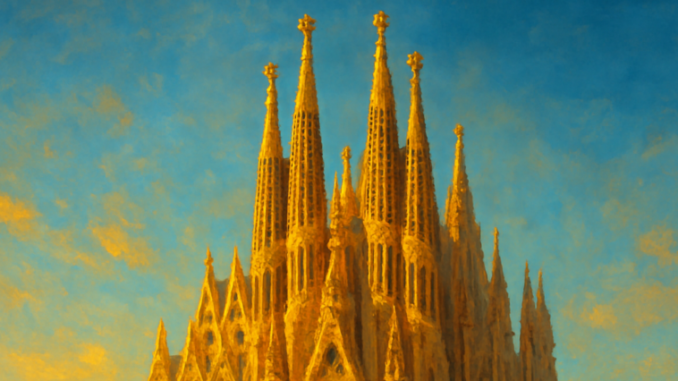
When Dan Brown published Origin in 2017, Barcelona’s Sagrada Família took centre stage as the dramatic backdrop for a confrontation between science and religion. Antoni Gaudí’s unfinished basilica was presented as a building brimming with hidden meanings and mysterious symbolism. But how much of what Brown suggests about this iconic structure is historically and architecturally accurate — and where does the novelist’s creative licence begin? This fact-check explores what we actually know about the Sagrada Família, stripped of the fictional layer that Origin drapes over it.
The Building’s History: What the Facts Tell Us
The Sagrada Família is undeniably one of the most extraordinary structures on Earth, and the facts about its origins are fascinating enough without fictional embellishment. The first stone was laid in 1882 under the direction of architect Francisco de Paula del Villar. A year later, Antoni Gaudí took over the project and would devote the rest of his life to it, right up until his death in 1926. Gaudí dramatically transformed the original neo-Gothic design and created an entirely unique architectural language inspired by organic forms found in nature.
In Origin, Brown presents the basilica as a building with hidden layers of meaning that can only be revealed through modern technology. While this makes for a compelling plot device, architectural history tells a different story. Gaudí’s design papers, models, and correspondence have largely been preserved or reconstructed. His intentions are extensively documented by art historians and the Junta Constructora de la Sagrada Família — the committee that continues to oversee construction. No academic sources point to deliberately concealed messages of the kind Brown suggests.
Gaudí’s Symbolism: Religious, Not Esoteric
A central theme in Origin is the alleged tension between religious and scientific symbolism in the Sagrada Família’s architecture. The truth is more nuanced. Gaudí was a deeply devout Catholic who, in his later years, adopted an almost ascetic lifestyle, sleeping in his workshop on the building site. The symbolism in his design is overwhelmingly biblical and liturgical: the eighteen towers represent the twelve apostles, the four evangelists, the Virgin Mary, and Jesus Christ. The three façades tell the story of Christ’s Nativity, Passion, and Resurrection.
The symbolism of the Sagrada Família is not a hidden code — it is an open testament of Catholic faith, translated into stone and glass by an architect who regarded his work as prayer.
What Brown does in Origin is add a layer that cannot be supported historically: the suggestion that the basilica also contains scientific or anti-religious messages. Art historians such as Gijs van Hensbergen, author of an authoritative Gaudí biography, emphasise precisely the opposite. Gaudí saw no conflict between natural science and faith; he studied nature in order to better understand and translate God’s creation into architecture. His hyperboloid structures and parabolic arches are based on mathematical principles, but always in the service of a religious vision.
Fictional Elements in Origin: Where Brown Departs from Reality
As with all of Dan Brown’s thrillers, the boundary between fact and fiction is deliberately blurred. In Origin, certain spaces and artworks within the Sagrada Família are described in ways that do not correspond to reality. The crypt where certain scenes take place does indeed exist and contains Gaudí’s tomb, but the dramatic elements Brown adds are, of course, fictional. No secret chambers or hidden artworks have been discovered that relate to themes from the novel.
Another fictional element involves the technological presentation that takes place inside the basilica in the novel. While the Sagrada Família does host cultural events and modern technology is used in its construction, a presentation like the one described in Origin has never taken place. The basilica is primarily an active church where daily masses are celebrated — not a conference venue for scientific revelations.
Gaudí and Freemasonry: A Persistent Misconception
In discussions about Origin, the question of whether Gaudí had ties to Freemasonry comes up with striking regularity. This is a persistent misconception that is not supported by historical sources. Gaudí was a member of Catholic lay movements and died a deeply religious man. In the Spain of his era, the Catholic Church and Freemasonry were frequently at odds. No archives, letters, or testimonies point to any membership or even sympathy on Gaudí’s part for Masonic organisations.
The confusion likely arises because certain geometric and symbolic elements in Gaudí’s work bear a superficial resemblance to Masonic symbols. However, these similarities are better explained by shared sources: both Freemasonry and the Catholic building tradition drew on the same medieval guild knowledge and geometric principles. The square and compasses that appear in Masonic contexts were originally simply the tools of stonemasons — and Gaudí consciously worked within the tradition of the medieval cathedral builders.
For Freemasons reading this, the distinction is worth noting. The Craft’s symbolic toolkit evolved from the operative masonry of the Middle Ages, and it is entirely natural that a devout architect working in that same tradition would employ similar geometric forms. Shared visual language does not imply shared membership or ideology. Gaudí’s geometry served the glory of God as he understood it; Freemasonry’s geometry serves as a moral and philosophical framework for self-improvement. Both are noble pursuits, but they are not the same pursuit.
The Power of Fiction: Why It Matters
Dan Brown’s work, including Origin, has inspired millions of readers to learn more about architecture, art, and history. This is genuinely valuable — provided readers maintain a clear distinction between novel and reality. The Sagrada Família deserves admiration for what it truly is: a monument to human creativity, religious devotion, and extraordinary craftsmanship. Adding fictional mysteries does not do justice to the real complexity and beauty of Gaudí’s legacy.
The Sagrada Família has been under construction since 1882 and remains unfinished to this day — a fact that is, in itself, more remarkable than any thriller could invent.
The enduring fascination with the Sagrada Família — and the recurring myths about Gaudí’s supposed Masonic connections — remind us how easily the lines between history, symbolism, and storytelling can blur. For those of us interested in Freemasonry, the lesson is clear: rigorous attention to historical fact strengthens our understanding far more than romantic speculation ever could. Gaudí’s masterpiece stands as a testament to faith and geometry working in concert, and it needs no fictional embellishment to inspire awe.
Copyright text & image: devrijmetselaar.nl
Texts are based on the ideas and content of the author of devrijmetselaar.nl, reviewed, corrected, and supplemented with the assistance of OpenAI. Images are created based on the ideas of the author of devrijmetselaar.nl using OpenAI/DALL-E.

Be the first to comment