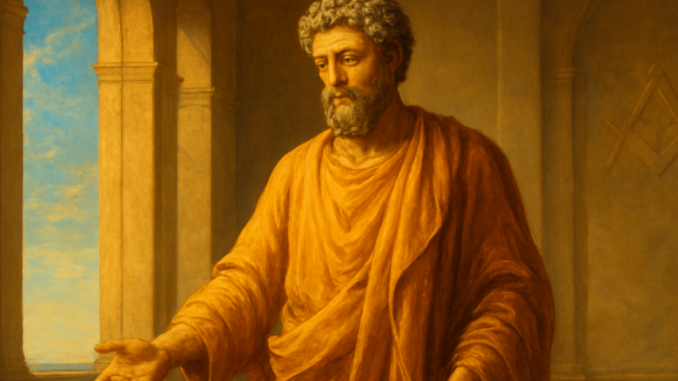
Why do people do harm? Not the grand, deliberate evil of tyrants and criminals, but the everyday cruelty, the misunderstandings, the small betrayals that touch all of our lives. The Roman emperor Marcus Aurelius wrestled with this very question more than eighteen centuries ago. In Book XI of his Meditations, he examines the origins of human evil and arrives at insights that remain strikingly relevant for anyone committed to personal growth and the bonds of brotherhood.
The Stoic Tradition as Foundation
To understand Marcus Aurelius, you first need to understand the philosophical ground he stands on. He is the last great representative of Stoicism, a school of philosophy founded around 300 BCE by Zeno of Citium in Athens. The Stoics believed the world is governed by a rational order — the logos — and that human beings can find happiness by living in harmony with this cosmic reason.
Marcus Aurelius did not learn Stoicism from books alone. He had access to the finest teachers of his era and corresponded extensively with philosophers. His most important intellectual mentor was Epictetus, whose teachings survive through his student Arrian. Epictetus, himself a formerly enslaved man, taught that we have no control over external events — only over our responses to them. This principle lies at the very heart of what Marcus Aurelius writes about human evil.
Seneca and the Art of Forgiveness
Another major influence on Marcus Aurelius was Seneca, the Roman philosopher and statesman who lived roughly a century before him. Seneca wrote extensively about anger, forgiveness, and dealing with difficult people. In his treatise De Ira (On Anger), he explores how anger arises from false judgments and how we can master this emotion by shifting our perspective.
This influence is clearly visible in Book XI. Marcus Aurelius repeatedly insists that people do harm out of ignorance, not deliberate malice. They simply do not understand what is truly good. This is no naive excuse — it is a profound philosophical insight that traces back to Socrates, who argued that no one does evil willingly.
He who does evil out of ignorance deserves compassion, not condemnation, for he harms himself more than anyone else.
The Cosmopolitan Vision of the Stoics
An essential element in Marcus Aurelius’ thinking about evil is Stoic cosmopolitanism. The Stoics believed that all human beings belong to one great community, united by the shared reason present in each of us. When someone wrongs you, it is therefore worth remembering that this person is, in essence, your brother or sister — connected to the same cosmic logos.
This idea has deep roots in Greek philosophy. Aristotle already described the human being as a social creature — a zoön politikon — but the Stoics extended this concept into a universal brotherhood that transcends all national and social boundaries. For Marcus Aurelius, this means concretely that even your enemies must be treated as members of the same human family.
Plato’s Influence on the Understanding of Evil
Although Marcus Aurelius was no Platonist, echoes of Plato resound clearly throughout his work. In dialogues such as the Gorgias and the Republic, Plato argues that injustice harms the soul of the one who commits it. It is better to suffer wrong than to inflict it, because the wrongdoer wounds his own inner harmony.
Marcus Aurelius takes up this idea and makes it practically applicable. When someone insults or deceives you, consider that this person does the greatest harm to himself. He disrupts his own inner peace and estranges himself from the reason that makes him human. This insight makes it easier to respond not with anger, but with understanding.
The Rough Stone and the Work on Yourself
Here the philosophy of Marcus Aurelius touches upon a central theme in Freemasonry: working the rough stone. In Masonic symbolism, the rough ashlar represents the unrefined individual, with all his imperfections and jagged edges. It is every Freemason’s task to shape this stone into a perfect ashlar that fits into the greater edifice of humanity.
Marcus Aurelius would have understood this symbolism immediately. For him, human life is one great project of self-improvement. The faults of others remind us of our own shortcomings. Every confrontation with wrongdoing is an opportunity to examine and refine our own reactions. Are you prone to anger? Then that is a rough edge that needs smoothing.
The Practice of Daily Reflection
The Meditations are not a systematic philosophical treatise but personal notes, likely written during military campaigns along the borders of the Roman Empire. Marcus Aurelius wrote for himself, to organize his thoughts and practice his Stoic principles. This makes the work remarkably intimate and accessible.
The discipline of daily self-reflection that Marcus Aurelius practiced so consistently will be familiar to anyone acquainted with Freemasonry. The ritual of self-examination, reflecting on your actions at the close of day, asking whether you have lived according to your highest principles — these are practices the Stoics already cultivated and that have been preserved within Masonic tradition.
When you read Book XI, you are invited to engage in the same exercise — not as a passive reader, but as an active participant in an age-old tradition of wisdom and self-improvement. The question is not merely what Marcus Aurelius thought about evil in human nature, but what you will do with these insights in your own life.
The philosophical background of Book XI of the Meditations reveals a rich tradition in which Stoicism, Platonism, and the practical art of living converge. Marcus Aurelius builds upon the work of thinkers like Epictetus, Seneca, and Socrates, weaving their insights into a deeply personal guide for navigating human imperfection. For Freemasons and all seekers of wisdom, his message endures: understanding the roots of human evil is not an intellectual luxury — it is the essential first step in the lifelong work of shaping the rough stone into something worthy of the greater temple we build together.
Copyright text & image: devrijmetselaar.nl
Texts are based on the ideas and content of the author of devrijmetselaar.nl, reviewed, corrected, and supplemented with the assistance of OpenAI. Images are created based on the ideas of the author of devrijmetselaar.nl using OpenAI/DALL-E.



Be the first to comment