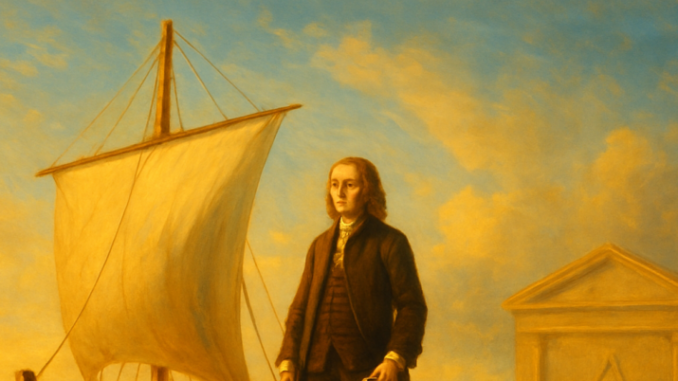
Some thinkers cast such a long shadow across history that their influence feels almost timeless. Voltaire is one of them. His name conjures images of a razor-sharp pen, fearless convictions, and an unwavering faith in human reason. What many people don’t realize, however, is that Voltaire was initiated into Freemasonry in 1778, joining the Parisian lodge Les Neuf Sœurs just weeks before his death. The connection between his Enlightenment ideals and the Craft is no coincidence — it’s a story of shared values that still resonate powerfully today.
A Thinker Finds His Brothers
Picture this: you are 83 years old. You have spent your entire life fighting intolerance and injustice, wielding words as weapons against tyranny. And then you choose to join a brotherhood that upholds the very values you have championed for decades. That is exactly what Voltaire did — barely two months before he died. His decision to become a Freemason was not a passing whim. It was a deliberate affirmation of everything he had stood for throughout his extraordinary life.
The lodge Les Neuf Sœurs — named after the nine Muses of Greek mythology — was a gathering place for enlightened minds. Writers, scientists, and philosophers met within its walls to exchange ideas and explore the frontiers of human knowledge. Benjamin Franklin, himself a Freemason, was among those who supported Voltaire during his initiation. It was a deeply symbolic moment: two men whose ideas about liberty and reason had crossed the Atlantic Ocean, now united within the same brotherhood.
Reason as a Guiding Compass
Voltaire’s entire philosophy revolved around using reason as an instrument to understand and improve the world. He believed that prejudice, superstition, and dogmatism were humanity’s greatest enemies. In his famous Letters on the English (also known as the Philosophical Letters), he argued for the necessity of questioning everything — of refusing to accept any assumption as self-evident.
This resonates deeply with the Masonic tradition. Anyone who has entered a lodge knows that the central theme is the search for light. That light represents knowledge, truth, and understanding. Like Voltaire, Freemasonry invites its members to seek actively, to ask questions, and to embrace doubt — not to tear things down, but to build on a stronger foundation.
Voltaire and Freemasonry share the same core conviction: true brotherhood emerges where reason replaces prejudice.
Tolerance as a Life’s Work
You have probably heard the famous declaration often attributed to Voltaire: “I disapprove of what you say, but I will defend to the death your right to say it.” While the exact words actually come from a later biographer, Evelyn Beatrice Hall, they capture the essence of his thinking perfectly. Voltaire spent his entire life fighting for tolerance and against religious persecution.
The case of Jean Calas stands as the most powerful example. Calas, a Protestant merchant in Toulouse, was wrongfully convicted and executed in 1762 on trumped-up charges of murdering his own son. Voltaire dedicated years to clearing Calas’s name and exposing the judicial travesty behind the verdict. This was not abstract philosophizing — it was action, driven by the unshakeable conviction that every human being deserves a fair judgment.
Freemasonry carries this same principle at its heart. The Craft welcomes men of all religious backgrounds. A candidate is not asked which god he worships, but whether he believes in a higher ordering principle. That openness — that refusal to discriminate on the basis of faith — is precisely what Voltaire advocated throughout his life.
Brotherhood Beyond Borders
What makes Voltaire truly remarkable is that he sought connection across every boundary. He corresponded with kings and philosophers throughout Europe. He believed that ideas needed no passport, that the human mind was universal in its capacity for growth and understanding. This conviction aligns seamlessly with Freemasonry, which has been an international brotherhood since its earliest days.
When a Freemason visits a lodge in another country, he is received as a brother. The rituals may be conducted in a different language, but the symbols are instantly recognizable — the square, the compasses, the apron. They speak a language that transcends words. Voltaire would have understood this better than most. He knew that genuine connection happens when people meet as equals, free from the baggage of national pride or religious conflict.
Inner Growth Through Critical Thinking
There is a deeper layer to the bond between Voltaire and Freemasonry that deserves attention. Both emphasize that lasting change begins within. Voltaire encouraged his readers to examine their own prejudices, to resist the temptation of following authority blindly. Freemasonry invites its members toward self-reflection — toward working on the rough ashlar that every person starts out as.
This is not a casual invitation. It takes real courage to look honestly at yourself and acknowledge where you fall short. But that is precisely where growth begins. Voltaire understood that a better world starts with better individuals — not by forcing people to change, but by inspiring them to think.
A Legacy of Light
The Enlightenment was not some dusty, abstract movement confined to old books. It was a living current of ideas that inspired people to think differently and act with greater purpose. Voltaire stood at the very heart of that movement, and his brief time as a Freemason was the crowning moment of a life devoted to reason and humanity.
If you reflect today on what you want to do with your own life — on how you relate to others and to the world around you — both Voltaire and Freemasonry offer a compass. Not a ready-made answer, but an invitation to seek, to question, and to grow. Perhaps that is the greatest legacy of the Enlightenment: the understanding that light does not come from the outside, but must be kindled from within.
Voltaire and Freemasonry share far more than a historical moment in a Parisian lodge. They share a vision of human beings as creatures capable of growing through reason, connecting through tolerance, and building a better world through brotherhood. That message is not outdated. It remains an open invitation — for you, and for everyone who dares to think.
Copyright text & image: devrijmetselaar.nl
Texts are based on the ideas and content of the author of devrijmetselaar.nl, reviewed, corrected, and supplemented with the assistance of OpenAI. Images are created based on the ideas of the author of devrijmetselaar.nl using OpenAI/DALL-E.


Be the first to comment