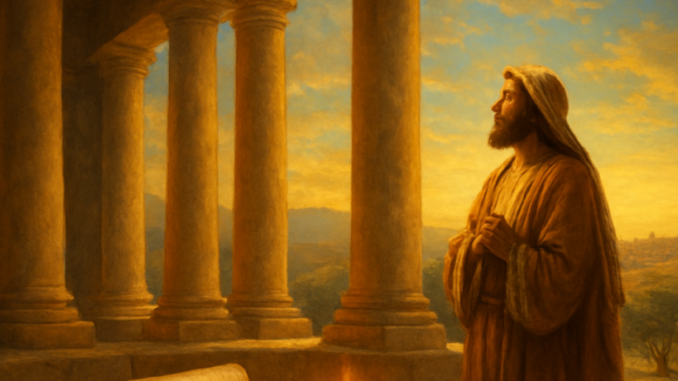
In 586 BCE, an event unfolded that would shake the Jewish people to their very core: the destruction of the Temple in Jerusalem by the Babylonians. At the center of this historical catastrophe stood a figure who had been sounding warnings for decades. The prophet Jeremiah, whose name has become synonymous with lamentation and prophecy of doom, also carried within him a message of profound hope. For those willing to look beyond the rubble, his vision of rebuilding extended far beyond walls of stone — it reached into the very depths of the human heart.
A Prophet in Times of Decline
Jeremiah’s prophetic calling began around 627 BCE, during a period when the kingdom of Judah was slowly sliding toward political and moral collapse. What makes the Book of Jeremiah so remarkable is its deeply personal tone. Unlike many other prophetic writings, Jeremiah reveals a man who struggles with his mission, who doubts and suffers. He was called to uproot and tear down, but also to build and to plant. This dual commission forms the very heart of his message.
Understanding the historical context is essential to grasping Jeremiah’s significance. The Assyrian Empire had collapsed, Egypt and Babylon were vying for dominance in the Middle East, and the small kingdom of Judah found itself caught between these great powers like a pawn on a chessboard. Solomon’s Temple, once the supreme symbol of divine presence and national unity, was about to be destroyed. Jeremiah warned that outward religiosity without inner transformation was hollow and meaningless.
The Potter as a Symbol of Transformation
One of the most evocative images in the Book of Jeremiah is that of the potter. The prophet is instructed to visit a potter’s house and receive a lesson there. He watches as a flawed piece of work is taken up, re-kneaded, and shaped into a different vessel. This image speaks powerfully to anyone who believes in the possibility of personal transformation.
“As the clay is in the potter’s hand, so are you in my hand.”
For the Freemason, this image resonates deeply with the concept of the rough ashlar — the unworked stone that must be shaped and refined. The rough stone, symbolizing the individual in their unpolished state, is transformed through labor and dedication into a perfect ashlar that fits within the greater structure. Jeremiah’s potter and the Masonic stonecutter share the same fundamental truth: we are not condemned to remain as we are. Through conscious work upon ourselves, we can assume a nobler form.
The Covenant Written in the Heart
Perhaps the most revolutionary passage in all of Jeremiah is the prophecy of a new covenant. No longer would the law be inscribed on tablets of stone, but within the innermost being of each person — written upon the heart. This internalization of the divine represents a turning point in religious history. It suggests that true spirituality does not depend on temples, rituals, or outward forms, but on an inner disposition of the soul.
This concept touches the very essence of what Freemasonry strives toward. The lodge is not merely a building but a state of being. The working tools are not physical objects but symbols pointing to inner qualities. The temple being constructed is ultimately the temple of one’s own character. Jeremiah’s vision of a law written in the heart aligns seamlessly with the Masonic ideal of the inward journey — the belief that the most important work a person can undertake is the work they do within themselves.
Destruction as a Prerequisite for Rebuilding
The destruction of the Temple was, for Jeremiah’s contemporaries, an unbearable catastrophe. Yet embedded within his message lies a paradoxical hope: sometimes the old must be completely torn down before something new can arise. This is not nihilism — it is a recognition that genuine renewal often demands painful transformation.
Consider the parallels: the rough stone must be hewn — material is lost, but beauty emerges. The old temple falls, but makes way for a spiritual edifice. Personal crisis can lead to deeper self-understanding. The loss of certainties opens the door to new insight.
In Freemasonry, we encounter this pattern in the symbolic death and rebirth experienced in certain degrees. The candidate leaves behind his former self in order to be reborn as a renewed individual. Jeremiah’s prophecy of destruction and rebuilding follows the same arc: through the darkest point, the light of a new day begins to break through.
Lessons for the Present Day
What can Jeremiah still teach us today? First, that honesty sometimes makes us unpopular. Jeremiah was persecuted, imprisoned, and despised because he spoke uncomfortable truths. Yet he remained faithful to his calling. Every Freemason understands the importance of truth as the foundation of any structure — even when that truth is inconvenient or unwelcome.
Second, Jeremiah reminds us that outward forms lose their value when they become disconnected from inner meaning. A temple without justice is an empty shell. A ritual without reflection is mere theater. The symbols we employ — whether biblical imagery or Masonic working tools — gain their true significance only when they are connected to sincere moral growth and genuine self-improvement.
The Eternal Building Commission
Jeremiah’s prophecies did not end with destruction. After the exile, a remnant would return. The city would be rebuilt. But more importantly, a new kind of covenant would emerge — one rooted in the heart of every individual. This is the promise that has echoed through the centuries and continues to speak to the modern seeker.
The historical Temple of Solomon no longer stands. But the ideal of the Temple — as a symbol of human perfection and divine presence — lives on. In Freemasonry, brethren work on that invisible Temple, stone by stone, generation after generation. Jeremiah reminds us that this work always begins with an honest look inward, with the willingness to be broken down and reshaped — like clay in the hands of the potter.
The ancient prophet and the modern Freemason may be separated by millennia, but they share a common understanding: the most sacred temple is the one we build within. Jeremiah’s enduring message — that destruction can precede creation, that the law must live in the heart, that transformation requires both courage and surrender — remains as relevant today as it was in the shadow of a falling temple. For every brother who picks up his working tools and turns his gaze inward, Jeremiah’s voice still resonates: build, plant, and never stop refining the rough stone of your soul.
Copyright text & image: devrijmetselaar.nl
Texts are based on the ideas and content of the author of devrijmetselaar.nl, reviewed, corrected, and supplemented with the assistance of OpenAI. Images are created based on the ideas of the author of devrijmetselaar.nl using OpenAI/DALL-E.
Frequently Asked Questions
What is the connection between the prophet Jeremiah and Freemasonry?
Jeremiah's teachings about inner transformation and personal refinement align closely with Masonic principles of self-improvement and spiritual development. Both traditions emphasize that true growth comes from within the individual through dedicated personal work, rather than relying solely on external forms or rituals. The prophet's message of reshaping oneself, like clay in a potter's hands, mirrors the Masonic journey of refining the rough ashlar into a perfect stone.
What does the potter's vessel symbolize in Freemasonry?
In Freemasonry, the potter's vessel represents the journey of personal transformation and self-improvement that every Mason undertakes. Just as the potter re-kneads flawed clay into a more perfect form, Freemasons work to refine themselves through study, reflection, and moral development. This symbol teaches that we are not fixed in our current state but have the potential to become nobler versions of ourselves through conscious effort and dedication.
How does Jeremiah's concept of the 'new covenant' relate to Masonic teachings?
Jeremiah's prophecy of a covenant written upon the heart—emphasizing inner spirituality over external forms—resonates with Freemasonry's focus on internal moral development and personal enlightenment. Both traditions teach that true spirituality and growth come from within the individual's soul, not merely from outward observances. This principle encourages Masons to cultivate genuine virtue and understanding in their hearts rather than relying solely on ritual or ceremony.
Why is Jeremiah relevant to Freemasons today?
Jeremiah's message of hope, transformation, and inner rebuilding speaks powerfully to modern Freemasons seeking to improve themselves and contribute meaningfully to society. His emphasis on personal responsibility, moral integrity, and the possibility of positive change aligns with Masonic values and provides historical wisdom for contemporary spiritual seekers. The prophet's example shows that even in times of crisis and uncertainty, individuals can work toward meaningful personal and collective renewal.

Be the first to comment