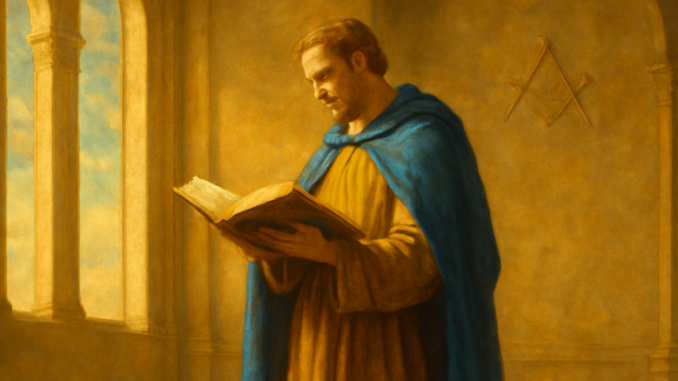
Can a machine understand the human soul? And what happens when technology promises answers to the questions that religion has guarded for centuries? In Origin, Dan Brown puts these provocative questions front and center. But how does his fictional world compare to actual Freemasonry? Let’s explore the tension between imagination and reality, between what Brown’s thriller claims and what the Craft truly stands for.
What Does Origin Actually Claim About AI and Faith?
In Origin, Dan Brown paints a world where artificial intelligence doesn’t merely calculate — it tackles the great existential questions of human existence. The novel presents a scenario in which technology threatens to supplant religion as the authority on life’s biggest mysteries. A futuristic computer mind could potentially explain where we come from and where we’re going — questions that have been the domain of priests, rabbis, and imams for millennia.
It’s fiction, of course, but it touches on genuine anxiety. Many readers find themselves wondering: could technology truly replace religion? And what would that mean for organizations devoted to the search for meaning — organizations like Freemasonry?
How Does Freemasonry Actually View Technology?
Here’s where a fascinating gap opens up between Brown’s fiction and reality. Freemasonry is not a religious institution. It makes no pronouncements about the origin of the universe or the existence of an afterlife. It establishes no dogmas about creation or the end of days. Instead, it offers a brotherhood — and in many jurisdictions, a sisterhood — where people of all backgrounds, believers and doubters alike, work together on personal growth and ethical conduct.
Freemasonry takes no position on where humanity comes from. But it does ask: what do we do with the time we’ve been given?
This means that the dramatic tension Brown creates between artificial intelligence and religion doesn’t actually threaten Freemasonry in the way his novel implies. A Freemason can be devoutly religious and deeply fascinated by technological progress without any internal conflict. The lodge is not a church that feels endangered by scientific discovery.
But Doesn’t Brown Use Masonic Symbolism?
He certainly does, and this is where things get interesting. In earlier works like The Lost Symbol, Dan Brown wrote extensively about Masonic rituals and their alleged secrets. In Origin, his focus shifts toward technology, but the underlying theme persists: there are hidden truths out there that will transform humanity.
This is precisely where fiction and reality part ways. Freemasonry guards no cosmic secrets about the origin of life. Its symbols — the compass, the square, the rough and polished stone — refer to personal development, not hidden scientific knowledge. When a Freemason speaks of “light,” the reference is to enlightenment in the sense of wisdom and self-knowledge, not a technological breakthrough.
Can Technology Have Spiritual Meaning?
This may be the most fascinating question that Origin raises. Thinkers throughout the ages have wrestled with the relationship between human creations and the divine. Goethe, himself a Freemason, wrote about the creative power of humanity. Isaac Newton, also connected to Freemasonry, saw in the laws of nature evidence of divine order.
From a Masonic perspective, technology is a tool — much like the hammer and the chisel. The question isn’t whether artificial intelligence exists, but how we use it. Does it serve to connect or to divide? To spread wisdom or to sow fear? The ethical dimension remains central, no matter how advanced our machines become.
What Should We Take Away from Origin?
“Believe” might not be the right word when it comes to a thriller. Dan Brown writes gripping fiction that plays on real fears and desires. His books invite reflection, but they are not a reliable guide to actual Freemasonry or its relationship with religion and science.
Here are some key distinctions worth keeping in mind:
Freemasonry is not a religion and does not compete with religions over cosmic truths. Freemasons may hold any worldview, provided they believe in a higher ordering principle. Technology is not seen as a threat but as a neutral instrument that demands ethical use. Masonic symbols point to inner growth, not to hidden science.
It’s tempting to buy into the dramatic opposition between artificial intelligence and religion as Brown frames it. But reality is more nuanced — and, dare I say, more interesting. The real question isn’t whether machines will replace religion, but how we as human beings continue to create meaning in our lives, with or without technology.
Why This Still Matters for Freemasons Today
Because the questions that Origin raises — however fictionally packaged — are real questions. In an era where algorithms make an increasing number of decisions for us, Freemasonry may be more relevant than ever. Not as a keeper of secrets, but as a community that reflects on what it means to be human. The lodge offers a space where brothers and sisters can contemplate progress, responsibility, and the good life together.
Dan Brown’s Origin is a compelling thriller that asks big questions about technology and faith. But anyone who truly wants to understand Freemasonry won’t find the answers in hidden algorithms or spectacular revelations. The real work takes place in silence, in reflection, in the daily practice of becoming a better person. That’s not a secret — it’s an invitation open to everyone.
Copyright text & image: devrijmetselaar.nl
Texts are based on the ideas and content of the author of devrijmetselaar.nl, reviewed, corrected, and supplemented with the assistance of OpenAI. Images are created based on the ideas of the author of devrijmetselaar.nl using OpenAI/DALL-E.


Be the first to comment