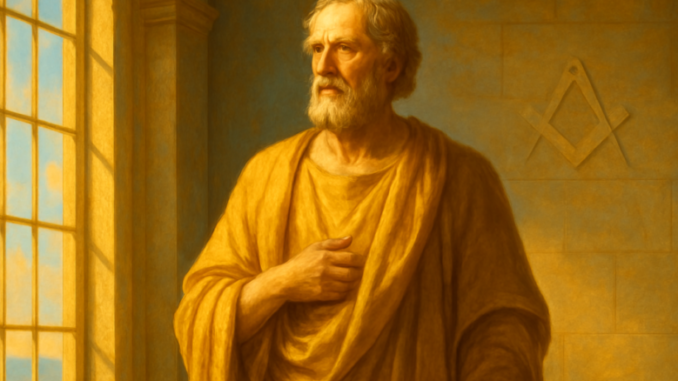
How do we grieve without losing ourselves in the process? It is a question Lucius Annaeus Seneca posed nearly two thousand years ago in a letter to his friend Lucilius — and it is a question that still resonates in lodges today, wherever Brethren must bid farewell to those they held dear. In Letter LXIII, Seneca explores the delicate balance between sorrow and remembrance, between tears and gratitude. His words touch on something every Freemason instinctively understands: the art of honoring our bonds of fellowship, even after the physical connection has been severed.
What Does Seneca Really Mean by Mourning?
Seneca opens his letter with a striking claim: grief is natural, but excessive grief is not. He tells Lucilius that we may miss our friends, that we may shed tears, but that we must not allow ourselves to sink into a bottomless pit of anguish. Does that sound cold? Seneca would say it is the opposite — it is an act of love. To mourn endlessly, he argues, is to dishonor the memory of the one we lost. The real question becomes: how do you honor someone by continuing to live?
For Seneca, the answer lies in how we hold the departed in our thoughts. He encourages Lucilius to recall the good conversations, the shared moments, the wisdom that was exchanged between friends. In this way, grief ceases to be a dead end and becomes a transformation. Sorrow gradually turns into gratitude, and the emptiness left behind fills with meaningful memories.
How Does This Relate to Masonic Values?
In Freemasonry, the bond of Brotherhood is central to everything we do. Brethren call each other Brothers for a reason — the connection forged within the lodge transcends the ordinary. When a Brother passes to the Grand Lodge Above, the loss cuts deep. The Lodge of Sorrow, a solemn ceremony observed in many Masonic traditions, formally acknowledges this grief. But even here, Seneca’s teaching holds true: we mourn not to remain frozen in place, but to continue growing.
True Brotherhood does not end at death — it transforms into grateful remembrance and the continuation of virtue.
Freemasonry encourages every Brother to reflect: What did this Brother mean to me? Which virtues did he embody that I can carry forward? Seneca would have recognized this impulse immediately. He writes that the best way to honor a friend is to become a better person yourself. This aligns seamlessly with the Masonic pursuit of moral perfection — not as a final destination, but as a lifelong journey.
Is Grief a Sign of Weakness?
Absolutely not — and Seneca is unequivocal on this point. He criticizes two extremes: those who claim they never grieve, and those who allow sorrow to consume them entirely. The Stoic does not deny emotions. Seneca himself wept for lost friends. The difference lies in attitude: grief should be like a wave that rises and recedes, not an ocean in which you drown.
For Freemasons, this is a vital insight. The lodge is a space where vulnerability is permitted to exist. Masonic ritual provides structure for emotions that might otherwise become overwhelming. Just as Seneca uses the epistolary form as a framework for his reflections, the Masonic ritual offers a vessel in which grief can be expressed, contained, and ultimately transformed into something constructive.
What Can We Learn from Seneca’s Relationship with Time?
A striking element in Letter LXIII is Seneca’s attention to the role of time in mourning. He warns that some people only begin to grieve when others are watching, while they have long since moved on in private. Others remain locked in mourning for decades without ever finding peace. The wise person, Seneca argues, finds a middle path. He grants himself permission to grieve, but he also sets a boundary.
This calls to mind the Masonic interplay between light and darkness. The search for truth acknowledges that there will be periods of darkness in every life. But the Freemason does not sit in the dark indefinitely. He seeks the light — not by denying his grief, but by walking through it. Seneca would have understood this perfectly. The path to wisdom sometimes leads directly through the valley of loss.
How Do Remembrance and Brotherhood Come Together?
Seneca writes something beautiful: “Let us enjoy our friends, for we do not know how long we shall have them.” This is not pessimism — it is a clear-eyed realism that leads to deeper, more intentional connection. Every Freemason knows this feeling. Each gathering in the lodge is an opportunity to strengthen the bonds of Brotherhood, in full awareness that nothing in this life is permanent.
The convergence of Stoic philosophy and Masonic practice offers a powerful framework for navigating loss. Consider the principles that emerge when these two traditions meet:
Remembrance as a living act, not passive nostalgia. The continuation of virtue as a tribute to the departed. A Brotherhood that transcends death through shared values. Ritual as a structure for emotional processing and healing.
Seneca provides the intellectual foundation; the lodge provides the community in which these insights can be lived and experienced. Together, they offer an answer to one of the most difficult questions of human existence: how do we continue living after loss?
Seneca’s Letter LXIII is far more than a letter of consolation. It is a guide for anyone wrestling with the paradox of grief: how can we be both sorrowful and grateful at the same time? How can we miss someone deeply and yet still move forward? The Freemason finds in these ancient words a familiar echo. Brotherhood teaches us that connection does not end when someone leaves us — it lives on in the virtues we cultivate and the memories we cherish. Seneca invites us to mourn as the wise mourn: with tears that dry, but with a love that endures.
Copyright text & image: devrijmetselaar.nl
Texts are based on the ideas and content of the author of devrijmetselaar.nl, reviewed, corrected, and supplemented with the assistance of OpenAI. Images are created based on the ideas of the author of devrijmetselaar.nl using OpenAI/DALL-E.


Be the first to comment