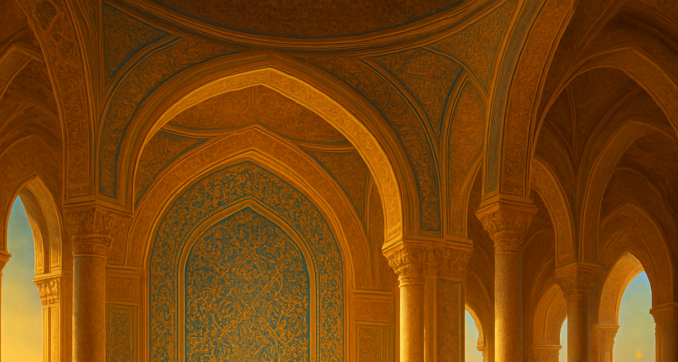
Have you ever gazed up at the moon and wondered what this celestial light has meant to humanity across the ages? The moon is far more than a heavenly body — it is a mirror of our inner world, a symbol of cyclical change and quiet contemplation. In the Islamic tradition, the fifty-fourth chapter of the Quran bears the name Al-Qamar, meaning The Moon. This short but powerful text invites reflection on impermanence, warning, and the possibility of inner transformation. For those with an interest in spiritual traditions, this surah offers striking points of connection with the values that also stand at the heart of Freemasonry.
The Heart of Surah Al-Qamar
Surah Al-Qamar opens with a dramatic image: the moon being split in two. This refers to an event from early Islamic tradition, in which the Prophet Muhammad is said to have shown this sign to skeptics. Whether you interpret this literally or symbolically, the message is clear: there are moments in life when reality cracks open and you are compelled to stop and take notice. The surah continues with accounts of earlier peoples who ignored divine warnings and suffered the consequences. These are not threats — they are invitations to reflect. The text asks you directly: are you willing to listen when life calls upon you?
Warning as a Spiritual Tradition
In many spiritual traditions, warning plays a crucial role — not as a means of instilling fear, but as a loving call to awareness. Consider the Stoic philosopher Seneca, who in his letters constantly pointed to the fleeting nature of life and the urgency of acting now. Plato, too, emphasized the importance of self-knowledge and the recognition of one’s own shortcomings. Surah Al-Qamar belongs to this same tradition: it holds up a mirror and asks you to look honestly at yourself.
Within Freemasonry, we find a comparable function in ritual practice. The symbolic death and rebirth in initiation ceremonies are not designed to provoke fear, but to awaken you to the transformation that becomes possible when you are willing to release old patterns. The warning is not punitive — it is an act of care, a nudge toward greater consciousness.
The Moon as a Symbol of Reflection
The moon does not shine by its own light; it reflects the light of the sun. This makes it a quintessential symbol of reflection, both literally and figuratively. In Freemasonry, the moon plays a modest yet meaningful role alongside the sun and the Worshipful Master. Where the sun represents direct light and active knowledge, the moon embodies the capacity to receive wisdom, to contemplate it, and to let it mature. You might say the moon invites you not only to look outward, but above all to look within.
The moon teaches us that true knowledge is not merely gathered — it is considered in silence.
This idea resonates deeply with the emphasis Freemasonry places on personal reflection. The goal is not to accumulate facts, but to integrate insights into your daily life. The moon invites contemplation — the creation of space for stillness in a world that is often noisy and demanding.
Impermanence and Building the Inner Temple
A recurring theme in Surah Al-Qamar is impermanence. The peoples mentioned in its verses — powerful and proud — have vanished. Their stories serve as reminders that nothing endures except what you build within yourself. This connects seamlessly with the Masonic metaphor of building the inner temple. You are not working on a physical structure, but on your own character, your moral compass, your capacity for compassion and wisdom. The rough ashlar you begin with is slowly polished into a stone that fits within a greater whole.
Marcus Aurelius, the Stoic emperor-philosopher, wrote frequently in his Meditations about the fleeting nature of fame and possessions. He stressed that the only true wealth lies in how you live, not in what you own. Surah Al-Qamar carries the same message: what remains is not your status or your power, but the quality of your soul.
Brotherhood in the Light of Warning
Another striking aspect of this surah is its emphasis on community. The warnings are not directed solely at individuals but at peoples — groups of human beings who make choices together. This touches on the Masonic ideal of brotherhood. You do not stand alone in your search for wisdom and growth. You are part of a chain of individuals who support, challenge, and inspire one another. Sometimes brotherhood also means holding up a mirror for a fellow traveler — not to judge, but to grow together.
The core themes that unite Surah Al-Qamar and Masonic philosophy can be distilled into four essential ideas: the moon as a symbol of receptivity and reflection; warning as an invitation to self-examination; impermanence as motivation for inner growth; and brotherhood as shared responsibility.
An Invitation to Stillness
What Surah Al-Qamar ultimately offers is neither dogma nor commandment, but an invitation. An invitation to pause, to listen to the signals life sends your way, and to consciously choose how you move forward. In Freemasonry, we call this the journey from darkness to light — a journey that is not completed in a single moment, but step by step, night after night, moon after moon.
The next time you see the moon, take a moment to stand still. Ask yourself: what am I reflecting on? What do I want to build in my inner temple? And with whom do I want to share this journey? These are questions without simple answers, but that is precisely where their value lies.
Surah Al-Qamar reminds us that spiritual growth begins with a willingness to listen and reflect. Whether you are Muslim, a Freemason, or simply a seeker of meaning, the message remains profoundly relevant: do not invest your energy in what is transient, but in what endures within yourself. Let the moon be your guide in the silence of the night, and discover what grows when you make room for contemplation.
Copyright text & image: devrijmetselaar.nl
Texts are based on the ideas and content of the author of devrijmetselaar.nl, reviewed, corrected, and supplemented with the assistance of OpenAI. Images are created based on the ideas of the author of devrijmetselaar.nl using OpenAI/DALL-E.

Be the first to comment