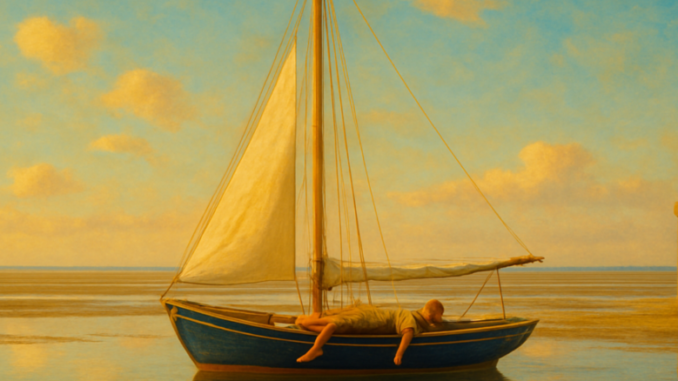
The engine has been droning for two straight days when the sailboat finally enters the harbor. It is eleven in the morning, and the island lies quiet under a gentle summer sun. Yet the noise continues — not in the engine room, but somewhere deeper, inside the sailor’s mind. It isn’t until hours later, during an unexpected nap, that something suddenly switches off. An inner engine falls silent. What is that moment of sudden stillness? And why do certain places feel like a homecoming for the soul?
The Crossing as a Rite of Passage
A journey over water is never merely a physical displacement. Anyone who takes the ferry or sails their own vessel to one of the Wadden Islands undergoes an unnoticed transformation. The mainland slips behind the horizon, the familiar patterns of daily life dissolve into the salt haze. What remains is water, sky, and the promise of something new. In the symbolic tradition of Freemasonry, this transition is recognized as a passage — leaving the known to step toward the unknown.
The sailing trip from Medemblik to Den Helder, and from there to the island, took longer than planned. A dead calm forced the crew to motor, mile after mile. It is an experience every sailor knows: the surrender to conditions beyond your control. And yet there is wisdom in that powerlessness. Not everything unfolds as we plan, and it is precisely in resistance that a deeper lesson sometimes reveals itself.
The Island as a Dark Chamber
In Freemasonry, there is the ritual of the Chamber of Reflection — an enclosed space where the candidate withdraws before receiving the light. It is a place of contemplation, of confrontation with one’s own inner world. An island can serve exactly the same function. Cut off from the mainland, free from the constant stream of stimuli, the mind settles. The forests smell different, the horizon stretches wider, and somewhere in that emptiness, something begins to speak.
The moment the inner engine switched off came without warning. For two days, the droning had echoed through the sailor’s mind, long after the actual engine had fallen silent. Only in the safety of the harbor, in the stillness of the early afternoon, did the body finally let go. This is often how restlessness works: we carry it with us without realizing, until a place or a moment invites us to feel what is truly there.
The Scent of Memory
Scent has a remarkable gateway to memory. The pine forests of a Wadden island summon recollections of earlier visits, of parents who once walked the same paths, of a past that merges with the present. In Freemasonry, we speak of the chain of generations — the invisible bond that connects us to those who came before. On an island where your parents once wandered, that chain becomes tangible. The paths still hold their footprints, even if the sand erased them long ago.
A place of intense joy is never just a place. It is a mirror in which we recognize ourselves. The quaint village, the vast mudflats, the enchantment of the forest — it is no coincidence that these particular elements stir the heart. They resonate with something in our character, with a longing for simplicity, for connection with nature, for a life that flows more slowly. The island holds up a mirror and shows us what we so often forget amid the rush of everyday existence.
Letting Go of Plans as Practice
The original route led further, to a city on the mainland. But delayed departures and strong headwinds forced a reconsideration. The plan was released — not with disappointment, but with acceptance. There is always a next time. That flexibility is an art the sailor learns at sea, but it applies just as much to life on land.
In Freemasonry, the individual is seen as a rough stone, shaped through labor upon oneself. Part of that labor consists in learning to deal with what does not go according to plan. The ego wants to cling to expectations, to the illusion of control. But growth often arises precisely in letting go — in the willingness to adjust the course when circumstances demand it. The rough stone does not become smooth by insisting on a single direction; it is shaped by responding to the chisel of experience.
Falling in Love with a Place
There is such a thing as falling in love with a place. It is not a metaphor but a genuine experience. Certain landscapes touch us in ways we cannot fully explain. They awaken an intense happiness, a feeling of homecoming that reaches beyond rational understanding. Perhaps it is the combination of elements — water, sand, forest, sky. Perhaps it is the memory of who we were the last time we stood here. Or perhaps it is simply the silence that allows us to be ourselves.
That love can be shared. A partner who initially did not understand why this island was so special can gradually come to feel the same enchantment. This is how experiences spread, how connection deepens. It is one of the most beautiful aspects of human existence: that joy multiplies when it is shared.
The Return to the Mainland
Every journey has its return. The island recedes, the engine starts again, the mainland horizon draws near. But anyone who has truly stood still carries something back. A memory of rest, a glimpse of who he might be when the world falls quiet. In this sense, every island visit is a small ritual — a passage through the dark chamber toward a renewed self-awareness.
The island asks nothing of us, except that we be present. In that simplicity lies its power. Whoever makes the crossing — physical or inner — discovers that silence is not emptiness, but a space in which the soul can speak to itself. The engine that finally falls silent is not the one in the ship. It is the restlessness we carry with us, which sometimes, on an enchanted shore at the edge of the mudflats, is finally allowed to come to rest.
Copyright text & image: devrijmetselaar.nl
Texts are based on the ideas and content of the author of devrijmetselaar.nl, reviewed, corrected, and supplemented with the assistance of OpenAI. Images are created based on the ideas of the author of devrijmetselaar.nl using OpenAI/DALL-E.
Frequently Asked Questions
What does Freemasonry teach about spiritual transformation and inner change?
Freemasonry recognizes that true transformation often occurs through symbolic passages and transitions, much like crossing water to reach new shores. The tradition teaches that by stepping away from the familiar and confronting our inner world in spaces of contemplation, we can experience profound spiritual awakening and silence the restless noise of everyday life.
What is the Chamber of Reflection in Freemasonry, and why is it important?
The Chamber of Reflection is a sacred ritual space in Freemasonry where candidates withdraw for personal contemplation before receiving enlightenment or 'the light.' This enclosed space allows individuals to confront their inner world and prepare themselves for deeper understanding, making it a cornerstone of the Masonic journey toward self-knowledge.
How does Freemasonry connect us to our ancestors and past generations?
Freemasonry speaks of the 'chain of generations' — an invisible spiritual bond connecting us to those who came before us. Through this tradition, we honor our ancestors' journeys and wisdom, recognizing that their footprints guide our path, and that places and moments can make this eternal connection tangible and real.
Can places have spiritual significance in Freemasonry?
Yes, Freemasonry teaches that certain places can serve as mirrors for the soul and spaces for profound inner work, similar to how an island or natural sanctuary can invite stillness and self-reflection. These meaningful locations become gateways to understanding ourselves and our connection to something greater than ourselves.

Be the first to comment