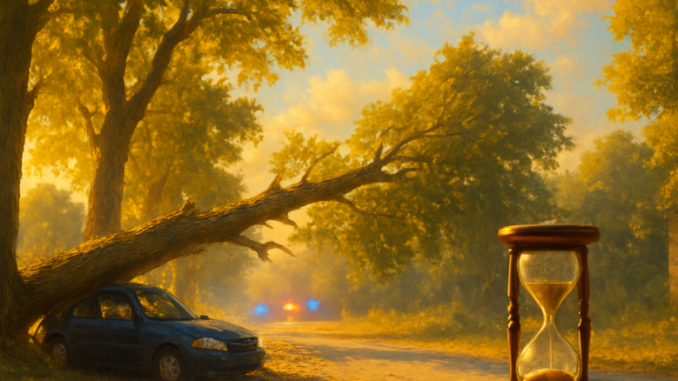
Picture an ordinary weekday. You’re driving along a familiar road. The sun is shining, the trees are swaying gently in the breeze. Then, in a fraction of a second, everything changes. A tree falls, and the life you knew ceases to exist. Tragedy struck recently when a woman lost her life after a tree crashed onto her car. Emergency services were overwhelmed with calls, alerts flooded in from every direction. In moments of chaos and grief like these, an ancient question rises to the surface: what truly binds us together as a community when fate strikes without mercy?
The Fragility of Existence
Perhaps you’ve felt it yourself — that sudden, jarring moment when you realize just how fragile life really is. You walk down the street, you breathe, you make plans for tomorrow, and somewhere deep down you know that none of it is guaranteed. Freemasonry has always acknowledged this vulnerability. Not as something to fear, but as something to embrace. Throughout the symbolism of the lodge, you find constant reminders of human mortality: the skull, the hourglass, the extinguished candle. These symbols aren’t meant to darken your mood. They’re meant to wake you up. To remind you that every single moment counts.
When an unexpected tragedy strikes a community, we are collectively confronted with that fragility. The surge of calls flooding emergency lines, the alerts sent out to nearby phones — they speak to something deeper than logistical overload. They reveal how many people simultaneously want to help, want to report, want to contribute. Hidden within the chaos is something beautiful: the deeply human impulse to be there for one another.
The Chain of Service
In Freemasonry, we often speak of the chain of union — the invisible bond connecting people who share the same values. But that chain doesn’t stop at the walls of a lodge. It extends into the whole of society. When you see how people respond to an emergency — how they call for help, how they pull over to assist, how they set aside their own plans for a complete stranger — you see that chain in action. You witness brotherhood without a name, without ritual, but carrying the very same essence.
True brotherhood reveals itself not in words, but in deeds — especially when those deeds are hardest to perform.
The emergency operators who fielded call after call for hours on end, the passersby who stopped their cars, the dispatchers who kept calm under immense pressure — they are all links in a chain older than any organization. It is the human reflex to help, to comfort, to simply be present. Freemasonry has always sought to cultivate that reflex, to strengthen it, to nurture it. Not as an exclusive possession, but as a universal value that lies dormant in every one of us.
Ritual and Reality
You might wonder what the rituals practiced inside a Masonic lodge could possibly have to do with a falling tree and an overwhelmed emergency dispatch center. More than you’d think. The rituals of Freemasonry are exercises in awareness. They teach you to pause and reflect on what truly matters, to set your ego aside, to listen deeply to others. These are precisely the skills a society needs in moments of crisis. Not the ritual itself, but the disposition it cultivates.
When an operator talks down a panicked caller, when a firefighter struggles to free a stranger from a wreck, when a bystander takes off her coat to cover someone in shock — in all of these acts, you can see the same principles practiced in the lodge. Remaining calm under pressure. Being of service. Seeing the greater whole. Freemasonry doesn’t claim ownership of these values. It simply tries to keep them alive, generation after generation, through conscious and deliberate practice.
Community as a Living Organism
A society is not merely the sum of its individuals. It is a living organism in which everything is connected. When one member suffers, the entire body feels it. The emergency alerts sent out that day were more than technical notifications. They were a collective heartbeat — a signal that something was wrong, a call to pay attention. And people listened. They called, they shared, they worried about someone they had never met.
Think about all the small gestures that emerge from tragedy: the caller who stayed on the emergency line just to ask if the victim was okay; the driver who pulled over even though he was already late for an appointment; the neighbor who brought coffee for the first responders; the stranger who laid flowers at the scene. In every one of these quiet acts, you can see the community breathing.
Freemasonry teaches that you are part of something larger than yourself. But you don’t need a lodge to develop that awareness. It can also arise on a rain-soaked road, beside a fallen tree, reflected in the face of a first responder you’ve never seen before. Brotherhood takes many forms.
What Remains After the Grief
The grief will slowly fade. The victim’s name will disappear from the headlines. The tree will be cleared. Traffic will flow normally again. But something lingers. A memory of vulnerability. A sense of connection. A quiet, persistent question: how do I want to live, knowing that any moment could be my last?
Freemasonry doesn’t offer a definitive answer to that question. What it does offer is a space to ask it — to share it, to let it mature. It offers a community of people who carry the same questions and who support one another in the search. Not for final answers, but for a way of living that honors both the brevity and the preciousness of existence.
A tree fell. A life ended. An emergency center was overwhelmed with the voices of concerned citizens. Within that chaos lay a quiet beauty: the beauty of people who care about each other, who want to help, who refuse to look away. Freemasonry invites you to see that beauty, to cherish it, and to become it yourself. Not necessarily by joining a lodge, but by choosing — every single day — to be a link in that ancient, unbreakable chain of human compassion.
Copyright text & image: devrijmetselaar.nl
Texts are based on the ideas and content of the author of devrijmetselaar.nl, reviewed, corrected, and supplemented with the assistance of OpenAI. Images are created based on the ideas of the author of devrijmetselaar.nl using OpenAI/DALL-E.
Frequently Asked Questions
What does Freemasonry teach about facing life's tragedies?
Freemasonry acknowledges human vulnerability and mortality not as something to fear, but as something to embrace. Through symbols like the skull and hourglass, the fraternity reminds members that life is fragile and every moment counts, helping them develop compassion and purpose when facing unexpected hardships.
How does Freemasonry promote community service and helping others?
Freemasonry cultivates the universal human impulse to help through the concept of the 'chain of union'—an invisible bond connecting people who share common values. This chain extends beyond lodge walls into society, encouraging Masons to strengthen their natural reflex to comfort, assist, and be present for others in times of crisis.
What is the 'chain of union' in Freemasonry?
The chain of union represents the invisible bond connecting people who share the same values and commitment to brotherhood. It demonstrates that true brotherhood is revealed through actions and deeds, especially during emergencies and difficult times, reflecting an ancient human impulse to help one another.
Does Freemasonry brotherhood extend beyond lodge members?
Yes, absolutely. Freemasonry teaches that brotherhood is a universal value that lies dormant in every person. The fraternity seeks to cultivate and strengthen the human reflex to help, comfort, and support others, making it a value applicable to all of humanity, not just exclusive to lodge members.

Be the first to comment