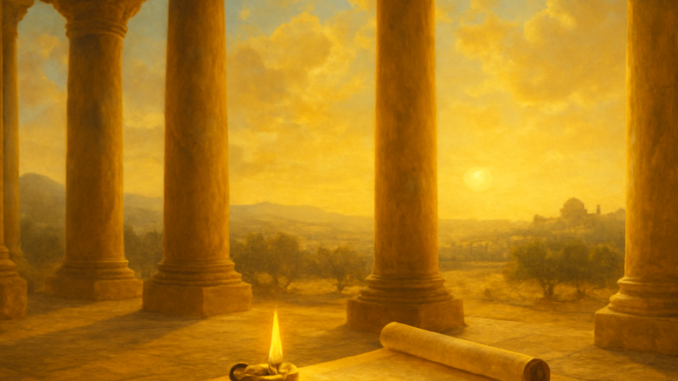
Around the year 55 CE, Paul of Tarsus sat down in Ephesus to write a letter to the fledgling Christian community in Corinth. This bustling port city, perched on a strategic isthmus between two seas, thrived on commerce, philosophy, and religious diversity. The letter we know as First Corinthians contains some of the most compelling imagery in early Christian literature: the community as a temple, believers as building stones, and the imperative to build upon a solid foundation. For those familiar with the symbolic language of Freemasonry, these metaphors sound remarkably familiar.
A Letter to a Divided Community
Understanding the historical context of this letter is essential to grasping its symbolism. First-century Corinth was a cosmopolitan city where Greeks, Romans, Jews, and freedmen lived side by side. The young congregation Paul had founded there was struggling with internal division. Different factions rallied behind different leaders, threatening to fracture the community’s unity. It is against this backdrop that Paul develops his powerful building metaphor.
In the third chapter, he compares the community to a building whose foundation he himself has laid. Others build upon it, but the quality of their work will be tested by fire. This image of the skilled master builder who carefully selects his materials and works upon a solid base would, centuries later, take a central place in the symbolic language of Freemasonry.
The Temple as a Symbol of Inner Development
What Paul writes next is particularly recognizable to Freemasons. He declares that the faithful collectively form a temple in which the Spirit dwells. But individually, too, each person is a temple. This dual symbolism — the community as a building and the individual as a sacred space — constitutes a core theme that has been carried through the centuries. The Temple of Solomon, whose construction forms a central myth in Freemasonry, takes on a spiritual dimension here: it is not about stone and timber, but about human qualities.
The true art of building lies not in stacking stones, but in shaping character and connecting hearts.
This idea resonates strongly with the Masonic ideal of the rough ashlar that, through labor and self-reflection, is shaped into a perfect cube. The building metaphor was never meant to be taken literally. Both in Paul’s letter to the Corinthians and in the rituals of Freemasonry, the focus is on moral and spiritual growth.
Wisdom That Was Hidden
Another striking theme in First Corinthians is the distinction between superficial knowledge and deeper wisdom. Paul speaks of a wisdom that was hidden and that becomes accessible only through initiation. He distinguishes between those who still need milk and those who can digest solid food. This image of phased knowledge transmission — where insight is gradually revealed as one matures — runs parallel to the degree system in Freemasonry.
The philosopher Plato, whose influence on early Christianity was considerable, likewise recognized this distinction between exoteric and esoteric knowledge. In his Academy, certain teachings were transmitted only orally to advanced students. This tradition of gradual revelation lives on in countless initiatory movements, Freemasonry among them.
The Body as a Lodge of Members
In the twelfth chapter, Paul develops his famous metaphor of the body with many members. Each member has its own function, yet no member can do without the others. The eye cannot say to the hand, “I have no need of you.” This organic unity in diversity forms a core principle of brotherhood.
Every member contributes to the whole from their own unique talents. The weakest member deserves the greatest care and honor. Mutual dependence strengthens the community. Diversity is not a threat but a blessing.
For Freemasons, who gather in the lodge with brothers from every walk of life and from widely varying backgrounds, this is a deeply recognizable ideal. The lodge functions as a microcosm in which differences are transcended by a shared pursuit: the improvement of oneself and the world.
The Hymn to Love as an Ethical Compass
The thirteenth chapter, often referred to as the Hymn to Love, is one of the most widely quoted texts in world literature. Paul asserts that all gifts, no matter how impressive, are worthless without love. This love is not sentimental but practical: it is patient, kind, not envious, not boastful. It bears all things, believes all things, hopes all things, endures all things.
Marcus Aurelius, the Stoic emperor who lived roughly a century after Paul, would develop comparable thoughts on the interconnectedness of all people and the duty of compassion. This universal ethic, which transcends religious boundaries, also forms the foundation of Freemasonry. It is no coincidence that the fraternity welcomes members of all religious backgrounds, united by shared values rather than shared creeds.
From Corinth to the Modern Lodge
What can we learn today from this nearly two-thousand-year-old text? The challenges the Corinthians wrestled with are surprisingly current: division, status-seeking, neglecting the vulnerable, and the temptation to settle for superficial knowledge rather than deep wisdom. The answers Paul offered remain relevant: build on a solid foundation, recognize the value of every member, and let love be your compass.
For Freemasons, this letter offers a rich source of reflection. The building symbolism so central to Masonic ritual takes on a spiritual depth here that far transcends the literal work of cutting stone. It is about building yourself and your community, stone by stone, with patience and craftsmanship.
First Corinthians stands as one of those rare ancient texts whose imagery bridges millennia with startling clarity. Paul’s vision of a community built on a firm foundation, where every member matters and love guides all endeavor, speaks directly to the heart of Freemasonry. Whether read in a church, studied in a library, or reflected upon in the quiet of a lodge room, these words remind us that the most enduring structures we can build are not made of stone — they are made of character, wisdom, and brotherly love.
Copyright text & image: devrijmetselaar.nl
Texts are based on the ideas and content of the author of devrijmetselaar.nl, reviewed, corrected, and supplemented with the assistance of OpenAI. Images are created based on the ideas of the author of devrijmetselaar.nl using OpenAI/DALL-E.
Frequently Asked Questions
What building metaphors does Paul use in First Corinthians that relate to Freemasonry?
Paul describes the Christian community as a temple with believers serving as building stones laid upon a solid foundation, imagery that directly parallels Freemasonry's symbolic language of construction and craftsmanship. He emphasizes that the true art of building lies not in stacking stones, but in shaping character and connecting hearts, which aligns beautifully with the Masonic ideal of personal and spiritual development. These metaphors suggest that both traditions view building not as a literal act, but as a profound journey of moral and spiritual growth.
How does the concept of the Temple of Solomon connect Paul's writings to Freemasonry?
Paul teaches that the faithful collectively form a sacred temple where the Spirit dwells, transforming the Temple of Solomon from a physical structure into a spiritual symbol of inner development. In Freemasonry, the Temple of Solomon occupies a central place in its mythology and rituals, representing the same spiritual and moral dimensions that Paul emphasized. Both traditions use the temple concept to inspire practitioners to build themselves into vessels of wisdom, virtue, and enlightenment.
What does Paul mean by the 'rough ashlar' concept mentioned in relation to Freemasonry?
The rough ashlar is a Masonic symbol representing an unfinished stone that, through labor and self-reflection, is shaped into a perfect cube, directly mirroring Paul's teaching about spiritual and character development. Paul's building metaphor suggests that individuals, like stones, must be carefully shaped and refined to contribute meaningfully to the greater spiritual structure. This concept emphasizes that both Paul and Freemasonry view personal improvement as an ongoing, deliberate process of refinement.
How does Paul's teaching about progressive wisdom relate to the Masonic degree system?
Paul distinguishes between superficial knowledge and deeper wisdom, suggesting that insight is gradually revealed as one matures—those still needing 'milk' versus those ready for 'solid food'—which parallels the Masonic degree system's phased approach to knowledge transmission. Both traditions recognize that spiritual and moral education must unfold progressively, with each stage building upon the previous one. This shared philosophy demonstrates how ancient wisdom traditions understood that true enlightenment requires time, dedication, and readiness to receive deeper truths.

Be the first to comment