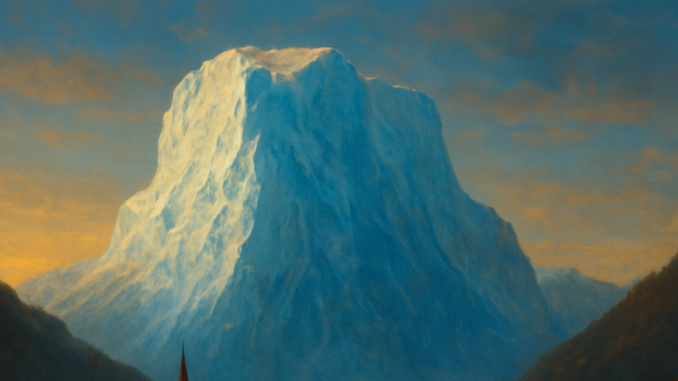
Somewhere in the Swiss Alps, a colossal block of ice is sliding twenty centimeters per day toward a village. The residents watch as the mountain above them moves slowly but inexorably. It’s an image that touches something deeper than geology — it raises the question of what people do when the ground beneath their feet becomes uncertain. And it is precisely in that moment that something Freemasonry has treasured for centuries as its deepest foundation reveals itself: brotherhood.
Twenty Centimeters a Day
At first glance, twenty centimeters is almost nothing. It’s the width of a man’s hand, the length of a pencil. You can measure it with a ruler. And yet, twenty centimeters per day, day after day, is enough to throw an entire village into disarray. Houses are evacuated, roads are closed, lives are suspended. The threat is not sudden, like an earthquake or a flood. It is slow, steady, unavoidable. The ice gives people time to think — but that does not make them any less vulnerable. On the contrary, the slowness of the danger may make the uncertainty even more unbearable.
What do you do when the mountain moves? The first response is practical: measure, calculate, evacuate. But the second response is deeply human, and far harder to organize. The second response is seeking your neighbor’s eyes, placing a hand on someone’s shoulder, making a plan together while knowing the plan may not be enough. It is precisely in that second response that brotherhood is born.
The Stone and the Ice
Freemasonry takes the rough ashlar as the starting point of its work. That stone represents the human being as they are: unfinished, angular, full of undiscovered potential. Through labor, through reflection, through fellowship with brothers and sisters, the stone is gradually shaped into a perfect ashlar that fits within a greater structure. But what happens when the building material itself begins to shift? What if the stone you thought you stood upon turns out to be ice?
The Swiss ice mass threatening a village reminds us that certainty can be an illusion. The mountain that offered protection for generations suddenly becomes a threat. The ground that seemed solid moves. This is no abstract philosophical question. It is the daily reality of people forced to leave their homes, not knowing if they will return. And, in a figurative sense, it is the reality of every person who discovers that what they believed to be permanent is, in fact, changeable.
Marcus Aurelius and the Shifting World
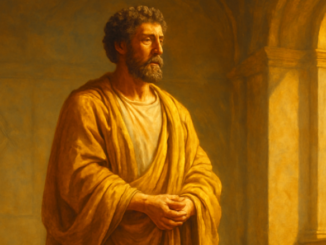
The Roman emperor and Stoic philosopher Marcus Aurelius wrote in his Meditations that everything in the world is change, and that life itself is nothing more than an opinion about life. He did not mean that nothing matters — rather that we should not cling to the apparent solidity of things. The mountain is firm today, but perhaps not tomorrow. The house stands now, but may not stand much longer. What remains when everything shifts is the quality of our connection with others.
Seneca, too, emphasized that fortune is unpredictable and that a person’s true wealth lies in their capacity for connection and care. In his ninety-fifth letter, he wrote about the duty to care for others — not as a favor, but as an expression of our deepest nature. That thought resonates powerfully with what Freemasonry understands as brotherhood: not a casual friendliness, but a fundamental willingness to stand beside another person when the ground shifts.
Brotherhood is not the promise that the ground will remain firm. It is the certainty that you will not stand alone when it moves.
The Ritual of Keeping Watch Together
In the Swiss village, geologists and volunteers keep watch together. They measure the movement of the ice, monitor the cracks, sound the alarm when the shifting accelerates. There is something ritualistic about this vigil. It calls to mind the ancient traditions of the stonemason guilds — the forerunners of Freemasonry — in which brothers watched over the construction and over each other. The ritual of keeping watch together is not spectacular. It is quiet, persistent, repetitive. But it is precisely that repetition that builds trust.
In Freemasonry, ritual serves a similar function. It is not performance, not theater, but an exercise in attention and presence. By performing the same actions together, speaking the same words, sharing the same silences, a bond emerges that reaches far beyond the individual. Johann Wolfgang von Goethe, himself a Freemason, wrote that a person only truly becomes human in the mirror of another. The ritual offers that mirror, time and again.
The Glacier as Teacher
A glacier moves slowly, but it moves. It grinds rocks, carves valleys, transforms landscapes over centuries. It is simultaneously destructive and creative. Within that duality lies a lesson that Freemasonry recognizes: growth comes with loss, building with demolition, formation with discomfort. The rough ashlar is not refined without pieces falling away.
The village in the Alps faces a choice no one makes willingly. But in the way its residents confront that choice — in their mutual support, their shared vigilance, their willingness to step into the unknown together — we see something greater than mere survival. We see brotherhood in its purest form: not as an ideal, but as a practice. Not as a word, but as a deed.
What Remains When the Ice Melts
When the ice finally comes to rest — or when the village must be permanently evacuated — the question will not be how many centimeters the block shifted per day. The question will be: Did we look after each other? Did we take our neighbor’s fear seriously? Did we share what we had? Did we keep watch when it was needed?
These are the questions Freemasonry poses to its members — not in the face of a glacier, but in the quiet of the lodge, in the exchanges after a meeting, in the everyday moments when a brother or sister needs a hand or an ear. The glacier will one day retreat or the village will be rebuilt elsewhere. But the bonds forged in the shadow of the mountain — those endure.
The ground beneath us is never as solid as we believe. Mountains move, ice shifts, certainties crumble. What Freemasonry teaches — and what the people of that small Alpine village demonstrate so powerfully — is that the answer to instability is not found in firmer ground, but in firmer bonds. Brotherhood does not prevent the glacier from advancing. It does something far more important: it ensures that no one faces it alone. And in the end, when the ice has come and gone, it is not the stone or the mountain that tells the story. It is the people who stood together.
Copyright text & image: devrijmetselaar.nl
Texts are based on the ideas and content of the author of devrijmetselaar.nl, reviewed, corrected, and supplemented with the assistance of OpenAI. Images are created based on the ideas of the author of devrijmetselaar.nl using OpenAI/DALL-E.
Frequently Asked Questions
What is the connection between the glacier threat in the Swiss Alps and Freemasonry?
The article uses the glacier moving twenty centimeters per day toward a Swiss village as a metaphor for how uncertainty and shared danger reveal the deepest principles of Freemasonry: brotherhood. When people face the ground beneath their feet becoming unstable, they instinctively seek each other's eyes, offer support, and make plans together — this human response to crisis exemplifies the brotherhood that Freemasonry has treasured for centuries.
What does the 'rough ashlar' represent in Freemasonry according to this article?
The rough ashlar represents the human being as they naturally are: unfinished, angular, and full of undiscovered potential. Through labor, reflection, and fellowship with brothers and sisters, the rough stone is gradually shaped into a perfect ashlar that fits within a greater structure. The article uses this concept to explore what happens when the foundation we rely upon — like the 'solid' ground — turns out to be changeable and uncertain.
How does the article suggest we should respond when certainty becomes an illusion?
The article indicates that while the first response to uncertainty is practical (measuring, calculating, evacuating), the deeper and more difficult human response is seeking connection with others. This involves making eye contact with neighbors, offering physical support, and making plans together even when those plans may not be enough. This second response — the seeking of human connection in the face of uncertainty — is where true brotherhood is born.

Be the first to comment