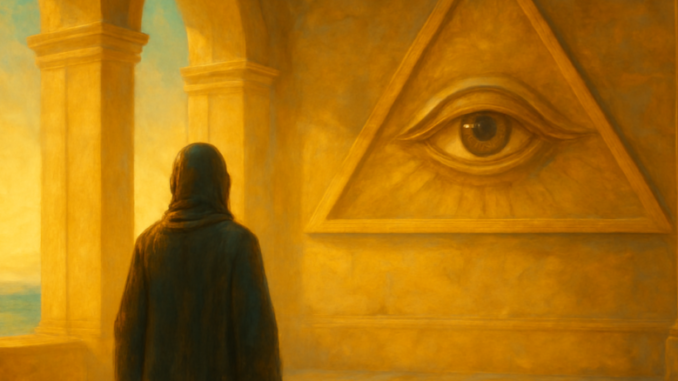
On March 2, 1785, Elector Karl Theodor of Bavaria issued a final edict banning all secret societies within his territories. It was a death sentence for an organization that had existed for barely nine years, yet continues to captivate imaginations to this day: the Order of the Illuminati, founded by Adam Weishaupt in the Bavarian city of Ingolstadt in 1776. What made this society so threatening to the powers of the eighteenth century? And what connects its spiritual quest to Freemasonry — both then and now?
A Professor with an Enlightenment Dream
In 1776, Adam Weishaupt was a 28-year-old professor of canon law at the University of Ingolstadt. Frustrated by the Jesuits’ dominance over academic life and inspired by Enlightenment thinkers such as Voltaire, Jean-Jacques Rousseau, and Baron d’Holbach, he resolved to found a society that placed reason, moral self-improvement, and tolerance at its center. He initially called it the Order of the Perfectibles — a name he soon changed to the Order of the Illuminati.
Weishaupt designed a hierarchical degree system reminiscent of Freemasonry’s structure, with initiation rituals that guided candidates step by step deeper into the society’s philosophy. This was no coincidence: around 1780, Weishaupt himself joined a Masonic lodge and began actively recruiting members from within the Craft. His most important ally became Adolph Freiherr von Knigge, an experienced Freemason and writer who significantly refined and expanded the Order’s degree system.
Rapid Growth and Deep Ties to Freemasonry
Between 1780 and 1784, the Order grew at an explosive rate. At its peak, it counted an estimated two to three thousand members, spread across Bavaria, Saxony, Austria, parts of Italy, and possibly France. Its ranks included prominent figures such as Johann Wolfgang von Goethe, Duke Ernest II of Saxe-Gotha, and numerous nobles, civil servants, and academics. The Order deliberately operated through existing Masonic lodges — a strategy that would prove to be both its greatest strength and its most critical vulnerability.
The Order’s spiritual program was ambitious. The higher degrees promised insight into what Weishaupt called “the mysteries”: an inner illumination through which the individual freed himself from prejudice, superstition, and blind obedience to secular and ecclesiastical authorities. In this, one can hear the echo of both the ancient mystery traditions and the spiritual core of Freemasonry, in which each person is invited to know himself and to work upon himself as a rough stone that must be refined.
The Fall: Betrayal, Fear, and Political Repression
The downfall of the Order began from within. In 1783, a bitter conflict erupted between Weishaupt and Von Knigge over the direction and leadership of the society. Von Knigge departed, taking his loyalty — and his network — with him. Shortly afterward, several disgruntled members defected to the Bavarian authorities, handing over documents, membership lists, and descriptions of the Order’s rituals.
Elector Karl Theodor, who had long been suspicious of secret societies, issued a first ban on all unrecognized associations in June 1784. When intercepted documents revealed the Order’s hierarchical structure and political ambitions, the comprehensive ban followed on March 2, 1785. Raids were carried out at the homes of prominent members. Weishaupt fled to Gotha, where Duke Ernest II offered him protection. He would never return to Bavaria.
A brief timeline of key events illustrates how swiftly things unfolded: in 1776, Adam Weishaupt founded the Order in Ingolstadt. By 1780, the collaboration with Masonic lodges had begun through Von Knigge. In 1783, the rift between Weishaupt and Von Knigge tore the organization apart. The first ban on secret societies in Bavaria came in 1784, and by 1785, the final edict formally dissolved the Order.
Separating Historical Fact from Enduring Myth
What is historically established is that the Order of the Illuminati was a real society with a documentable membership list, a fully developed degree system, and concrete objectives. The original documents — including Weishaupt’s correspondence and the so-called “Original Writings” published by the Bavarian government — have survived and been extensively studied by historians. What is equally certain is that the Order ceased to exist as a formal organization after 1785.
What is not established — and what belongs firmly to the realm of myth — is the idea that the Order secretly survived and orchestrated major historical events, from the French Revolution to modern-day world politics. These conspiracy theories emerged shortly after the ban, fueled in particular by publications from the Frenchman Augustin Barruel and the Scotsman John Robison in the 1790s. Both claimed the Order had engineered the Revolution. Serious historians have repeatedly debunked these claims, yet they have proven remarkably persistent in popular culture.
The Spiritual Legacy: What Freemasons Can Learn
The story of the Illuminati touches Freemasonry at a fundamental level. Both traditions share the conviction that human beings are capable of inner growth, of transcending prejudice, and of cultivating a moral compass that is not imposed by external authorities but grows from within. That spiritual core — the belief in the perfectibility of humanity — is older than either society and reaches back to the classical philosophy of Plato and Aristotle, who regarded virtue as a capacity that could be practiced and developed.
The Order of the Illuminati was not banned because it possessed dangerous secrets. It was banned because the very idea of inner freedom and independent thought terrified the rulers of the eighteenth century.
The essential difference between the Order and Freemasonry, however, is significant. Where Weishaupt pursued a political and social program aimed at dismantling the structures of church and state, Freemasonry has historically positioned itself as a non-political fraternity focused on personal moral development. The Illuminati sought to change the world by infiltrating institutions of power; Freemasonry seeks to change the world by transforming the individual. That distinction matters — and it is one reason why Freemasonry endured while the Illuminati did not.
For modern Freemasons, the Illuminati’s story serves as both an inspiration and a cautionary tale. The inspiration lies in the sincere desire for enlightenment, for the triumph of reason over superstition, and for the moral elevation of humanity. The caution lies in the danger of conflating spiritual aspiration with political ambition, and of building structures of secrecy so opaque that they breed suspicion rather than trust.
The Order of the Illuminati burned brightly and briefly. Its legacy, stripped of conspiracy and myth, is one of radical idealism — a belief that human beings could be made better through knowledge, self-reflection, and brotherhood. That same belief lives on in every Masonic lodge where brothers gather to work on themselves and on the world around them. The Illuminati may have disappeared from history, but the light they sought to kindle — the inner light of reason and moral awareness — continues to burn wherever people commit themselves to the ancient and honorable work of self-improvement.
Copyright text & image: devrijmetselaar.nl
Texts are based on the ideas and content of the author of devrijmetselaar.nl, reviewed, corrected, and supplemented with the assistance of OpenAI. Images are created based on the ideas of the author of devrijmetselaar.nl using OpenAI/DALL-E.
Frequently Asked Questions
What was the Order of the Illuminati and who founded it?
The Order of the Illuminati was a secret society founded by Adam Weishaupt, a 28-year-old professor of canon law at the University of Ingolstadt, in 1776. Initially called the Order of the Perfectibles, it was designed to promote reason, moral self-improvement, and tolerance, with a hierarchical degree system similar to Freemasonry. The organization existed for only nine years before being banned in 1785.
Why was the Order of the Illuminati banned?
On March 2, 1785, Elector Karl Theodor of Bavaria issued a final edict banning all secret societies within his territories, effectively ending the Order of the Illuminati. The organization was considered threatening to the powers of the eighteenth century due to its emphasis on individual enlightenment, freedom from prejudice, and liberation from blind obedience to secular and ecclesiastical authorities.
What was the connection between the Order of the Illuminati and Freemasonry?
The Order of the Illuminati had deep ties to Freemasonry. Adam Weishaupt joined a Masonic lodge around 1780 and began recruiting members from within the Craft. His most important ally was Adolph Freiherr von Knigge, an experienced Freemason who helped refine and expand the Order's degree system. The Illuminati deliberately operated through existing Masonic lodges, which facilitated rapid growth but also contributed to its vulnerability when authorities targeted secret societies.



Be the first to comment