Rain hammers against the towering windows of a Spanish cathedral. Inside, a man stares at a screen where a computer program promises to reveal the origin of life itself. This is the opening premise of Dan Brown’s 2017 thriller Origin. But how much of the book’s spectacular claims are actually grounded in science and history? In this fact-check, we examine what is demonstrably true, what is dramatically exaggerated, and what turns out to be pure fiction.
The Central Premise: Can Technology Replace Religion?
In Origin, Dan Brown suggests that artificial intelligence will ultimately deliver the answers that religions have promised for centuries. This idea is far from new — it belongs to a long philosophical tradition. Thinkers like Auguste Comte predicted as early as the nineteenth century that science would take over the role of religion. Yet the question of whether technology can ever replace human meaning-making remains unanswered within the scientific community. Sociologists point out that religious practices often actually increase during periods of technological upheaval, as the sociologist of religion Peter Berger documented in his research on secularisation.
What Dan Brown presents as an imminent revolution is, in reality, an ongoing philosophical debate with no definitive conclusion. The claim that technology will eradicate religion is not scientifically substantiated — it is a speculative thesis embraced by some futurists, but rejected or nuanced by most scholars of religion and society.
Artificial Intelligence: Where Do We Really Stand?
The computer program in Origin possesses human-like creativity and emotional intelligence. This diverges sharply from the reality of artificial intelligence, both in 2017 and today. While machine learning has made impressive strides, no system possesses consciousness or self-aware creativity. Researchers at institutions like MIT and Stanford University emphasise that current systems recognise patterns without truly understanding them.
Fact: Artificial intelligence can perform complex calculations and recognise patterns.
Exaggeration: The suggestion that such systems can achieve philosophical breakthroughs.
Fiction: A program with consciousness and emotional bonds with its creator.
Origin blends scientific facts with speculation, deliberately blurring the boundaries between present capability and distant future possibility.
The Origin of Life: Miller-Urey and Beyond
The book references experiments that supposedly explain the chemical origin of life. The famous Miller-Urey experiment of 1952 is historically accurate: scientists Stanley Miller and Harold Urey created amino acids by sending electrical discharges through a mixture of gases designed to simulate the early Earth’s atmosphere. This experiment proved that organic molecules can arise spontaneously under certain conditions.
However, the leap from amino acids to living cells is enormous and remains unexplained. No laboratory has ever created life from non-life. The suggestion in Origin that this mystery has been solved is fictional. Scientists like Jack Szostak continue working on protocells, but a definitive answer to how life began still eludes us.
Historical Locations and Symbolism
Dan Brown is known for his meticulous descriptions of real-world locations. The Guggenheim Museum in Bilbao, the Sagrada Família in Barcelona, and the Royal Palace of Madrid all exist and are described with architectural accuracy. However, the symbolic interpretations that characters attach to these buildings are largely fictional or greatly exaggerated.
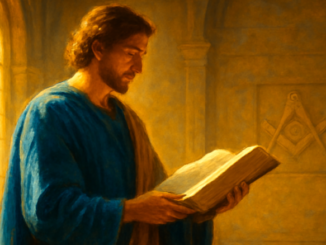
The connection to Freemasonry deserves particular attention. While Dan Brown wrote extensively about Masonic symbolism in earlier works like The Lost Symbol, it plays a smaller role in Origin. That said, the emphasis on light, architecture, and the search for truth resonates deeply with Masonic principles. It is worth noting that architect Antoni Gaudí, the designer of the Sagrada Família, was not a Freemason but a deeply devout Catholic. Claims that his work contains Masonic symbolism, as some readers conclude after reading Brown’s novel, lack historical foundation.
Religion and Science: A False Dichotomy?
Origin presents religion and science as fundamentally opposed. Historically, this portrayal is problematic. Many great scientists were people of faith, from Isaac Newton to Georges Lemaître — the Belgian priest who formulated the Big Bang theory. Freemasonry has recognised for centuries that science and spirituality can coexist. The concept of the Great Architect of the Universe allows room for diverse interpretations of the divine, bridging rational inquiry and spiritual reverence.
The thesis that new scientific discoveries automatically undermine religion is one that historians of religion consistently challenge. After every major scientific breakthrough — from Darwin’s theory of evolution to the discovery of DNA — critics predicted the end of religion. Yet religious traditions remain vital around the world. This suggests that the relationship between faith and science is far more complex than Dan Brown’s narrative implies.
The Verdict: Fact, Exaggeration, or Fiction?
Origin is first and foremost a thriller, not a scientific work. The book’s strength lies in sparking curiosity about life’s biggest questions. The descriptions of architecture and artworks are largely accurate. The scientific claims range from partially true to highly speculative. The philosophical conclusions are firmly stated opinions, not proven facts.
For readers interested in the actual state of science surrounding the origin of life, works by scientists like Nick Lane and Paul Davies offer more reliable insight. Dan Brown himself has acknowledged in interviews that his books are entertainment designed to inspire people to conduct their own research — not to accept presented theories uncritically.
Dan Brown’s Origin offers a thrilling blend of real science, genuine locations, and imaginative speculation. For Freemasons and those drawn to the Craft’s traditions, the book’s themes of seeking light, questioning established truths, and reconciling knowledge with wonder will feel familiar. But as with any work of fiction, the key is to let it inspire inquiry rather than replace it. The true origin of understanding, as any Mason knows, begins with the willingness to keep searching.
Copyright text & image: devrijmetselaar.nl
Texts are based on the ideas and content of the author of devrijmetselaar.nl, reviewed, corrected, and supplemented with the assistance of OpenAI. Images are created based on the ideas of the author of devrijmetselaar.nl using OpenAI/DALL-E.
Frequently Asked Questions
Does Dan Brown's claim that technology will replace religion have scientific support?
No. While Dan Brown suggests artificial intelligence will deliver answers that religion has promised, this is a speculative thesis, not a scientifically substantiated claim. Philosophers like Auguste Comte predicted this in the nineteenth century, but the scientific community remains divided. In fact, sociologist Peter Berger's research shows that religious practices often increase during periods of technological upheaval, contradicting Brown's premise.
How accurate is the portrayal of artificial intelligence in Origin?
The AI depicted in Origin is largely fictional. While the book correctly notes that modern AI can perform complex calculations and recognize patterns, it dramatically exaggerates by suggesting such systems can achieve philosophical breakthroughs and emotional intelligence. In reality, no current AI system possesses consciousness, self-awareness, or true creativity—capabilities that researchers at MIT and Stanford emphasize remain far beyond our technological reach.
What does this fact-check reveal about Dan Brown's approach to science and history in Origin?
The fact-check demonstrates that Origin deliberately blurs the boundaries between present scientific capability and speculative future possibilities. Dan Brown blends documented facts with dramatic exaggeration and pure fiction to create a compelling narrative. While some premises are rooted in real scientific and philosophical traditions, the book's spectacular claims about technology replacing religion and conscious AI are presented as imminent when they remain highly contested or entirely fictional.

Be the first to comment