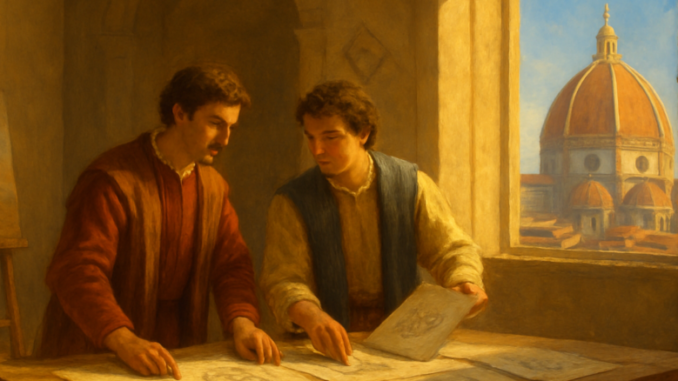
In fifteenth-century Florence, something remarkable happened. While rival artists competed fiercely for commissions, a culture of mutual influence quietly emerged that would transform Western art forever. The key to this unprecedented flourishing was the breaking down of zero-sum thinking — the deeply held belief that one person’s gain must come at another’s expense. For Freemasons, this historical episode offers profound insights into the power of collaboration over competition.
Guild Culture and the Zero-Sum Mindset of the Middle Ages
Medieval guilds operated according to rigid hierarchies. A master craftsman would take on only a limited number of apprentices, and trade secrets were jealously guarded. The underlying logic was simple: sharing knowledge with others meant weakening your own position. This competitive mindset, in which every advance by a rival was perceived as a direct threat, defined artisan life for centuries.
The building lodges of the great cathedrals were a subtle exception to this rule. Itinerant stonemasons shared their knowledge with selected brothers — not in spite of, but precisely because of the understanding that monumental structures could only be raised through cooperation. The foundations of what would later become Freemasonry were laid in this very insight: that some goals transcend individual interests.
Florence as a Laboratory Against Zero-Sum Thinking
When the Medici family began patronizing artists, a unique ecosystem came into being. Leonardo da Vinci, Michelangelo Buonarroti, Sandro Botticelli, and Raphael all worked in the same city, sometimes on the same projects. Rivalry certainly existed, but so did cross-pollination. Leonardo studied the anatomical drawings of Antonio del Pollaiuolo, Michelangelo learned from the frescoes of Masaccio, and Raphael incorporated techniques from both masters into his own work.
What is truly striking is that these artists did not become poorer by sharing. On the contrary: Florence’s collective reputation as an artistic capital attracted more patrons, which generated more commissions for everyone. This is the essence of what economists would later call positive-sum thinking — situations in which cooperation expands the total value available, so that all parties can benefit.
Philosophical Roots: From Aristotle to Spinoza
The idea that mutual benefit is not only possible but desirable has deep roots in classical philosophy. Aristotle described in his Nicomachean Ethics how true friendship is founded on mutual virtue, with both parties growing through the relationship. Baruch de Spinoza developed this further in his Ethics, arguing that people guided by reason desire nothing for themselves that they would not also desire for others.
Art and wisdom are not finite resources that deplete as more people draw upon them; they multiply through being shared.
Johann Wolfgang von Goethe, himself a Freemason and one of the greatest minds of the Enlightenment, embodied this principle throughout his life. His extensive correspondence with Friedrich Schiller reveals two geniuses who saw each other not as competitors but as mutual whetstones. Goethe’s dramas grew sharper through Schiller’s critique, and Schiller’s work was equally enriched by the exchange.
The Masonic Lodge as a Training Ground
Within Freemasonry, this principle is practiced ritually. The lodge is not an arena where brothers compete for a limited supply of wisdom or recognition. It is a workshop where each individual’s growth contributes to the growth of all. The symbols of the square and compasses do not point toward competition — they point toward the collective building of a spiritual temple that is greater than any structure one person could raise alone.
Art history provides a compelling parallel. When Wolfgang Amadeus Mozart, himself a Freemason, composed The Magic Flute, he drew freely on traditions that others had developed before him. The Singspiel form, the Masonic symbolism, the musical conventions of his era — these were all gifts from those who came before. Mozart added his genius to this inheritance and passed the enriched whole on to the next generation.
Practical Lessons for Today
Breaking free of mutually exclusive thinking is not naive idealism. It does, however, require a fundamental shift in perspective. Instead of asking “How can I win?” the question becomes “How can we achieve more together?” This applies to artists who collaborate with colleagues, to craftsmen who pass on their knowledge, and to Freemasons who work on themselves as a contribution to humanity.
The Renaissance flourished because artists studied each other’s work instead of hiding their own. Expertise shared within building lodges made possible cathedrals that no one could have built alone. Philosophers from Aristotle to Spinoza demonstrated that mutual benefit is both rational and ethical. And Freemasons like Goethe and Mozart practiced this principle in their art and their lives.
From Zero-Sum Thinking to Shared Growth
The history of art teaches us that the greatest breakthroughs rarely spring from isolated genius. They arise within networks of exchange, critique, and mutual inspiration. The fear that sharing leads to loss — that stubborn zero-sum reflex — proves unfounded time and again when we look at the evidence. Florence did not grow poorer because its artists learned from one another; it became the center of Western civilization.
For Freemasons, this is more than a historical curiosity. It is a living practice. Every lodge meeting where brothers share their insights, every transmission of ritual knowledge, every collective reflection on symbolism — these are exercises in what the Renaissance modeled for us centuries ago. The rough ashlar is not shaped into a perfect cube through competition, but through the shared effort of all who enter the workshop. In this way, art — in the broadest sense of the word — becomes an act of connection rather than contest.
Copyright text & image: devrijmetselaar.nl
Texts are based on the ideas and content of the author of devrijmetselaar.nl, reviewed, corrected, and supplemented with the assistance of OpenAI. Images are created based on the ideas of the author of devrijmetselaar.nl using OpenAI/DALL-E.
Frequently Asked Questions
What is zero-sum thinking and how did it affect medieval craftsmen?
Zero-sum thinking is the belief that one person's gain must come at another's expense. In the Middle Ages, medieval guilds operated under this mindset, with master craftsmen limiting apprentices and jealously guarding trade secrets because they believed sharing knowledge would weaken their own position. However, building lodges of cathedral stonemasons were an exception, as they understood that monumental structures required cooperation—a principle that became foundational to Freemasonry.
How did Renaissance Florence demonstrate positive-sum thinking in art?
In fifteenth-century Florence, rival artists like Leonardo da Vinci, Michelangelo, Botticelli, and Raphael competed fiercely but also shared knowledge and techniques with one another. Rather than diminishing individual success, this collaboration enhanced Florence's collective reputation as an artistic capital, attracted more patrons, and generated more commissions for everyone. This demonstrated that cooperation could expand total value so all parties benefit—the essence of positive-sum thinking.
What lessons does the Renaissance offer to Freemasons about collaboration?
The article presents the Renaissance as a historical example showing that breaking down zero-sum thinking in favor of collaboration and mutual influence can lead to unprecedented flourishing. For Freemasons, the lesson is that some goals transcend individual interests and that cooperation—as practiced by cathedral stonemasons and later Renaissance artists—generates greater collective achievement and value than competition alone.


Be the first to comment