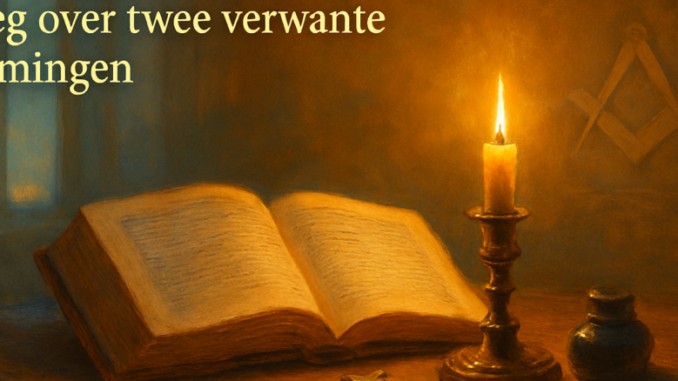
When people learn you’re a Freemason, the same question often comes up: doesn’t that have something to do with those secret societies from the eighteenth century? It’s an understandable question. The Enlightenment and Freemasonry emerged during the same period and shared similar ideals. Yet the two movements are frequently conflated or even treated as one and the same. In this article, I’ll clearly explain what each movement represents, where they intersect, and where they fundamentally differ — because placing them side by side is one of the best ways to understand what Freemasonry truly is.
The Enlightenment: An Intellectual Revolution
The Enlightenment was a philosophical movement that emerged across Europe during the seventeenth and eighteenth centuries. Thinkers such as Voltaire, Jean-Jacques Rousseau, Immanuel Kant, and John Locke challenged superstition, religious dogma, and absolute power. They believed that through reason and science, humanity could arrive at a better understanding of the world. Kant’s motto — Sapere aude, or “dare to think” — captured this attitude perfectly.
This intellectual movement led to concrete societal changes. The separation of church and state, the rise of democratic ideals, and the emphasis on human rights can all be traced directly back to Enlightenment thinkers. It was a period in which long-held certainties were questioned and new answers were sought through critical inquiry rather than blind trust in tradition.
Freemasonry: A Practice of Self-Improvement
Modern Freemasonry was formally established in 1717 with the founding of the first Grand Lodge in London, under the leadership of figures such as James Anderson and John Theophilus Desaguliers. Although its roots reach back to the medieval stonemason guilds, the fraternity evolved during the eighteenth century into a society focused on moral and spiritual development. Unlike the Enlightenment, which was primarily an intellectual movement, Freemasonry offers a practical method — one built on rituals, symbols, and fraternal dialogue.
A crucial distinction is that Freemasonry does not prescribe a specific philosophy. Where Enlightenment thinkers took definitive positions on religion, politics, and science, Freemasonry leaves room for personal interpretation. The fraternity welcomes people of all religions and worldviews, as long as they believe in a higher order of existence. This makes Freemasonry not a rival to religion, but a complement to it.
Where the Two Movements Intersect
It’s no coincidence that many prominent Enlightenment thinkers were also Freemasons. Voltaire was initiated into a Parisian lodge at an advanced age. Wolfgang Amadeus Mozart was an active member of a lodge in Vienna. Benjamin Franklin combined his scientific curiosity with deep involvement in the fraternity. These men saw Freemasonry as a space where like-minded individuals could gather, regardless of social background or religious conviction.
Both the Enlightenment and Freemasonry place a central question at their core: how can an individual improve themselves and contribute to a better society?
Both movements share an optimistic view of human nature. They believe that people are capable of growth, of overcoming prejudice, and of building a more just world. The Enlightenment pursued this through publications, debates, and political reform. Freemasonry offers a more personal path: through introspection, ritual experience, and brotherly conversation within the privacy of the lodge.
Fundamental Differences
Despite their shared values, there are essential differences. The Enlightenment was a public movement that strived for societal change. Its ideas were published, debated, and contested in the public arena. Freemasonry, by contrast, is a private fraternity focused on the inner development of its members. It does not involve itself in politics or religious disputes, and as an organization it takes no positions on social issues.
Consider these key distinctions:
- The Enlightenment is a philosophical movement with concrete positions; Freemasonry is a practice without a prescribed philosophy.
- Enlightenment thinkers pursued societal reform; Freemasons focus on personal inner growth.
- Many Enlightenment figures were skeptical of religion, and some were outright atheists; Freemasonry requires its members to believe in a higher power, however they may define it.
This difference in approach to spirituality is particularly significant. By requiring a belief in a Supreme Being — without dictating how that belief should be expressed — Freemasonry opens its doors to men of all faith traditions, from Christians to Muslims, from Jews to Hindus.
What We Can Learn from Both
When you examine these two movements side by side, it becomes clear that they are complementary rather than competing. The Enlightenment provides an intellectual framework for critical thinking and civic engagement. Freemasonry offers a method for internalizing those ideals through personal experience and community. You can read the works of Kant and still long for a space where you work alongside others on character development. You can be a lodge member and still draw deep inspiration from Enlightenment ideas.
The confusion between the two often stems from critics who have historically lumped them together. Conspiracy theories about secret societies controlling the world blend historical facts with fantasy. In reality, Freemasonry was never a political movement, even though some of its individual members were politically active. The fraternity provided a meeting place, not a political platform.
The Enlightenment and Freemasonry are two related but distinct phenomena that blossomed during the same historical period. They share a belief in human progress and self-improvement, yet they choose very different paths. The Enlightenment changed the world through ideas and reforms. Freemasonry changes individuals through ritual and reflection. Understanding both — and the space between them — offers a richer, more nuanced appreciation of what it means to pursue truth, build character, and strive toward a better world.
Copyright text & image: devrijmetselaar.nl
Texts are based on the ideas and content of the author of devrijmetselaar.nl, reviewed, corrected, and supplemented with the assistance of OpenAI. Images are created based on the ideas of the author of devrijmetselaar.nl using OpenAI/DALL-E.
Frequently Asked Questions
Is Freemasonry the same as the Enlightenment?
No, they are two distinct movements that emerged during the same period. The Enlightenment was an intellectual movement led by philosophers who challenged tradition through reason and science, while Freemasonry is a fraternal organization focused on moral and spiritual self-improvement through rituals and symbols. Although many Enlightenment thinkers were Freemasons, the two movements operated differently and had different purposes.
When was modern Freemasonry officially established?
Modern Freemasonry was formally established in 1717 with the founding of the first Grand Lodge in London. Although its roots trace back to medieval stonemason guilds, the fraternity evolved during the eighteenth century into the society focused on moral and spiritual development that we know today.
Does Freemasonry conflict with religion?
No, Freemasonry is not a rival to religion but rather a complement to it. Unlike the Enlightenment thinkers who took definitive positions on religion, Freemasonry welcomes people of all religions and worldviews as long as they believe in a higher order of existence. This inclusive approach allows members to maintain their personal faith while participating in the fraternity.
Were famous historical figures members of Freemasonry?
Yes, many prominent Enlightenment thinkers were active Freemasons. Voltaire was initiated into a Parisian lodge, Wolfgang Amadeus Mozart was an active member in Vienna, and Benjamin Franklin combined his scientific curiosity with deep involvement in the fraternity. These men viewed Freemasonry as a valuable space where like-minded individuals could gather regardless of social background or religious conviction.

Be the first to comment