When Marcus Aurelius penned the twelfth and final book of his Meditations, he wrote as a man who knew his days were numbered. Across the centuries, in Masonic lodges around the world, brethren gather to contemplate the very same question that consumed the Roman emperor: how do we achieve inner completion before the light fades? Two worlds separated by eighteen centuries, yet bound together by one of humanity’s most fundamental concerns — the pursuit of a life fully lived.
The Stoic at the End of His Journey
Marcus Aurelius most likely wrote Book XII during his final military campaigns along the Danube, while plague ravaged his Roman legions and his own body grew weaker by the day. For him, completion had nothing to do with external success or leaving behind an imposing legacy. Here was an emperor who ruled over millions, yet he sought fulfillment in something no legion could conquer: harmony between his inner world and the cosmic order of which he was a part.
In these final meditations, Marcus Aurelius returns again and again to the awareness that all things are impermanent. The glory of Alexander the Great, the wisdom of Socrates, the power of every emperor before him — all of it fades to dust. But this apparent pessimism is only the surface. Beneath it lies a profound conviction that this very impermanence sets us free to live as we ought to live: virtuously, presently, and in connection with the whole.
The Freemason in the Temple of Self-Reflection
The Freemason enters the lodge with a comparable intention, though in a very different context. Where Marcus Aurelius was engaged in a solitary dialogue with himself, the Freemason finds his path toward completion precisely in the presence of others. The brotherhood functions as a mirror in which each member comes to know himself — not through isolation, but through connection.
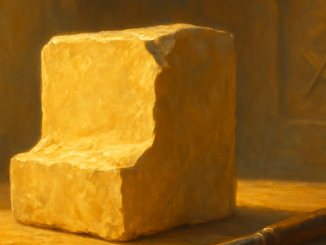
Masonic ritual speaks continually of the rough ashlar that must be shaped into a perfect cube. This image of moral perfection differs fundamentally from the Stoic approach. Where Marcus Aurelius preaches acceptance of what is, the Freemason emphasizes the active transformation of what can be. The rough stone is not accepted in its imperfection — it is patiently and lovingly reshaped.
Where Two Paths Converge
Despite these differences, both traditions share a fundamental insight: true completion lies not in the external but in the internal. Marcus Aurelius writes that we must seek our citadel within ourselves — an impregnable fortress of reason and virtue. The Freemason builds his inner temple, stone by stone, ritual after ritual, until the edifice of his character stands complete.
Both the Stoic and the Freemason understand that death is not the enemy of a life well lived, but the measure against which every life is judged.
Both traditions also recognize the central role of brotherhood, though in different ways. Marcus Aurelius reminds himself that he was born to cooperate — like teeth, hands, and eyelids, human beings are designed to work together. We are social creatures who cannot flourish in isolation. Freemasonry has institutionalized this insight in the form of the lodge, where brethren support one another on their shared journey toward the light.
The Symbolism of Light
In Book XII, Marcus Aurelius speaks of a divine fire burning in every soul — a spark of universal reason that connects us to the cosmic whole. This image resonates deeply with the Masonic symbolism of light. The search for truth, for knowledge, for wisdom is portrayed in both traditions as a movement from darkness toward illumination.
For the Stoic, this light is reason itself — the logos that permeates and orders the cosmos. For the Freemason, light represents the higher knowledge that is gradually revealed, degree by degree, initiation by initiation. In both cases, the light is not something that arrives from the outside. Rather, it is something discovered from within. It was always there; we simply had to learn to see it.
Lessons for the Modern Seeker
What can we draw from this comparison? Perhaps this: that no single tradition holds a monopoly on wisdom. The Stoic philosophy of Marcus Aurelius and the ritual tradition of Freemasonry both offer valuable perspectives on the same enduring human question. They complement each other where they differ and reinforce each other where they agree.
Both traditions emphasize self-reflection as the path to inner growth. Both acknowledge the finite nature of life as a source of meaning. Both seek completion in virtue rather than external recognition. And both regard human beings as fundamentally connected to one another.
The Freemason who reads Marcus Aurelius recognizes a kindred spirit across the centuries. The Stoic who studies the Masonic tradition discovers a practical embodiment of principles he endorses in theory. In this mutual recognition lies a lesson that both traditions underscore: the search for wisdom never takes place in isolation, but always in dialogue with others who ask the same questions.
Marcus Aurelius ended his Meditations with the thought that life is like a play whose length is not ours to determine, but whose quality is. The Freemason would add that this play is not performed solo but in an ensemble of brethren who help one another fulfill their roles with dignity. Two perspectives, one truth: completion lies not in what we achieve, but in who we become along the way.
Copyright text & image: devrijmetselaar.nl
Texts are based on the ideas and content of the author of devrijmetselaar.nl, reviewed, corrected, and supplemented with the assistance of OpenAI. Images are created based on the ideas of the author of devrijmetselaar.nl using OpenAI/DALL-E.

Be the first to comment