A simple puzzle game became the center of an international controversy this week. The White House published an online game that satirically depicted immigrants, prompting the creator of the world-famous falling-blocks game to threaten legal action over copyright infringement. The game was swiftly removed. But beyond the headlines, what does an incident like this actually reveal about personality — about how people and institutions respond under pressure? And what might a Freemason learn from it about the lifelong work of building character?
Why Does Conflict Reveal Our True Character?
It is an ancient truth, one that Aristotle articulated long ago: we do not discover someone’s character in times of prosperity, but in moments of tension. When criticism arrives, when legal threats follow, when public opinion turns against you — that is when true nature surfaces. The speed with which the game was taken down tells us something. Was it wisdom or cowardice? Pragmatism or a lack of backbone? The answer depends entirely on how we define personality and character.
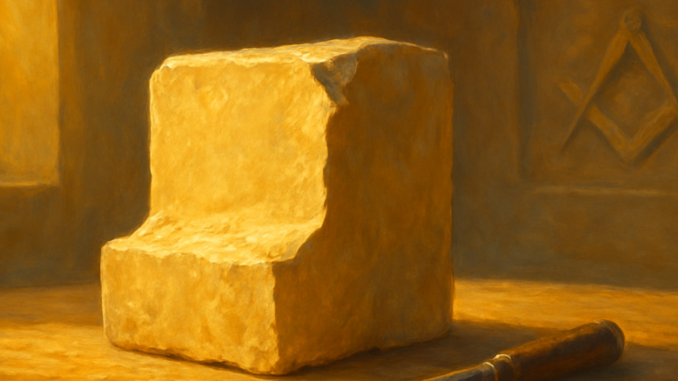
In Freemasonry, there is a core principle that becomes deeply relevant here: a person is not born a finished character but shapes themselves through conscious, deliberate work. The rough ashlar must be hewn into a perfect cube that fits within the greater structure. This demands self-reflection with every action, every reaction. It is not only what you do that matters, but why you do it — and how you handle things when they go wrong.
What Do We Really Mean by Personality?
The concept of personality has many layers. In psychology, we speak of traits, tendencies, and patterns of thought and feeling. But in the philosophical tradition — and certainly in Masonic thinking — it runs deeper. Personality is not merely what you are; it is what you choose to become. It is the product of a lifelong inner dialogue between impulse and reflection, between self-interest and concern for the community.
Montaigne wrote extensively in his essays about the importance of self-knowledge as the foundation of a good life. He urged us to constantly interrogate ourselves: Am I acting out of conviction or out of habit? Out of fear or out of wisdom? These questions are not only relevant for individuals but also for organizations and governments. When an institution withdraws a product under external pressure, the question is not just whether it was practically sensible, but whether it aligns with the values that institution claims to uphold.
How Does This Relate to the Masonic Ideal?
In the lodge, a brother or sister is not judged by external successes but by the inner journey they undertake. The aim is the pursuit of improvement, not perfection. Making a mistake is human; how you deal with it defines your character. The Freemason learns to see adversity as a school, to receive criticism as a gift, and to approach conflict with dignity rather than defensiveness.
Personality is not what you display when everything is going well — it is what you reveal when the pressure mounts.
This principle applies at every level. Whether you are a head of state confronted with a legal threat or an ordinary citizen receiving criticism on social media, the question remains the same: Are you responding from your best self, or from fear and self-interest?
What Can We Learn from This Controversy?
The controversy surrounding this removed game holds up a mirror — not so we can judge others, but so we can examine ourselves. How do we react when our ideas are challenged? When something we have created or said turns out to hurt others? Are we willing to engage in genuine reflection, or do we reach for excuses?
Freemasonry does not offer ready-made answers, but it does offer a method. The ritual work in the lodge is designed to confront the participant, time and again, with fundamental questions about who they are and who they wish to become. It is a form of mental and spiritual exercise that strengthens character, much as physical training strengthens the body.
Is There a Connection Between Creativity and Responsibility?
It is worth noting that both the creators of the original falling-blocks game and the designers of the controversial government game are creative minds. Creativity is one of the most admirable human qualities, but it carries responsibility. What you create has impact. Goethe, himself a Freemason, wrote about the artist as someone who does not merely depict the world but actively shapes it. With that power comes a moral dimension.
A game is never just a game. Satire is never just a joke. Every creation bears the fingerprint of its maker and speaks to an audience. The question a Freemason would ask themselves is this: Does what I create contribute to light or to darkness? Does it build up, or does it tear down?
How Do We Continue Building Ourselves?
Current events offer us daily opportunities to test our personality. A news article, an online discussion, a conflict at work — these are all moments where we face a choice. Do we choose convenience or integrity? A quick reaction or a thoughtful response?
Freemasonry invites us to live a life of conscious choices. Not to be perfect, but to become ever more aware of our own patterns, our own reactions, our own blind spots. This is the true labor on the rough ashlar: not chiseling away imperfections, but integrating them into a coherent whole.
A removed video game will be forgotten news by tomorrow. But the question it raises remains deeply relevant: Who am I when it truly matters? The Freemason does not seek the answer in external validation but in the quiet, steady work on their own character. Day after day, stone by stone, reaction by reaction. This is not an abstract ideal — it is a concrete practice that can be exercised in every news event, no matter how small.
Copyright text & image: devrijmetselaar.nl
Texts are based on the ideas and content of the author of devrijmetselaar.nl, reviewed, corrected, and supplemented with the assistance of OpenAI. Images are created based on the ideas of the author of devrijmetselaar.nl using OpenAI/DALL-E.
Frequently Asked Questions
What does Freemasonry teach about character development?
According to Freemasonry, a person is not born with a finished character but must actively shape themselves through conscious, deliberate work. This is represented by the metaphor of the rough ashlar being hewn into a perfect cube that fits within a greater structure. It requires constant self-reflection on not only what you do, but why you do it and how you handle difficult situations.
Why do conflicts and moments of tension reveal a person's true character?
As Aristotle articulated, we do not discover someone's character in times of prosperity, but in moments of tension and pressure. When criticism arrives, legal threats follow, or public opinion turns against someone, their true nature surfaces. How a person or institution responds under these circumstances reveals whether they act from wisdom or cowardice, from conviction or fear.
What is the difference between personality in psychology versus Masonic philosophy?
While psychology views personality as traits, tendencies, and patterns of thought and feeling, Masonic and philosophical tradition define it more deeply. Personality is not merely what you are, but what you choose to become through a lifelong inner dialogue between impulse and reflection, and between self-interest and concern for the community.

Be the first to comment