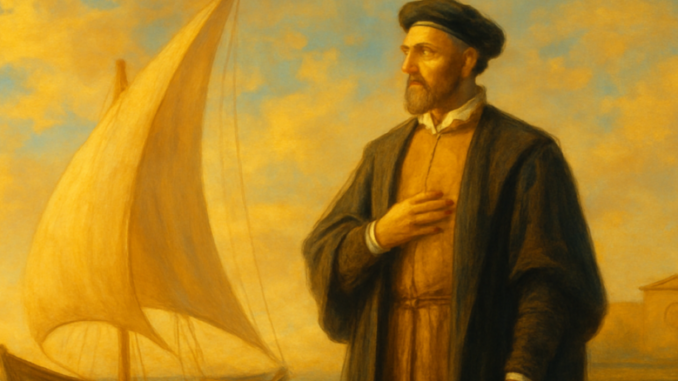
An empty table, a simple meal, a glass of water. For most people in the sixteenth century, this was daily life. Yet in his fortieth essay of the first book, Michel de Montaigne articulated an insight that remains uncomfortably relevant in our age of abundance: we lack nothing. Not because we possess everything, but because nature has already equipped us with all that is truly necessary. Modest in length but profound in scope, this essay invites us to look beyond the surface of material possession and discover the wealth already hidden within us.
The Core Idea: Nature as the Perfect Provider
In That We Lack Nothing, Montaigne argues that human beings naturally possess everything they need to live a good life. Nature, he insists, did not equip us half-heartedly. She gave us a body capable of withstanding cold and heat, a mind suited for reflection, and senses that connect us to the world around us. The problem is not that we have received too little. The problem is that we have manufactured artificial needs that blind us to our original completeness.
Montaigne is responding here to a complaint common among his contemporaries — and one that stretches back to antiquity. Pliny the Elder had already lamented that the human being enters the world naked and defenseless, unlike animals endowed with claws, fur, or wings. Montaigne turns this grievance on its head with elegant pragmatism. It is precisely the absence of fixed equipment that constitutes humanity’s greatest gift: adaptability. We are not bound to a single mode of survival but can adjust to every circumstance.
Lessons from Antiquity and the Natural World
To strengthen his point, Montaigne draws on a characteristic range of examples that reveal his eclectic way of thinking. He refers to peoples who live without clothing in harsh climates, to the Spartans who raised their children in deliberate austerity, and to the Stoic philosopher Seneca, who championed the power of simplicity. Socrates also makes an appearance — the philosopher who walked barefoot through the snow and proved that the body is capable of far more than we allow ourselves to believe.
For Montaigne, these are not mere curiosities. They serve as evidence that our supposed needs are cultural constructions rather than natural necessities. He also turns his gaze toward the animal kingdom. Animals live with what nature provides, without discontent over what they lack. A deer does not complain about the absence of claws; a fish does not mourn its lack of wings. The human being, Montaigne observes with a blend of humor and gravity, is the only creature that feels impoverished while living in abundance.
The Empty Cup as a Mirror of Inner Richness
Picture a simple cup, empty, standing on a bare table. From an everyday perspective, we see emptiness — a void, something that needs to be filled. But from another vantage point, that empty cup represents the opposite: it is available, open, receptive. It has not fallen short of anything; it is precisely what it needs to be in order to receive whatever comes. This image captures the heart of what Montaigne is trying to say. The person who views himself as incomplete sees only the emptiness. The person who recognizes that he is already equipped sees the space that allows him to grow.
Within Freemasonry, this motif resonates deeply. The rough ashlar — the symbol of a person at the beginning of their inner journey — is not defective. It is rough, certainly, but it already contains all the potential of the perfect cube. The work upon the stone is not the addition of something that is missing but the revelation of what was always already there. Seen in this light, Montaigne’s philosophical intuition and the Masonic tradition walk the same path: the starting point is not deficiency but the recognition that the core is already whole.
Whoever realizes that nature has already equipped him with everything essential no longer seeks outside himself for what can only be found within.
Contentment as a Philosophical Practice
Montaigne does not present contentment as passivity or resignation. Instead, he frames it as an active philosophical stance. The point is not that we should stop striving altogether, but that we should become conscious of the impulse behind our striving. A person who chases something out of a feeling of incompleteness will never find enough. A person who acts from the awareness that he is already whole experiences every step as enrichment rather than a desperate leap. This distinction is subtle but transformative, and it runs like a thread through many of Montaigne’s essays — just as he argues in his famous reflections on education and on solitude that inner disposition matters more than outward circumstances.
Epicurus, whom Montaigne quotes regularly, put it succinctly: the richest person is not the one who possesses the most but the one who needs the least. Montaigne connects this Epicurean insight to his own observations about the peoples of the New World, whom he describes as living in a state of natural abundance — not because they had more, but because they desired less.
A Mirror for the Modern Reader
In an era in which consumption, comparison, and the craving for more are deeply embedded in daily life, Montaigne’s message sounds almost provocative. The claim that we lack nothing runs counter to virtually every advertisement, every social media feed, and every economic incentive that surrounds us. Yet it is precisely this friction that makes the essay so valuable. It challenges us to sit with an uncomfortable question: what if “enough” has already been reached, and we simply haven’t recognized it yet?
For those familiar with Freemasonry, this question will not sound strange. Initiation into the lodge does not begin with the promise of receiving something new from outside. It begins with the recognition that something already present within the candidate is waiting to be uncovered. The ritual, the symbols, and the fellowship of the lodge are not designed to fill an emptiness — they are designed to help the initiate see what was already there. In this sense, every Freemason who takes up the gavel to work upon the rough stone is enacting, perhaps unknowingly, the very principle Montaigne describes in this essay.
Montaigne’s philosophy and the Masonic tradition share a conviction that is as simple as it is radical: the foundation for a meaningful life is not something to be acquired. It is something to be recognized. The tools are already in our hands. The stone already contains its perfect form. The cup is not empty — it is ready.
Montaigne’s brief but powerful essay reminds us that the sense of lack we carry is often a construct rather than a reality. Nature has equipped us generously; it is our artificially inflated desires that obscure this truth. For Freemasons, this insight carries a particular resonance: the work in the lodge has never been about filling a void but about chipping away at illusion to reveal the completeness that was always there. In a world that constantly tells us we need more, Montaigne’s quiet insistence that we already have enough is not just philosophy — it is a form of liberation.
Copyright text & image: devrijmetselaar.nl
Texts are based on the ideas and content of the author of devrijmetselaar.nl, reviewed, corrected, and supplemented with the assistance of OpenAI. Images are created based on the ideas of the author of devrijmetselaar.nl using OpenAI/DALL-E.
Frequently Asked Questions
What is Montaigne's main argument in 'That We Lack Nothing'?
Montaigne argues that human beings naturally possess everything they need to live a good life because nature has equipped us with a capable body, a reflective mind, and senses to connect with the world. He contends that the real problem is not insufficient provision from nature, but rather that we have created artificial needs that blind us to our original completeness and sufficiency.
How does Montaigne respond to the ancient complaint that humans are born defenseless?
Rather than accepting Pliny the Elder's lament that humans lack the natural defenses of other animals (claws, fur, wings), Montaigne reframes this apparent weakness as humanity's greatest strength. He argues that our lack of fixed equipment gives us adaptability—we are not bound to a single mode of survival but can adjust to every circumstance and environment.
What examples does Montaigne use to support his philosophy of natural sufficiency?
Montaigne draws on diverse historical and cultural examples including peoples who live without clothing in harsh climates, the austere child-rearing practices of the Spartans, the Stoic philosopher Seneca's advocacy for simplicity, and Socrates walking barefoot in the snow. He also observes that animals live contentedly with what nature provides without lamenting what they lack, suggesting that our perceived needs are cultural constructions rather than natural necessities.

Be the first to comment