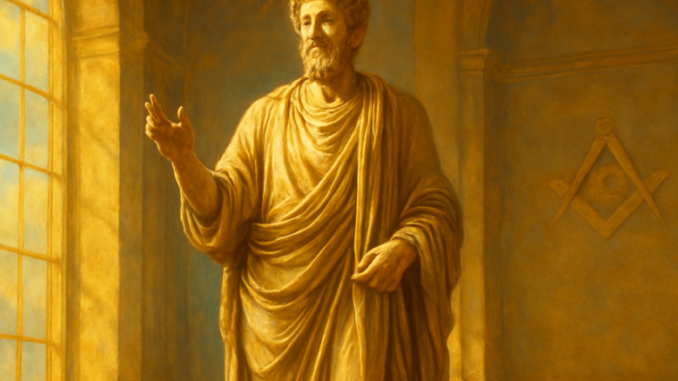
In 175 AD, amid grueling military campaigns along the Danube frontier, Emperor Marcus Aurelius penned his private reflections on prayer and the human relationship with something greater. These passages from the ninth book of his Meditations are not a theological treatise but an inner dialogue rooted in centuries-old philosophical traditions. The question he posed to himself reverberates across the ages, reaching into the ritual spaces of modern lodges: what does it truly mean to direct yourself toward something larger than yourself?
The Stoic View of the Divine
To understand what Marcus Aurelius meant by prayer, we need to return to the foundations of Stoicism. This philosophical school, founded by Zeno of Citium around 300 BC, developed a distinctive vision of the divine. The Stoics did not believe in anthropomorphic gods who granted favors in response to supplication. Instead, they saw the universe as permeated by a rational principle — the logos — that ordered and connected all things. This principle was both immanent and transcendent: it operated within everything while simultaneously being the source of all order.
For Marcus Aurelius, prayer was therefore never a request for personal gain. It was an exercise in attunement to this cosmic order. When he wrote about “the higher,” he did not mean a personal deity who listened and answered. He meant the recognition that the human soul is a spark of that same universal fire which animates all existence. Prayer thus became a form of philosophical contemplation — a moment of inner stillness in which the wise person remembered what truly mattered.
Seneca and Epictetus: The Voices That Shaped an Emperor
Marcus Aurelius drew directly from the work of his Stoic predecessors. Seneca, the Roman statesman and philosopher, had already written extensively about the relationship between humanity and the divine. In his Letters to Lucilius, Seneca stressed that the gods had no need for flattery and that prayer ought to serve as a means of shaping one’s own mind. A well-known passage reads: “Wish for nothing except what you can achieve through virtue.” This idea resonates powerfully in Book IX, where Marcus Aurelius suggests that true piety lies in accepting what comes rather than begging for change.
Epictetus, the former slave who became one of the most influential Stoic teachers, exerted an even more direct influence. His Enchiridion and Discourses formed the philosophical education of the young Marcus Aurelius. Epictetus taught that only our own judgments and actions lie within our power, while external events do not. Prayer directed toward the higher became, in this light, a reminder of that fundamental truth — not an attempt to change the world, but an effort to transform one’s own attitude toward it.
Plato’s Shadow and the Legacy of Greek Thought
Although Marcus Aurelius was primarily a Stoic, his thinking also carried traces of older Greek traditions. Plato’s Theory of Forms, in which the visible world is merely a shadow of a higher reality, influenced the Stoic conception of the logos. The notion that behind appearances lies a deeper order connects these traditions across centuries. When Marcus Aurelius writes about the higher, we hear the echo of Plato’s cave allegory: the wise person turns away from shadows and directs the gaze toward the light.
Aristotle’s concept of the Unmoved Mover — a first cause that itself remains unmoved — also operates in the background. The Stoic worldview combined these philosophical inheritances into a coherent whole in which human beings could find their place, not as slaves to capricious gods, but as participants in a rational cosmos.
A Philosopher-Emperor in a Time of Crisis
The reflections on prayer in Book IX did not emerge from academic tranquility. They were forged in the chaos of war and pestilence. Marcus Aurelius governed during the Antonine Plague, which claimed millions of lives, and waged years-long campaigns against Germanic tribes pressing against the empire’s northern borders. In this context, his meditations on the higher carry an urgent weight. How could a person stand firm when everything around him was collapsing?
The answer he found lay not in magical thinking or desperate supplication, but in philosophical discipline. The Meditations were never intended for publication. They were personal notes, written in a campaign tent after days of battle and decision-making. This is precisely what makes them so striking. Here speaks not a philosopher preaching from a lectern, but a human being wrestling with the questions that occupy us all: What is the meaning of all this? How do I relate to forces greater than myself?
Remarkable Parallels with Freemasonry
The way Marcus Aurelius approached the higher bears a remarkable kinship with the approach found within Freemasonry. In the Craft, no specific religion stands at the center. Instead, there is the acknowledgment of an ordering principle, often referred to as the Grand Architect of the Universe. This concept is deliberately kept abstract so that brethren from diverse religious backgrounds can recognize themselves in it.
The ritual work within the lodge contains moments of silence and contemplation that are functionally comparable to Stoic prayer. These are not petitions for personal advantage but opportunities for self-reflection and alignment with higher values. The symbolism of the temple — in which roughness is refined into beauty — mirrors the Stoic ideal of a person who shapes himself according to a higher model.
Several key parallels stand out between these two traditions. Both emphasize personal responsibility over reliance on external help. Both view the higher as an ordering principle rather than an intervening deity. And both value ritual moments of silence as instruments for self-development. These are not superficial resemblances but structural affinities rooted in a shared philosophical heritage that prizes inner transformation above outward petition.
What the Stoic Past Teaches Us Today
The philosophical background of Book IX reveals that Marcus Aurelius was not inventing something new when he wrote about prayer. He was drawing on a tradition stretching back at least five centuries before his time — one that sought to understand the human relationship with the cosmos without relying on superstition or blind faith. His approach was rational yet reverent, disciplined yet deeply personal.
For Freemasons today, this Stoic heritage offers a powerful lens through which to understand their own rituals and symbols. The moments of silence in the lodge, the invocation of the Grand Architect, and the emphasis on moral self-improvement all echo themes that Marcus Aurelius explored alone in his tent nearly two thousand years ago. They remind us that the search for meaning and the desire to align oneself with something higher are not relics of the past but enduring features of the human experience.
Stoic prayer, as Marcus Aurelius understood it, was never about asking the universe for favors. It was about cultivating the inner freedom to accept reality as it is and to act virtuously within it. That aspiration — quiet, disciplined, and profoundly humbling — remains as relevant in the twenty-first century as it was on the banks of the Danube in 175 AD.
Marcus Aurelius left us no system of prayer and no liturgy. What he left was something arguably more valuable: the example of a man who, in the most extreme circumstances, turned inward and sought alignment with a principle greater than himself. Whether we call that principle the logos, the Grand Architect of the Universe, or simply the order that underlies all things, the impulse is the same. It is the impulse at the heart of Stoicism and at the heart of Freemasonry — not to beg for a better world, but to become a better person within it.
Copyright text & image: devrijmetselaar.nl
Texts are based on the ideas and content of the author of devrijmetselaar.nl, reviewed, corrected, and supplemented with the assistance of OpenAI. Images are created based on the ideas of the author of devrijmetselaar.nl using OpenAI/DALL-E.

Be the first to comment