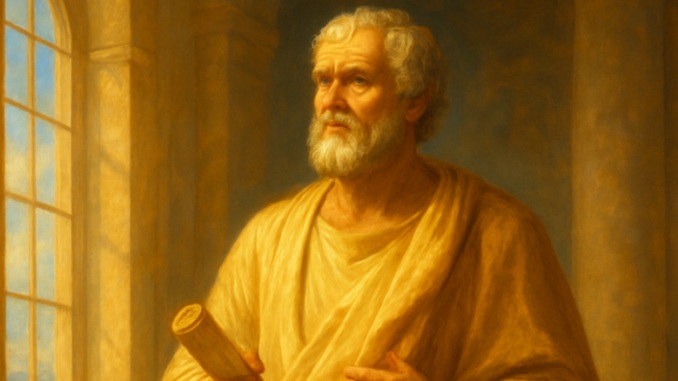
Few subjects cut as deeply into the human condition as the question of death and the moment it arrives. In his seventieth letter to Lucilius, the Roman philosopher Lucius Annaeus Seneca addresses this theme with a candor that still moves and challenges readers today. Letter LXX stands as one of the most penetrating texts in the Stoic tradition on mortality, dignity, and the question of who ultimately decides when life ends — questions that resonate far beyond the ancient world and into the reflective spaces where seekers of meaning still gather.
The Core Idea: Freedom to the Very End
Seneca opens Letter LXX with a deceptively simple observation: life is neither good nor bad because of its length, but because of its quality. This thought, echoing throughout the entire letter, forms the foundation of his argument about death. For Seneca, death is not an enemy to be fought but a boundary that gives life its meaning. The wise person does not fear death because he understands that dreading the inevitable is pointless.
The central theme of this letter, however, is more controversial than that general wisdom might suggest. Seneca raises the question of whether a person has the right to determine the moment of their own death. In an era when disease, slavery, or political persecution could render life unbearable, this was no abstract philosophical exercise — it was an urgent, practical question.
Two Perspectives on the End of Life
To understand Seneca’s position, it helps to set two fundamentally different viewpoints side by side. On one hand, there is the perspective that life is a gift we must not end ourselves — a view that would later come to dominate many religious traditions. On the other hand stands the Stoic conviction that Seneca represents: life is valuable as long as it can be lived virtuously, and a person always retains the freedom to choose.
As Seneca puts it, the wise person does not live as long as he can, but as long as he ought. He weighs the quality of his life, not its quantity. This is a distinction that cuts to the heart of what it means to live deliberately.
Seneca emphasizes that this freedom does not imply recklessness. On the contrary: precisely because death is always an option, every day we choose to live gains additional weight. The Stoic who knows he can depart but stays does so from strength, not weakness. This sharply distinguishes his position from despair or cowardice.
Examples from Antiquity
Seneca illustrates his argument with several historical examples that would have been familiar to his contemporaries. He references gladiators who chose in the arena to take their fate into their own hands, and slaves who, despite their captivity, preserved their inner freedom by making the ultimate choice. These examples are not meant to encourage imitation but to demonstrate that the human spirit cannot be entirely chained.
Particularly striking is his reference to Cato the Younger, the Roman statesman who, after his defeat by Caesar, chose not to live in subjugation. For Seneca, Cato embodies the ideal of a person who remains true to his principles to the very end. Whether one agrees with Cato’s choice or not, his consistency commands respect.
What the Stoic and the Seeker Share
Although Stoic philosophy and other philosophical and spiritual traditions often reach different conclusions about the end of life, they share a fundamental truth: death is inevitable and deserves our attention. Those who reflect on mortality, who meditate on the finite nature of existence, live more consciously. This insight connects the ancient philosopher with everyone today who seeks deeper meaning — whether in a lodge room, a study, or a quiet moment of personal contemplation.
Seneca’s letter invites reflection without moralizing. He acknowledges that not everyone will draw the same conclusions, but he insists that we take the question seriously. In a culture that often hides death away, that insistence alone is valuable. Confronting our mortality can help us see more clearly what truly matters.
Why Letter LXX Still Matters Today
Letter LXX continues to speak to modern readers because the questions Seneca asks are universal. How do we want to live? What makes a life worthy? And who ultimately has the right to decide when enough is enough? These are questions that surface repeatedly in medical ethics debates, in personal reflection, and in philosophical conversations.
The key themes Seneca draws out remain strikingly relevant: quality of life over quantity, inner freedom as the highest good, conscious reflection on mortality, and the courage to ask difficult questions. These are not dusty relics of ancient thought — they are living concerns that shape how we understand ourselves and the world around us.
Seneca does not write to convince us of one correct answer. He writes to shake us awake, to compel us to examine what we take for granted. That philosophical method — the questioning of assumptions — may be the greatest legacy of this letter. It is not the answer but the question itself that enriches us.
Nearly two thousand years after it was written, Seneca’s Letter LXX remains a text that touches and provokes. The Stoic philosopher invites us not to fear death but to understand it, not to deny it but to integrate it into our thinking about the good life. Whether we share his conclusions or not, the honesty with which he poses the ultimate questions deserves our attention. In a world that often makes death unspeakable, Seneca reminds us that it is precisely the confrontation with finitude that teaches us what it truly means to live.
Copyright text & image: devrijmetselaar.nl
Texts are based on the ideas and content of the author of devrijmetselaar.nl, reviewed, corrected, and supplemented with the assistance of OpenAI. Images are created based on the ideas of the author of devrijmetselaar.nl using OpenAI/DALL-E.


Be the first to comment