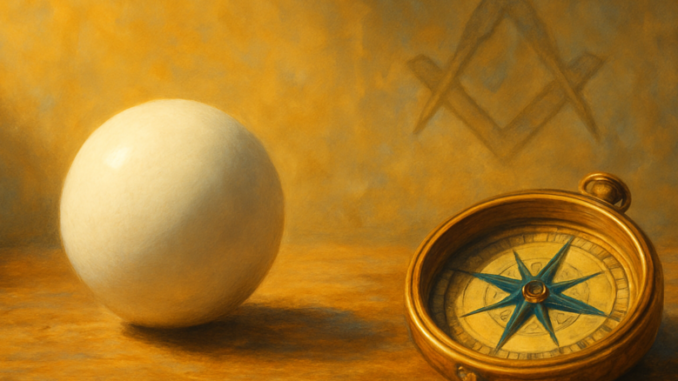
When the lottery balls roll and cup draw matchups are revealed, an entire nation reacts. A giant is paired with an underdog. A modest amateur club earns the right to dream of hosting one of the biggest teams in the country. “Pure chance,” we say with a shrug. But is it really? Behind every drawn lot lies an ancient question that has occupied philosophers, mystics, and Freemasons for centuries: does chance truly exist, or is everything that happens to us part of a larger, invisible pattern?
The Paradox of Fate
Here is the central proposition worth exploring: human beings claim not to believe in fate, yet constantly behave as though fate governs their lives. A cup draw is an everyday but striking example. Supporters speak of luck or misfortune at the draw, as though some higher power determines who faces whom. At the same time, everyone knows it is a random mechanism — statistics without intention. That contradiction is fascinating. Somewhere, deep within the human mind, a conviction lingers that nothing is ever truly random.
The Roman philosopher Seneca wrote extensively about fate. He warned that anyone who lets their happiness depend on external circumstances makes themselves a slave to fortune. The Stoics did not regard fate as punishment or reward, but as a neutral force against which one must build inner resilience. What mattered was not what happened to you, but how you responded to it. A lesson every sports fan might consider when the draw goes against them — but one that carries a far deeper spiritual dimension.
Chance as a Spiritual Exercise
Within Freemasonry, the concept of chance occupies a distinctive position. In ritual work, nothing is left to chance: every gesture, every word, and every position in the lodge is deliberate and charged with meaning. It is precisely by banishing randomness from the ritual that the Freemason learns to look more carefully at what he considers “chance” in daily life. Is an encounter truly coincidental? Is a setback genuinely random? Or does every event contain a possibility for growth that we only recognize when we are willing to listen?
A cup draw offers a surprising mirror here. When a small amateur club is paired with one of the nation’s powerhouses, something emerges that you might call a spiritual moment — not in a religious sense, but in the sense of wonder. The small meets the great. The ordinary touches the extraordinary. In such moments, a cup competition becomes more than sport: it becomes a parable about life itself, in which any person, regardless of their position, may unexpectedly find themselves standing before something far larger than themselves.
Equality on the Pitch and in the Lodge
There is another parallel worth contemplating. A cup competition is one of the few arenas in sport where hierarchy is temporarily suspended. League standings are irrelevant: the reigning champion and the fourth-division club stand as equals before the lottery ball. This principle of equality, regardless of rank or status, is one of the cornerstones of Freemasonry. When brethren enter the lodge, they leave their social positions behind. The CEO stands beside the carpenter, the professor beside the baker. Not as a gesture, but as a living principle.
Johann Wolfgang von Goethe, himself a devoted Freemason, wrote that a person only becomes truly free when they detach from the external circumstances that define them. Goethe did not view chance as the enemy of order, but as a necessary force that compels adaptation, creativity, and inner growth. A cup draw does precisely the same thing on a smaller scale: it forces teams to adapt to an opponent they did not choose. And it is exactly in that adaptation — in accepting what comes — that a form of spirituality emerges which reaches far beyond the playing field.
Spirituality begins where a person experiences the unexpected not as a threat, but as an invitation to grow.
The Counterpoint: Is Finding Meaning Just Self-Deception?
Naturally, this line of reasoning deserves a critical counterweight. A skeptic would argue that assigning spiritual meaning to a simple draw is a form of self-deception. The balls roll, the numbers fall, and there is nothing mysterious about it. Baruch Spinoza, the great Dutch philosopher of the seventeenth century, argued that what people call chance is merely a lack of knowledge about the causes of events. There is no hidden hand guiding the balls — only natural laws we do not fully comprehend.
And yet: even if Spinoza is right, even if chance is nothing more than a gap in our knowledge, the human tendency to assign meaning to it remains a phenomenon worthy of attention. For it is precisely that tendency that makes us human. Freemasonry acknowledges this without turning it into dogma. It does not prescribe belief in fate or providence, but encourages each brother to examine, question, and deeply engage with his own experiences. The lodge is not a church that provides answers — it is a workshop that keeps questions open.
The Game as a Mirror
When a top club faces a lower-division side in the cup, when players step onto the pitch knowing they are outmatched in every measurable way, something unfolds that is larger than sport alone. It is a ritual in its own right: two groups entering a bounded space, submitting to established rules, and accepting the outcome that emerges. The parallel with Masonic ritual is not literal, but neither is it far-fetched. In both cases, participants enter a structured environment where ordinary hierarchies are set aside, where the rules apply equally to all, and where the outcome — whatever it may be — must be met with dignity and grace.
The cup draw reminds us that life rarely follows the script we write for it. Plans are disrupted. Expectations are overturned. The underdog triumphs and the favorite stumbles. Freemasonry does not teach its members to control these forces, but to meet them with equanimity, curiosity, and an open heart. In that sense, every unexpected twist — whether on the pitch, in the lodge, or in life — is not an obstacle but an opportunity. An opportunity to practice what the Stoics preached, what Goethe embodied, and what the Masonic tradition continues to cultivate: the art of responding wisely to whatever fate places before us.
The next time lottery balls determine an improbable matchup — in sport, in business, or in life — consider pausing before dismissing it as mere chance. The question is not whether fate is real or imagined. The question is what you do with the hand you are dealt. Freemasonry offers no definitive answer to the mystery of chance, but it provides something perhaps more valuable: a framework for living with that mystery, for finding meaning without certainty, and for meeting the unknown not with fear but with the quiet confidence of someone who understands that growth begins precisely where control ends.
Copyright text & image: devrijmetselaar.nl
Texts are based on the ideas and content of the author of devrijmetselaar.nl, reviewed, corrected, and supplemented with the assistance of OpenAI. Images are created based on the ideas of the author of devrijmetselaar.nl using OpenAI/DALL-E.
Frequently Asked Questions
What is the central paradox about fate and chance discussed in this article?
The article explores the contradiction that humans claim not to believe in fate, yet consistently behave as though fate governs their lives. Using cup draws as an example, people speak of luck or misfortune despite knowing the mechanism is random. This suggests that deep within the human mind, there exists a conviction that nothing is truly random, even when we acknowledge statistical randomness.
How does Freemasonry view the concept of chance differently from everyday life?
In Freemasonry, chance is deliberately banished from ritual work—every gesture, word, and position is deliberate and meaningful. By eliminating randomness from ritual practice, Freemasons learn to examine what they consider 'chance' in daily life more carefully. This encourages them to question whether encounters are truly coincidental or if every event contains a possibility for spiritual growth and learning.
What lesson from Stoic philosophy does the article suggest for sports fans facing unfavorable cup draw outcomes?
The article references the Roman philosopher Seneca's Stoic teachings, which suggest that what matters is not what happens to you, but how you respond to it. Rather than letting happiness depend on external circumstances like a cup draw outcome, people should build inner resilience. This principle applies both to sports and carries a deeper spiritual dimension about accepting fate with equanimity.

Be the first to comment