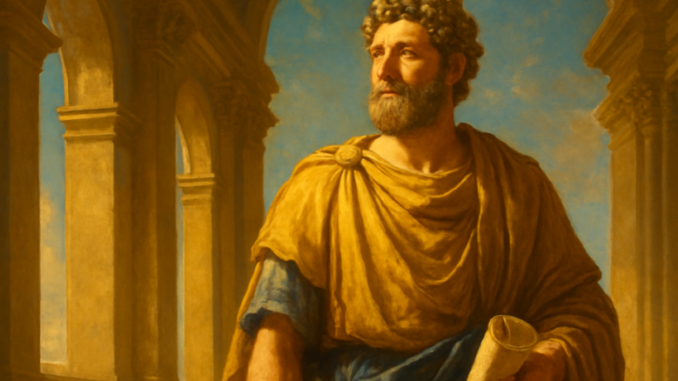
Somewhere around 173 AD, amid military campaigns along the Danube, a Roman emperor sat down by candlelight to write his thoughts. Not for publication, not for fame, but as an exercise in inner discipline. Marcus Aurelius knew that external circumstances could be stripped from him at any moment — his throne, his health, even his life. But one thing no one could take away: his character. In the sixth book of his Meditations, he distills this insight into a philosophical core that still resonates today, not least within Freemasonry.
The Historical Context of Book VI
To truly understand Book VI, we must transport ourselves to the Roman Empire in the second century. Marcus Aurelius ruled from 161 to 180 AD, a period marked by plague, frontier wars, and internal instability. Unlike the philosophers of his day, who could contemplate in relative tranquility, this Stoic emperor wrote his reflections quite literally on the battlefield. The Meditations are not a systematic treatise but a collection of personal notes, originally titled Ta eis heauton — “To Himself.”
Book VI was most likely composed during the Marcomannic Wars, when the emperor confronted mortality on a massive scale. It is precisely within this chaos that he seeks an anchor in one central principle: virtue as the only thing of true value. Everything beyond our control, he termed “indifferent” — not worthless, but unsuitable as a foundation for happiness.
The Core Idea: Virtue as a Compass
The central theme of Book VI can be distilled into a single conviction: only virtue is truly good, and only its absence is truly harmful. Wealth, health, reputation, and even life itself are not ends in themselves, but circumstances within which virtue can be practiced. Marcus Aurelius follows the Stoic tradition of Epictetus and Seneca here, but gives it a deeply personal, almost meditative quality.
Virtue is not a trait you possess — it is a choice you make anew in every moment.
Throughout various passages, the emperor reminds himself that external circumstances cannot truly harm him so long as he guards his inner disposition. An insult inflicts no pain; it is our interpretation that creates suffering. A setback is not a catastrophe; it is an opportunity to demonstrate steadfastness. This reframing lies at the very heart of Book VI.
Vivid Images from the Text
Marcus Aurelius develops his philosophy through concrete examples and striking imagery. He compares human life to a droplet in the ocean of time, to a grain of wheat in the immensity of the cosmos. These cosmic reflections are not meant to diminish humanity, but to offer perspective. If everything is transient, why cling to transient things?
Particularly compelling is his image of the river: thoughts, events, and lives flow past like water. Whoever clings to a single moment drowns. Whoever moves with the current while maintaining an inner course navigates successfully. Virtue functions here as the rudder, not the destination. What matters is how we sail, not which harbor we reach.
The four cardinal virtues that emerge throughout Book VI mirror those that have echoed across centuries of moral philosophy:
- Justice: Acting according to what is right, regardless of personal gain.
- Temperance: Taking no more than necessary, in possessions and in judgment.
- Courage: Standing firm when the world around you falters.
- Wisdom: Discerning what lies within our power and what does not.
Virtue and Freemasonry: A Hidden Kinship
Although Marcus Aurelius lived eighteen centuries before modern Freemasonry took shape, his thinking resonates remarkably with the principles of the Craft. Freemasonry prescribes no dogma, but it does offer a moral orientation. The work upon the rough ashlar — the central symbol of personal improvement — mirrors precisely what Marcus Aurelius describes: the continual refining of one’s character.
Just as the Stoic views virtue as a daily exercise, the Freemason regards self-improvement as a lifelong process. The square and compasses, symbols of righteousness and self-discipline, are visual expressions of the same principles the Roman emperor committed to words. Where Marcus Aurelius writes about walking the straight path, the Freemason speaks of laying a true foundation.
This kinship runs deeper than surface symbolism. Both traditions insist that moral development is not something that happens to you — it is something you do, deliberately and repeatedly. The lodge room, like the emperor’s private journal, is a space where one confronts oneself honestly, stripped of pretense and social masks. Both the Stoic and the Mason understand that the most demanding work is interior work.
From the Ancient World to the Present Day
What does Book VI teach us today? In a world that often revolves around external validation, social status, and material accumulation, Marcus Aurelius offers a radical alternative. His message is not that these things are worthless, but that they cannot serve as the foundation for a good life. Whoever builds their identity on fluctuating circumstances builds on sand.
The modern reader can apply these insights directly. In times of adversity: do not ask why this is happening to you, but how you can respond in a way that strengthens your character. In times of success: enjoy the moment, but do not identify with the outcome. You are not your achievements — you are the manner in which you handle both achievement and disappointment.
For Freemasons, this message carries an additional layer of meaning. Every lodge meeting, every ritual, every moment of reflection is an invitation to practice the same discipline Marcus Aurelius exercised by candlelight on the Danube. The tools may differ, but the work is the same: shaping oneself into something more just, more temperate, more courageous, and more wise.
The Enduring Relevance of Inner Freedom
Marcus Aurelius wrote for himself, but he spoke for the ages. His Book VI is not a historical curiosity — it is a living text that invites reflection. The Freemason who reads these words recognizes the call to self-development, to the building of an inner edifice capable of withstanding storms. The seeker who looks for wisdom beyond the lodge doors finds here a compass that has been functioning for nearly two thousand years.
Inner freedom, for Marcus Aurelius, was not an escape from reality but a way of engaging with it more fully. As emperor and soldier, he demonstrated that this freedom is possible even in the midst of chaos. His insights find their echo in Freemasonry, where working upon the rough stone demands the same devotion, the same patience, and the same honesty.
Book VI of the Meditations reminds us that virtue is not an abstraction — it is a daily practice. The question Marcus Aurelius leaves us with is not whether we understand his philosophy, but whether we are willing to live it. Not tomorrow, but today. Not under ideal circumstances, but precisely in the circumstances we find ourselves in right now. That is the true challenge — and the true reward — of both Stoic philosophy and the Masonic journey.
Copyright text & image: devrijmetselaar.nl
Texts are based on the ideas and content of the author of devrijmetselaar.nl, reviewed, corrected, and supplemented with the assistance of OpenAI. Images are created based on the ideas of the author of devrijmetselaar.nl using OpenAI/DALL-E.
Frequently Asked Questions
What is the main theme of Marcus Aurelius's Book VI of Meditations?
The central theme of Book VI is that virtue is the only true good and the only reliable foundation for happiness. Marcus Aurelius argues that external circumstances—wealth, health, reputation, and even life itself—are 'indifferent' and should not be the basis of our well-being. Instead, virtue is a choice made anew in every moment, and it is the only thing no one can take from us.
When and why did Marcus Aurelius write Book VI of Meditations?
Book VI was most likely written around 173 AD during the Marcomannic Wars along the Danube, when Marcus Aurelius was confronting mortality and chaos on a massive scale. Unlike other philosophers who had the luxury of peaceful contemplation, this Roman emperor wrote his reflections quite literally on the battlefield as a personal exercise in inner discipline and a means to anchor himself in virtue.
How does Marcus Aurelius's philosophy relate to Freemasonry?
According to the article, Marcus Aurelius's insights in Book VI about virtue as a compass and inner discipline resonate within Freemasonry. His principle that character is the only thing that cannot be stripped away, and that virtue must be practiced anew in every moment, aligns with Masonic teachings about self-improvement, moral development, and the cultivation of inner strength independent of external circumstances.



Be the first to comment