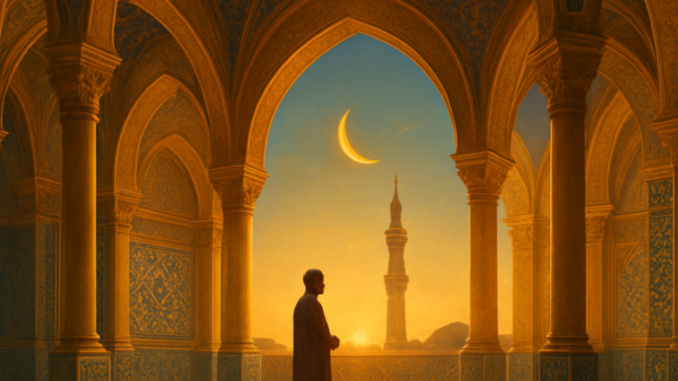
Imagine leaving behind everything you know — your family, your security, every familiar comfort. Not out of despair, but from a deep inner conviction that something greater awaits, something worth dedicating your entire life to. This is exactly what the patriarch Abraham did, and his story continues to resonate across three world religions to this day. In Surah Ibrahim, the fourteenth chapter of the Quran, we find a rich spiritual source with striking parallels to the inner journey that Freemasons know so well. Let us explore what this ancient narrative still has to teach us.
The Heart of Surah Ibrahim
Surah Ibrahim bears the name of the great patriarch for good reason. Abraham — known as Ibrahim in Arabic — symbolizes unconditional trust and the willingness to devote one’s entire existence to a higher truth. The surah opens with a powerful statement about light and darkness, describing how people are guided from darkness into light. This is a theme every Freemason will immediately recognize.
Revealed in Mecca and comprising 52 verses, the surah centers on a call to gratitude and the awareness that everything we possess has been bestowed upon us. Abraham appears here not as an abstract figure from a distant past, but as a living example of someone who follows his inner truth — even when that path invites misunderstanding and opposition.
From Darkness to Light: A Universal Theme
Perhaps you recognize this experience: you find yourself in a season of life where everything seems unclear. Questions multiply, certainties crumble. The Quran uses the image of darkness for such moments. But Surah Ibrahim offers perspective. Its opening verse speaks of a book revealed to lead people from darknesses into light. Notice the deliberate choice of words: darknesses in the plural, light in the singular. There are many forms of confusion and ignorance, but there is one light that illuminates everything.
The journey from darkness to light is not a one-time event but a continuous process of inner growth and awakening. For Freemasons, this theme runs to the very core of the Craft. The initiation ritual itself symbolizes this transition: the candidate enters the lodge blindfolded and ultimately receives the light. This is no coincidental parallel. Both the Islamic tradition and Freemasonry draw from the same primordial sources of human spiritual experience — the universal longing to move from ignorance toward understanding.
Abraham as Builder
What makes Abraham so remarkable that three major religions claim him as a spiritual father? Surah Ibrahim provides a key. Abraham is portrayed here as someone who builds. Not only physically — by restoring the Kaaba together with his son Ishmael — but above all spiritually. He builds a community, a tradition of monotheism, a legacy that endures to this day.
Freemasonry identifies itself as a fellowship of symbolic builders. Where the operative masons of old erected cathedrals and temples of stone, Freemasons work on the inner temple: character, soul, and moral compass. Abraham does the very same thing. His construction project is not a building of stone but a foundation of trust and surrender that transcends generations.
This parallel between Abraham’s building work and the Masonic concept of building the inner temple is one of the most compelling connections between Surah Ibrahim and the Craft. Both traditions recognize that the most enduring structures are not made of physical materials but of spiritual conviction and moral integrity.
Abraham’s Prayer: Gratitude and Connection
In verses 35 through 41 of Surah Ibrahim, we encounter a deeply moving prayer. Abraham asks for protection for his descendants, gives thanks for the blessings he has received, and acknowledges his own shortcomings. This prayer is no display of piety — it is the authentic expression of someone who understands that he is part of something far greater than himself.
He asks for safety for the city he founded. He prays for his children and their children after them. He acknowledges that only the Divine truly knows what lives in the human heart. He asks forgiveness for himself and for his parents. This attitude of gratitude and interconnectedness is precisely what Freemasons strive for in their work. The lodge is not a place for ego or self-interest but a space where brothers support one another in their shared pursuit of truth and self-improvement.
The Good Tree: A Symbol of Inner Growth
One of the most frequently cited images from Surah Ibrahim is that of the good tree. In verse 24, a good word is compared to a tree whose roots are firmly planted in the earth and whose branches reach toward the heavens. This tree bears fruit continuously. In contrast stands the bad tree, which has no stability and is easily uprooted.
This image speaks to anyone engaged in personal development. Ask yourself: how deep are my roots? Do I stand firmly in my values, or am I toppled by every gust of wind? Freemasonry offers practical tools to strengthen those roots — self-reflection, brotherly counsel, and the ongoing work of shaping the rough ashlar into a polished stone. The good tree is a powerful metaphor for the kind of character that Masonic work aims to cultivate: grounded, resilient, and ever-reaching toward the light.
Spirituality as Common Ground
Freemasonry is not a religion and makes no claims about which faith is the correct one. What Freemasons do share is the conviction that a higher reality exists, often referred to as the Grand Architect of the Universe. This openness makes it possible for Muslims, Christians, Jews, and people of many other backgrounds to work together on their spiritual development within the lodge.
Surah Ibrahim reminds us that the figure of Abraham is a shared heritage. He is not the exclusive property of any single tradition but a unifying figure who invites us to look beyond superficial differences. In a world that often seems divided along lines of religion, culture, and ideology, this is a lesson of immense value. Abraham’s story belongs to all seekers of truth, regardless of the specific path they walk.
When you read Surah Ibrahim through the eyes of a seeker, a timeless story unfolds — one of trust, inner growth, and the commitment to building something that transcends the self. Abraham left behind his certainties and discovered something far more precious: a life dedicated to truth and connection. Freemasons recognize in this story the echoes of their own journey from darkness to light, from the rough stone to the polished ashlar, from the individual self to a brotherhood united in purpose. In the figure of Abraham, the builder of faith and inner light, we find an enduring invitation to keep building — not with stone and mortar, but with integrity, gratitude, and an unwavering orientation toward the light.
Copyright text & image: devrijmetselaar.nl
Texts are based on the ideas and content of the author of devrijmetselaar.nl, reviewed, corrected, and supplemented with the assistance of OpenAI. Images are created based on the ideas of the author of devrijmetselaar.nl using OpenAI/DALL-E.
Frequently Asked Questions
What are the main parallels between Surah Ibrahim and Freemasonry?
Both traditions share the central theme of the journey from darkness to light as a symbol of spiritual awakening and inner growth. In Freemasonry, this is represented through initiation rituals where candidates enter blindfolded and receive light. Similarly, Surah Ibrahim opens with verses about guiding people from darknesses into light, emphasizing continuous inner development rather than a single transformative moment.
Why does Surah Ibrahim use the word 'darknesses' in plural and 'light' in singular?
This deliberate linguistic choice reflects the idea that there are many forms of confusion, ignorance, and spiritual uncertainty (darknesses), but only one unified truth or divine light that illuminates everything. This distinction emphasizes that while we may encounter multiple obstacles to understanding, spiritual enlightenment is singular and all-encompassing.
Who was Abraham, and what is his significance in Surah Ibrahim?
Abraham (Ibrahim in Arabic) is presented in the surah as a patriarch who exemplifies unconditional trust and devotion to a higher truth. Rather than being an abstract historical figure, he serves as a living example of someone who follows his inner conviction despite facing misunderstanding and opposition, making his story a powerful template for spiritual commitment and faith across three world religions.

Be the first to comment