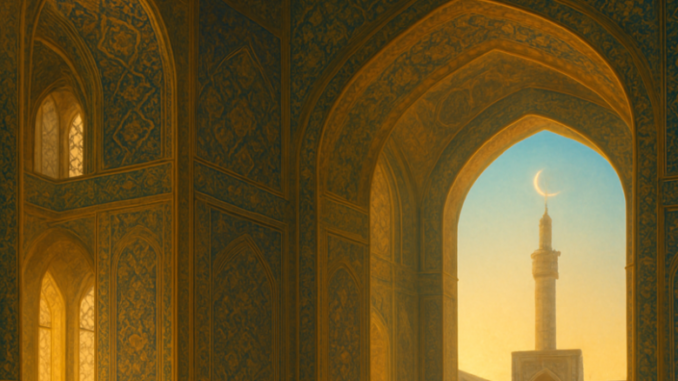
What truly makes a person valuable? Is it the glitter of gold and silver, the grandeur of palaces, or does real wealth reside somewhere deeper? These questions lie at the heart of Surah 43 of the Quran, known as Az-Zukhruf — The Ornaments. It is a text that invites us to look beyond the surface and rediscover the essence of spiritual growth. For Freemasons, who are equally concerned with distinguishing appearance from reality, this surah offers remarkably resonant insights.
Why Is This Surah Called The Ornaments?
The name refers to the gold and silver ornaments mentioned in the text as symbols of worldly wealth. But there is a paradox at work: the surah uses these very images to demonstrate how fleeting material splendor truly is. The Arabic word Az-Zukhruf denotes ornamentation, embellishment, decoration. The surah poses a striking question: if we could build houses of gold, would we actually be happier? The answer that reverberates through the text is unmistakable — no. True ornamentation is not what you accumulate around you, but what you cultivate within.
This theme resonates deeply across the spiritual traditions of many cultures. The philosopher Plato warned in his Allegory of the Cave about confusing shadows with reality. Spinoza emphasized that true joy lies not in external possessions but in understanding our place within the greater whole. The Ornaments aligns with this universal wisdom, speaking a language that transcends any single tradition.
What This Surah Teaches About Inner Richness
The surah delivers a powerful message about the value of wisdom over possessions. It speaks of prophets who were rejected by their contemporaries, often because those prophets carried no outward signs of royal splendor. The message is clear: spiritual guidance does not arrive adorned with crowns or jewels — it comes through insight and character. This echoes a truth that stands at the very center of Freemasonry: the rough stone must be worked upon, not gilded.
True ornamentation is not what the world sees on you, but what your soul builds in silence.
In Freemasonry, we know the symbol of the rough ashlar being shaped into the perfect ashlar. This process of refinement is not about outward embellishment — it is about inner transformation. The parallels with The Ornaments are striking: both traditions warn against the seduction of superficial shine and point toward a deeper form of beauty, one that can only be achieved through sustained inner work.
The Masonic Concept of Light and Its Echo in This Surah
One of the most recognizable themes in Freemasonry is the search for light. This light is not a physical glow but symbolizes knowledge, truth, and moral clarity. In The Ornaments, we find a remarkably similar movement: the text calls upon us to look beyond the dazzle of gold and to seek the true light of divine guidance.
The surah also mentions the prophet Ibrahim (Abraham), revered in Islamic, Jewish, and Christian traditions alike as a seeker of truth. Ibrahim turned away from idols and outward grandeur to find a purer understanding. This path of seeking — this shedding of false certainties — is precisely what a Freemason undergoes during his initiatory journey. The blindfold that is removed symbolizes the moment when illusion gives way to insight, when the candidate moves from darkness into light.
Does This Text Also Speak to Brotherhood?
Indirectly, it does — and powerfully so. The Ornaments critiques social hierarchies built on wealth and status. The text asks: why should a messenger of God only be deemed credible if he lives in a palace? This critique of status-based authority touches on a core principle of Freemasonry: within the lodge, all brethren are equal, regardless of their social standing outside the temple doors.
Consider the values these traditions share: the equality of all members within the ritual space, the appreciation of character over capital, and the emphasis on inner virtue as the true measure of a person. These principles can also be found in the writings of Enlightenment thinkers who profoundly influenced Freemasonry, such as Voltaire and Montesquieu. They championed a society where merit mattered more than birth. The Ornaments, written many centuries earlier, carries a kindred message.
What Can We Take From This Ancient Text Today?
In a world that often revolves around outward success, social media perfection, and material status symbols, The Ornaments offers a countervoice. The surah invites genuine self-reflection: which ornaments in our lives are truly valuable, and which ones distract us from what really matters? This is not a question that belongs exclusively to any single religion or tradition. It is a universal invitation to spiritual honesty.
For the Freemason working on his inner temple, this message is especially relevant. The working tools of the lodge — the compasses, the square, the level — are not ornaments to display with pride. They are symbols of a way of life: measuring, weighing, building character. The true ornament of a Freemason is not his apron, but his conduct in the world.
A Shared Wisdom Across Traditions
What The Ornaments ultimately teaches us is that spiritual traditions, however different in form, often strike the same essential chord. The Quran, the writings of the Stoics, the philosophy of the Enlightenment, the rituals of Freemasonry — they share a fundamental insight. Not all that glitters is gold, and what you possess does not define who you are. It is the inward journey, the quiet labor of the soul, that creates lasting value.
Surah Az-Zukhruf speaks of gold and silver, but its true treasure lies in the invitation to look beyond the visible. For Freemasons, and for anyone engaged in the pursuit of spiritual growth, this text holds up a mirror — one that reflects not our outward appearance, but the state of our inner temple.
The question that lingers after reading The Ornaments is both deeply personal and entirely timeless: what ornament are you building in your inner temple today? In a world eager to celebrate the superficial, this ancient surah — and the Masonic tradition alongside it — reminds us that the most meaningful work is the work no one else can see. It is the shaping of the stone within, the steady pursuit of light, and the quiet commitment to becoming not richer, but truly better.
Copyright text & image: devrijmetselaar.nl
Texts are based on the ideas and content of the author of devrijmetselaar.nl, reviewed, corrected, and supplemented with the assistance of OpenAI. Images are created based on the ideas of the author of devrijmetselaar.nl using OpenAI/DALL-E.

Be the first to comment