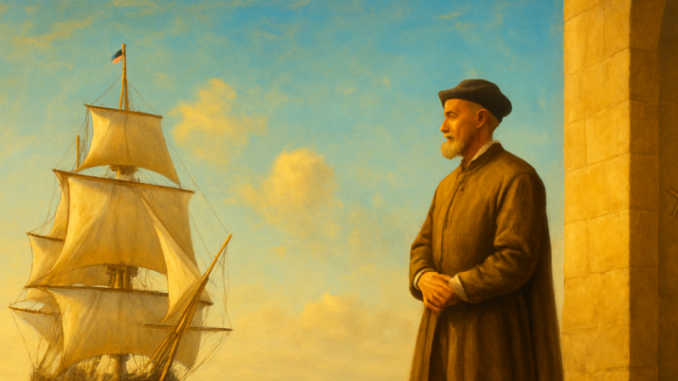
What if the deepest bond between people doesn’t arise from shared laughter or mutual success, but from the willingness to stand together in the face of life’s finitude? Michel de Montaigne, in his essay on a custom of the island of Cea, wrote a text that appears on the surface to be about death — but on closer reading is equally about the living. It is about the obligations we hold toward those who stand beside us, and about the nature of true connection. It is precisely in the tension between individual autonomy and mutual attachment that Freemasonry becomes a surprisingly fitting conversation partner.
The Paradox of Free Will and the Bond with Others
Montaigne opens the third essay of his second book with a deceptively simple question: does a person have the right to decide the end of their own life? But it quickly becomes apparent that the act itself is not his only concern. He continually weighs the consequences: what does such a decision mean for the people around you? What responsibility do you carry toward those who love you, who depend on you, who are bound to you?
Within this deliberation lies a paradox that Freemasonry knows intimately. The Mason is encouraged to think independently, to view the world as a free and sovereign individual. Yet at the same time, every Mason pledges loyalty to a brotherhood — to a chain of connection that reaches far beyond the self.
Montaigne cites Seneca and the Stoic conviction that a person is master of their own fate. But he immediately places a counterweight beside it: the duties we owe to community, to family, to friends. It is as though he invites the reader not to choose between freedom and connection, but to live fully within the tension between the two. That invitation is fundamentally Masonic in nature. In the lodge, a Brother or Sister does not learn to elevate one value above the other, but to find wisdom within the tension itself.
Self-Reflection as a Moral Obligation
One of the most striking features of Montaigne’s writing is his radical honesty. He does not merely examine the arguments of philosophers like Plato, Aristotle, and Epicurus — he scrutinizes his own reactions to them. He admits to doubt. He confesses that he sometimes recoils from his own conclusions. This attitude of unflinching self-reflection is not weakness; it is a form of intellectual courage that Freemasonry holds as one of the highest virtues.
To work the rough stone — as the Masonic metaphor has it — does not begin with grand gestures. It begins with the honest confrontation of your own flaws, fears, and contradictions.
Montaigne describes how the inhabitants of Cea, according to tradition, practiced a ritual in which the elderly took leave of life in the presence of their loved ones. What fascinates him is not the dying itself, but the community that surrounds it: the conversation, the presence, the shared awareness of what it means to be human. This image resonates deeply within the Masonic tradition, where ritual likewise serves as a space for collective contemplation of life’s most profound questions.
Brotherhood Beyond the Superficial
The connection Montaigne describes transcends the everyday. It is not about social pleasantries or polite convention, but about a bond capable of withstanding the heaviest trials. In Freemasonry, this is often referred to as the indissoluble chain — the conviction that Brothers and Sisters are linked by something deeper than friendship alone. That chain presupposes mutual responsibility. To be part of a brotherhood means bearing responsibility not only for yourself, but for the well-being of the other.
True connection does not arise despite our vulnerability, but precisely because we dare to face it together.
Montaigne understood this intuitively. His celebrated friendship with Étienne de La Boétie — which he describes elsewhere in the Essays as a kinship of souls that transcended all convention — forms the invisible foundation of this essay. When he writes about the duties a person owes to those closest to them, the echo of that loss reverberates through every line. It is as if he is saying: death is not the worst thing that can happen to a person. The worst is a life without deep connection.
The Counterweight: Autonomy and the Search for Truth
Yet it would do Montaigne an injustice to read him solely as a champion of connection. He is equally a defender of personal autonomy — of the right to judge for oneself, to choose for oneself, to think for oneself. Here, too, he touches on a core Masonic value: the search for truth is by definition an individual journey. No one can make that journey on behalf of another. The lodge provides the framework, the ritual provides the structure, the brotherhood provides the warmth — but inner growth is something each person must achieve alone.
Marcus Aurelius wrote in his Meditations that a person should not fear death, but rather a life that has never truly begun. Montaigne would have heartily agreed. His essay on the island of Cea is, at its core, a call to live consciously — not to let the days slip by unexamined, but to use every moment for self-reflection and for deepening the bonds that truly matter.
The Lodge as a Space for Essential Conversation
What Montaigne’s essay and Freemasonry share is the conviction that the conversations that truly matter are never the easy ones. They are conversations about finitude, about responsibility, about what we owe one another. The Masonic lodge functions as a protected space in which such conversations become possible — much as Montaigne’s study in the tower of his château gave him the freedom to reflect, without judgment, on the most charged subjects of human existence.
The strength of both traditions lies not in providing answers but in cultivating the courage to sit with the questions. Montaigne did not write his essays to settle debates; he wrote them to open inner landscapes. The lodge does not convene to hand down doctrine; it convenes to create a space where every Brother and Sister can undertake that most difficult of tasks — looking honestly inward, while remaining faithfully connected outward.
Montaigne’s essay on the island of Cea reminds us that the measure of a life well lived is not found in the avoidance of difficult truths, but in the willingness to face them — together. The Masonic chain is forged not in comfort, but in the shared courage to contemplate mortality, responsibility, and meaning. In both Montaigne’s philosophy and the Masonic tradition, the highest form of human connection is born from the same source: the honest recognition of our fragility, and the deliberate choice to stand beside one another in spite of it — and because of it.
Copyright text & image: devrijmetselaar.nl
Texts are based on the ideas and content of the author of devrijmetselaar.nl, reviewed, corrected, and supplemented with the assistance of OpenAI. Images are created based on the ideas of the author of devrijmetselaar.nl using OpenAI/DALL-E.
Frequently Asked Questions
What is the main connection Montaigne draws between individual freedom and responsibility to others?
Montaigne explores a paradox in his essay: while individuals may have the right to decide their own fate (a Stoic principle), they simultaneously carry obligations toward those who depend on them and love them. He argues that true wisdom lies not in choosing between freedom and connection, but in living fully within the tension between personal autonomy and mutual attachment—a principle that is fundamentally Masonic in nature.
How does Freemasonry relate to the themes Montaigne discusses?
Freemasonry embodies the same paradox Montaigne explores: Masons are encouraged to think independently and view themselves as free, sovereign individuals, yet they simultaneously pledge loyalty to a brotherhood and a chain of connection that extends beyond the self. In the lodge, members learn to find wisdom within the tension between individual autonomy and collective bonds, rather than elevating one value above the other.
What role does self-reflection play in Masonic philosophy according to this article?
The article identifies Montaigne's radical honesty and unflinching self-reflection as a form of intellectual courage that Freemasonry holds as one of its highest virtues. This practice of examining one's own reactions, admitting doubt, and scrutinizing one's conclusions is compared to the Masonic metaphor of working the rough stone—the process of refining oneself through honest self-examination and improvement.

Be the first to comment