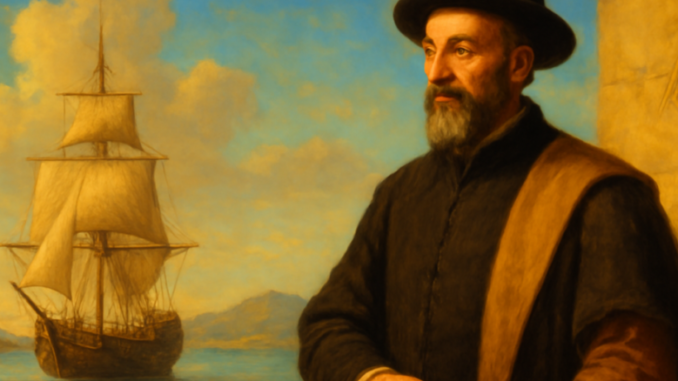
Imagine standing before a decision for which no script exists. No manual, no checklist, no clear-cut answer. It concerns the most fundamental question a human being can ask: how do I relate to my own mortality? In the third essay of his second book, titled A Custom of the Isle of Cea, Michel de Montaigne produced one of his boldest and most deeply human texts. This article offers an accessible summary of that essay and explores how its core ideas remain remarkably applicable to everyday life — and to the kind of reflective inner work that lies at the heart of Freemasonry.
What Is the Essay About?
Montaigne opens the essay with a reference to the inhabitants of the Greek island of Cea (also known as Keos), where a remarkable custom existed in antiquity. Elderly residents who felt their lives were complete would take ritualistic leave of their community. Montaigne uses this practice as a launching point for a wide-ranging philosophical inquiry into whether — and when — a person has the right to determine the end of their own life. He carefully weighs arguments for and against, draws on dozens of historical sources, and arrives at a nuanced position that invites every reader to form their own reflections rather than passively accept a verdict.
The Historical Examples Montaigne Draws Upon
What makes this essay so characteristic of Montaigne’s style is the abundance of concrete examples from classical antiquity. He cites the Stoic philosopher Seneca, who took dignified leave of life after being ordered to do so by Emperor Nero. He points to Cato the Younger, the Roman statesman who refused to live under the rule of Julius Caesar and chose to die as a free man. He also discusses the death of Socrates, who calmly drank the hemlock after the Athenian court had condemned him. These examples are far from arbitrary. In each case, Montaigne probes the motivation behind the act: was it courage, despair, or reason?
Beyond these famous figures, he draws on lesser-known cases from the works of historians such as Plutarch and Valerius Maximus. He describes women from Miletus who ended their lives en masse, soldiers who sought to escape the shame of defeat, and philosophers who could no longer bear pain and illness. Each example serves as a building block in his argument, but never as definitive proof. Montaigne does not judge. He investigates.
The Core Idea: Autonomy and Dignity
The thread running through the entire essay is the concept of personal autonomy. Montaigne argues that the manner in which someone departs from life says something essential about how that person has lived. He writes that it is not so much the act itself that matters, but the inner disposition with which someone approaches it. Does a person act from panic and desperation, or from a considered, serene conviction? For Montaigne, that question is far more important than any moral judgment about the act itself.
Montaigne teaches us in this essay that the quality of a human life is not measured solely by the number of years it spans, but by the consciousness with which it is lived and concluded. This resonates deeply with the Masonic emphasis on self-knowledge and the examined life — the idea that we are each responsible for the inner temple we build through our choices and reflections.
Here, Montaigne touches on a theme that is also central to the Stoic philosophy of Marcus Aurelius: the idea that the only thing truly ours is the way we respond to what befalls us. It is not our circumstances that determine our dignity, but our attitude toward those circumstances.
Practical Lessons for Your Own Life
The question Montaigne addresses is undeniably weighty and sensitive. But the practical lessons of this essay extend far beyond its literal subject. They are about conscious living, about daring to reflect on difficult questions, and about developing a thoughtful, personal stance. Here are three concrete ways to apply these lessons:
Reflect on your own finitude — not morbidly, but as motivation. Ask yourself: looking back on this past week, did I live in alignment with what I truly value? Montaigne practised this kind of daily reflection, and it did not make him gloomy — it made him more vital and engaged. For those on a Masonic path, this mirrors the practice of nightly self-examination that many traditions encourage.
Develop your own opinion on difficult subjects. Montaigne demonstrates that genuine thinking only begins when you are willing to honestly weigh opposing viewpoints. Take a topic that makes you uncomfortable, read about it from two different perspectives, and only then formulate your own position. This is the essence of intellectual integrity — a value prized equally in the lodge and in Montaigne’s library.
Practise respectful conversation about sensitive issues. Montaigne’s method is the opposite of polarisation: he listens to every voice before he speaks. Try this in a conversation with someone who thinks differently from you. The Masonic tradition of meeting on the level — treating every brother as an equal — serves the same purpose: creating space for honest dialogue without judgment.
Montaigne’s Method: Doubt as Strength
What makes this essay truly exceptional is that Montaigne explicitly refuses to deliver a conclusive answer. He lays out arguments from Stoics, Epicureans, and Christian thinkers side by side, without declaring a definitive winner. His famous motto — Que sais-je? (What do I know?) — is palpable on every page of this essay. That attitude of intellectual humility is not a weakness. It is an invitation to think for yourself, to feel for yourself, and to take personal responsibility for your convictions.
Montaigne wrote this essay during a time of religious wars, plague, and political chaos in France. In precisely those circumstances, he chose not to retreat into dogma but to look honestly at the complexity of human existence. This is what makes his work, more than four centuries later, still profoundly relevant — especially for anyone who refuses to adopt the opinions of others without question. For Freemasons, this resonates with the commitment to seek light and truth through one’s own labour, rather than accepting ready-made answers.
The Timeless Relevance of This Essay
In an era when societal debates over end-of-life issues, personal autonomy, and individual freedom of choice are more pressing than ever, Montaigne’s essay offers a surprisingly clear framework. Not by providing answers, but by asking the right questions. How do you define a life well lived? What role should personal conviction play in the most consequential decisions we face? And who has the authority to draw boundaries around another person’s freedom?
These are questions that do not belong to any single century or tradition. They are perennial. And Montaigne’s willingness to sit with uncertainty, to resist the comfort of easy conclusions, is itself a kind of answer — one that rewards anyone willing to engage with it honestly.
Montaigne’s essay on the Isle of Cea is not an endorsement or a condemnation. It is an exercise in courageous thinking — the kind of thinking that refuses to look away from life’s hardest questions. Its enduring power lies in the method rather than the message: weigh every perspective, maintain intellectual humility, and never surrender your capacity for independent reflection. Whether you encounter these ideas in Montaigne’s Essais, in Stoic philosophy, or in the symbolic work of the lodge, the lesson is the same. A life examined with honesty and lived with intention is a life worthy of the name.
Copyright text & image: devrijmetselaar.nl
Texts are based on the ideas and content of the author of devrijmetselaar.nl, reviewed, corrected, and supplemented with the assistance of OpenAI. Images are created based on the ideas of the author of devrijmetselaar.nl using OpenAI/DALL-E.



Be the first to comment