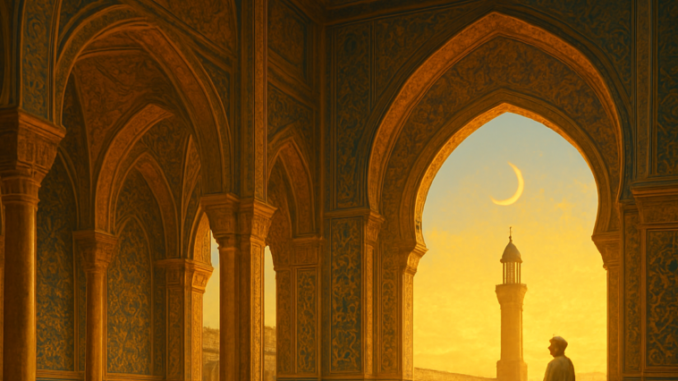
You know the feeling: your calendar is overflowing, your mind is tangled with worries about tomorrow, and somewhere along the way you’ve lost sight of what truly matters. It’s precisely in moments like these that an ancient text can speak with surprising clarity. Surah 87 of the Quran, titled The Most High, is one such text. In just nineteen verses, it calls for purification, remembrance, and a return to what is essential. For Freemasons — who regard the inner journey toward light and self-knowledge as a lifelong pursuit — this short surah offers a practical compass you can start using today.
What Is Surah The Most High About?
Surah Al-A’la (The Most High) belongs to the earliest revelations from the Meccan period. It opens with a call to glorify the name of the Most High Lord — the Creator who shaped all things, brought them into balance, and guided them toward their purpose. The surah then speaks of the path of ease offered to humanity, the power of remembrance, and the purification of the soul. Its closing verses reference the scriptures of Abraham and Moses, building a bridge to older revelatory traditions. In just a few lines, the text spans the entire arc of creation, guidance, and inner cleansing.
A Universal Problem: Forgetting What Matters
Verses 9 and 10 contain a remarkable exhortation: “Remind, if the reminder benefits. He who fears will be reminded.” This touches on something universally recognizable. We often know perfectly well what is good for us — honesty, attention to others, time for reflection — yet we forget it amid the rush of daily life. The surah does not condemn you for forgetting. It simply says: come back. Remember. This is not a reproach but an invitation.
In Freemasonry, we know this same movement. Every lodge meeting is a deliberate moment of remembrance. You step out of the external world, set aside your daily concerns, and return to your core. Not because you have failed, but because remembrance is a skill that requires regular practice. The opening and closing of a lodge, the repetition of ritual, the symbolic progression from darkness to light — all of it serves as a structured form of the very reminder that Surah 87 describes.
Purification as a Daily Practice
A key verse of the surah reads: “Successful indeed is he who purifies himself.” The Arabic word used here refers not merely to ritual cleansing but to a comprehensive purification of one’s inner life. This concept finds a striking parallel in the ritual tradition of Freemasonry. The Entered Apprentice degree revolves around working the rough ashlar — chipping away impurities of character and conduct to reveal a truer, better self beneath.
Aristotle wrote about virtue as a habit acquired through repetition. The Stoic philosopher Marcus Aurelius noted in his Meditations that every morning you can choose to bring out the best in yourself. Purification is not a one-time event but a daily choice. This is the very heart of both Surah The Most High and the Masonic tradition: every single day, you can begin again at the work of shaping your inner stone.
How do you put this into concrete practice? Here are three steps you can take today:
1. Begin your day with five minutes of silence. No phone, no podcast, no conversation. Just you and the question: what do I truly want to contribute today?
2. At the end of the day, identify one moment where you did not act according to your best self. Do not judge yourself — simply note it. Awareness is the first step toward change.
3. Seek out a weekly form of community centered on reflection, whether that is a lodge, a reading group, or a walk with a friend who is not afraid to ask you honest questions.
The Scriptures of Abraham and Moses: A Shared Heritage
The surah closes with a reference to the “former scriptures, the scriptures of Abraham and Moses.” This is a powerful signal: the message of purification and remembrance is not exclusive to any single tradition. It stretches across different faiths and eras. Freemasonry operates on precisely this principle. On the altar in the lodge rests the Volume of the Sacred Law, which may differ depending on the traditions of the brethren present. The Bible, the Quran, the Torah, or another sacred text — the principle is that every brother acknowledges his own source of wisdom while all build together at the same temple of humanity.
James Anderson, who drafted the first constitutions of modern Freemasonry in 1723, already emphasized that the Craft unites men of diverse religious convictions around shared moral values. Surah 87’s closing reference to Abraham and Moses underscores this same universalist spirit — the idea that wisdom has never belonged to one people or one age alone.
The Path of Ease: Trusting the Process
In verse 8, the surah promises: “We shall ease your way to the state of ease.” This verse is often understood as encouragement to trust that the path toward goodness does not have to be impossibly heavy. You do not have to do everything alone.
In Freemasonry, this translates into the principle of brotherhood. The lodge is a workshop where you pursue moral growth together. Johann Wolfgang von Goethe — himself a Freemason and one of the greatest thinkers in European cultural history — wrote about the necessity of allowing yourself to be shaped by others while remaining true to your own inner voice. That interplay between community and personal responsibility is precisely what Surah The Most High describes: guidance is offered, but the choice to purify yourself always remains your own.
What You Can Do Differently Tomorrow
Spirituality does not have to be vague or unattainable. Surah The Most High offers a surprisingly practical recipe: glorify what is greater than yourself, purify your intentions, and allow yourself to be reminded of what you already know but risk forgetting. For Freemasons, this is recognizable as the work at the rough ashlar, the pursuit of light in darkness, and the conviction that every day offers a new opportunity to become a better person.
You do not need to wait for a special occasion or a dramatic turning point. The lessons of Surah 87 and the Masonic tradition converge on one powerful truth: transformation is not reserved for extraordinary moments — it lives in the quiet discipline of daily remembrance, daily purification, and the willingness to begin again each morning. You can start right now, with those five minutes of silence and a single honest question about the person you want to be today.
Copyright text & image: devrijmetselaar.nl
Texts are based on the ideas and content of the author of devrijmetselaar.nl, reviewed, corrected, and supplemented with the assistance of OpenAI. Images are created based on the ideas of the author of devrijmetselaar.nl using OpenAI/DALL-E.

Be the first to comment