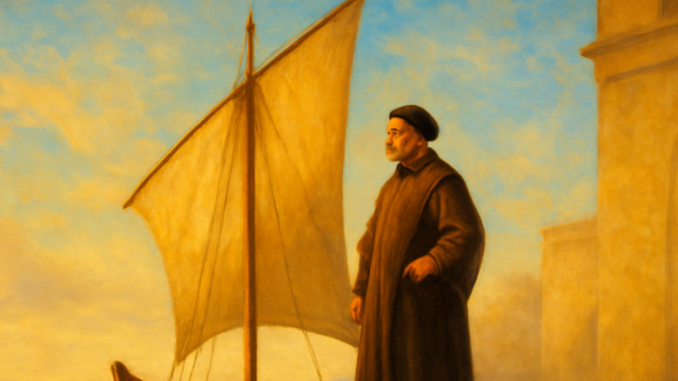
Picture this: after a long day, you’re sitting around a table with friends. The glasses are filled, the conversation loosens, the laughter grows louder. At some point, you notice yourself saying things you’d normally keep to yourself. The next morning, you wonder — was that the real me, or a version I’d rather not have revealed? This is precisely the tension Michel de Montaigne explored in his essay On Drunkenness, and it strikes at the very heart of what Freemasons pursue in their journey of personal development.
What Montaigne Is Really Asking Us
Michel de Montaigne didn’t write his essay On Drunkenness as a moral crusader. He wasn’t a preacher wagging his finger at anyone holding a glass of wine. Quite the opposite — he candidly described how people, himself included, navigate the boundary between enjoyment and loss of control. His central question wasn’t “Is drinking bad?” but rather “What does the loss of self-control reveal about who we truly are?” That question is timeless. And for anyone seriously engaged in personal growth, it’s unavoidable.
In his essay, Montaigne references figures like Cato the Elder, who claimed that wine exposes a person’s true nature. He also cites Plato, who regarded the controlled use of wine as a form of education — you learn about yourself by observing how you react when the guardrails come down. This is not a license for excess. It’s an invitation to honest self-examination.
Brotherhood at the Table of Honesty
Within Freemasonry, the shared meal — the so-called Table Lodge — plays a distinctive role. It’s a moment when brethren gather after a ritual meeting, raise their glasses, and engage with one another in a more relaxed atmosphere. It is precisely in this transition from ritual to conviviality that a subtle test reveals itself. How do you behave when the formal structure falls away? Do you remain faithful to the values of respect, sincerity, and temperance, even when the mood becomes informal?
Montaigne would recognize this dynamic instantly. He describes how some people adopt an entirely different personality under the influence, while others prove remarkably steady. That distinction is exactly what interests the Freemason. The question is not whether you drink or abstain, but whether you stay true to your core in every circumstance. Brotherhood is not only forged in ritual — it is tested and proven at the table afterward.
Self-Reflection as a Daily Practice
This is where things get practical. How do you translate the thoughts of Montaigne and the values of Freemasonry into everyday life? Not by swearing off wine forever, but by becoming more mindful of the moments when you’re in danger of losing your grip on yourself. It doesn’t have to be about alcohol. Think of road rage, impulse purchases, or that message you sent when you really should have waited.
Freemasons work with the principle of the Rough Ashlar: every person is an unworked block of stone that is gradually shaped through self-reflection and practice. Montaigne would appreciate that image. In his essay, he makes clear that a person doesn’t need to be perfect — but must be honest with themselves. That honesty is the tool with which the stone is worked.
True brotherhood doesn’t emerge in moments of control, but in the willingness to be honest about your own weaknesses and to learn from them together.
Three Practical Steps Inspired by Montaigne
What can you do with these insights today? Here are three concrete actions inspired by both Montaigne’s essay and the Masonic tradition.
1. Keep an evening mirror. Take three minutes every evening to look back on your day. Were there moments — however small — when you lost your composure? What did that teach you about yourself? This ritual aligns with the Masonic practice of daily self-reflection and with what Montaigne described as looking at yourself without a mask.
2. Seek the test in company. The next time you’re sitting at a table with others, consciously observe your own behavior. Not as a harsh judge, but as a curious observer. Are you staying true to who you want to be? Aristotle emphasized that virtue is not a theory but a habit, formed through repetition in daily life.
3. Share your vulnerability with someone you trust. Montaigne wrote his essays as a public act of vulnerability. Freemasons practice this within the privacy of the Lodge. But outside that context, you can also grow by being honest about your shortcomings with a friend, partner, or colleague. Connection begins where defensiveness ends.
Virtue Lies in the Middle
Montaigne was no absolutist. He didn’t categorically condemn drunkenness but warned against the loss of consciousness that can accompany it. That’s a remarkably nuanced position for the sixteenth century, and it fits seamlessly within the Masonic tradition, which prescribes no dogmas but calls upon every individual to find the golden mean — freely and with reason.
Marcus Aurelius, the Stoic emperor and philosopher, wrote in his Meditations that every morning a person should consider that they will encounter people who are pushy, ungrateful, or unrestrained — and prepare to respond with gentleness. That gentleness starts with yourself. When you catch yourself in a moment of weakness, the right response is not self-condemnation but self-knowledge.
Connection as the Final Destination
Perhaps the most beautiful insight Montaigne offers in this essay is this: the person who truly knows himself is better equipped to connect with others. Those who acknowledge their own weaknesses judge others more gently. Those who know where their limits lie can share those boundaries with trust. In Freemasonry, we call that brotherhood. In daily life, we simply call it being human.
Montaigne’s essay on drunkenness is far more than a reflection on wine and excess. It is a meditation on self-knowledge, honesty, and the courage it takes to face yourself without pretense. For Freemasons, these themes resonate deeply — they echo through the rituals, the symbols, and the shared meals that define Masonic life. Whether you’re a Mason or simply someone striving to live more consciously, the message is the same: know yourself, be gentle in that knowledge, and let it become the bridge that connects you to others.
Copyright text & image: devrijmetselaar.nl
Texts are based on the ideas and content of the author of devrijmetselaar.nl, reviewed, corrected, and supplemented with the assistance of OpenAI. Images are created based on the ideas of the author of devrijmetselaar.nl using OpenAI/DALL-E.
Frequently Asked Questions
What is Montaigne's main argument in his essay On Drunkenness?
Montaigne's central question is not whether drinking is good or bad, but rather what the loss of self-control reveals about who we truly are. He uses drunkenness as a lens for self-examination, drawing on philosophers like Cato the Elder and Plato to explore how people's behavior changes when their guardrails come down. His essay is an invitation to honest self-reflection rather than moral judgment.
How does the Masonic Table Lodge relate to Montaigne's ideas about drunkenness?
The Table Lodge is a gathering where Freemasons share a meal and conversation in a relaxed atmosphere after ritual work. This setting provides a subtle test of character: do brethren remain true to values like respect, sincerity, and temperance when formal structure falls away? Montaigne would recognize this as an opportunity to observe whether individuals stay faithful to their core principles in all circumstances, not just formal ones.
What is the connection between Montaigne's work and Freemasonry's quest for self-knowledge?
Both Montaigne and Freemasonry are fundamentally concerned with self-examination and personal development. The article argues that Montaigne's exploration of human nature under changing circumstances aligns with Masonic values of self-reflection and understanding one's true character. The Masonic journey tests whether a person can maintain their principles and integrity in every situation, from formal ritual to informal social gatherings, mirroring Montaigne's inquiry into authentic self-knowledge.


Be the first to comment