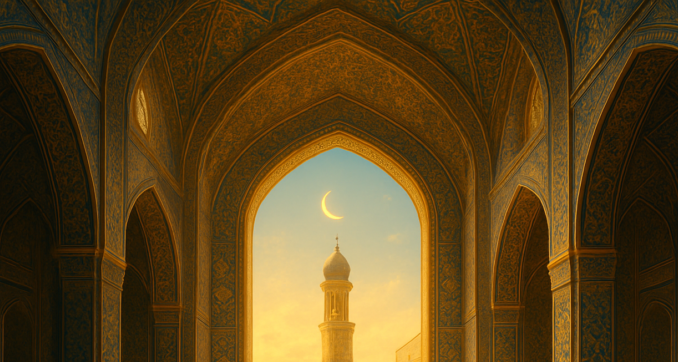
Sometimes, on a clear winter night, your eye catches a single star burning brighter than all the rest. It stands there not to be admired, but to give direction. This star — the piercing night star spoken of in the eighty-sixth Surah of the Quran — carries a message that reaches far beyond astronomy or poetry. It touches on something Freemasonry has known for centuries: the longing for light amid darkness.
A Star That Knocks Upon the Night Sky
The eighty-sixth Surah of the Quran opens with an oath sworn by the heavens and by the night star. The Arabic word used here — al-tariq — literally refers to something that knocks or strikes, like someone pounding on a door. The star is described as piercing, bright enough to cut through the layers of night. It is a powerful image: not merely a point of light, but a knocker — something that demands attention and refuses to be ignored.
This knocking inevitably brings to mind one of the most recognizable moments in Freemasonry. When a seeking individual approaches the door of a lodge, he knocks. That knock is no formality. It is an act of courage, a declaration that one is ready to step out of darkness and seek light. The night star in the Quran and the knocking seeker at the lodge door share the same essence: something determined to break through the darkness.
A Short Surah With a Deep Echo
The Surah consists of only seventeen verses and belongs to the shorter chapters of the Quran. Yet it contains a remarkable density of themes. After the opening oath about the night star, the text turns to the creation of humanity, the power of the divine word, and the distinction between truth and vanity. The Surah concludes with a warning: give the deniers time, for truth will unfold on its own. There is no haste here — only a deep trust that light always finds its way.
For those familiar with Islamic exegesis, this Surah is a meditation on both the vulnerability and the dignity of humankind. The human being is created from a drop of water, and yet a heavenly star watches over them. That paradox — insignificance and grandeur in a single breath — is a theme that also returns in thinkers like Blaise Pascal, who described humanity as a reed, but a thinking reed.
Light as a Universal Spiritual Principle
In virtually every spiritual tradition, light plays a central role. In the Quran, divine light is a recurring motif — most powerfully expressed in the famous Verse of Light, but unmistakably present here as well, in the night star. The star that pierces through the night is not merely a cosmic phenomenon but a sign: there is always something that shines, even when the world is asleep.
The night star teaches what Freemasonry has practiced for centuries: whoever knocks sincerely will find light — not outside themselves, but in the willingness to face the darkness.
Freemasonry understands light not as dogma but as a working tool. The ritual of initiation begins in blindness and ends in revelation. That light represents no specific religion, but the universal longing for insight and awareness. When the Quran speaks of a star cutting through the night, it touches the same experience: the moment when something in a person breaks open and clarity appears where opacity once reigned.
Why Short Texts Resonate Long
There is something remarkable about the brevity of this Surah. In seventeen verses, an entire worldview is laid down: creation, responsibility, truth, patience. It is reminiscent of the way short ritual phrases in Freemasonry sometimes carry more weight than lengthy dissertations. A Master who says, “So it is,” condenses an entire process of understanding into three words. The power lies not in volume, but in compression.
Michel de Montaigne — whose essays have been explored elsewhere in relation to impermanence and brotherhood — once wrote that the best books are those that compel the reader to finish the work themselves. The eighty-sixth Surah does exactly that. It presents images and leaves the reader or listener to draw the connections. This is not a shortcoming but a pedagogical principle also employed in Freemasonry: the ritual provides hints, but the insight must come from within.
The Guardian Over Every Soul
One of the most intriguing verses in the Surah states that a guardian is appointed over every soul. This idea of a watcher, a keeper, resonates deeply with the Masonic principle of conscience as an inner master. In the lodge, the Great Architect of the Universe is not an exclusive image of God, but an acknowledgment that something greater exists beyond the individual ego. The guardian from the Surah can be read as precisely that: a moral compass, an inner light that registers and gives direction.
Aristotle spoke in his ethics of the daimon, the inner being that leads a person toward their best self. The Stoic philosopher Marcus Aurelius described something comparable as the god within, which one must respect by living with dignity. And here, in a brief Quranic Surah from the seventh century, the same motif appears: something watches over us. The traditions differ in language, but the direction is the same.
A Contemplative Invitation
What happens when you step outside tonight and look up? Perhaps you see the moon, perhaps clouds, perhaps a single bright star. The Surah invites you to see in that star more than a physical object. It is a knocker, an alarm, a reminder of something you already knew but had forgotten — that you are not merely matter. That something shines within you, even when you yourself do not notice it.
Freemasonry offers no answers to the great questions of existence, but it does offer a workshop in which those questions are taken seriously. The Quran offers, in this brief Surah, a comparable invitation: pause, reflect, and recognize that the light piercing through the night is not only above you — it is within you.
The night star of the eighty-sixth Surah and the light sought in every Masonic lodge point toward the same timeless truth. Across centuries and traditions, the message endures: darkness is never final. For those willing to knock, willing to look up, and willing to turn inward, a piercing light waits — patient, persistent, and always ready to guide the way. The question was never whether the light exists. The question is whether we are willing to see it.
Copyright text & image: devrijmetselaar.nl
Texts are based on the ideas and content of the author of devrijmetselaar.nl, reviewed, corrected, and supplemented with the assistance of OpenAI. Images are created based on the ideas of the author of devrijmetselaar.nl using OpenAI/DALL-E.


Be the first to comment