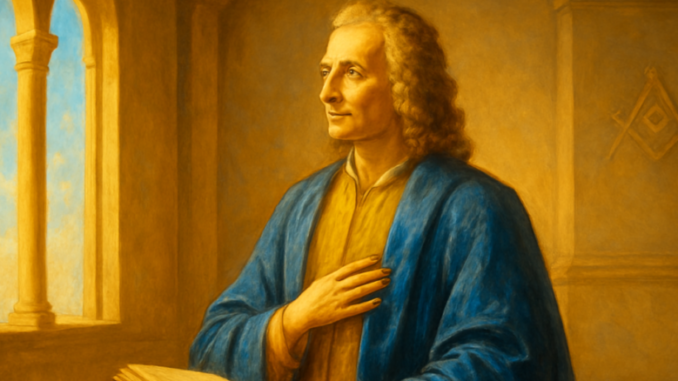
A candle flickers in the silence of a reading room. A young Brother leans over a yellowed copy of Voltaire’s Zadig, written in 1747. The words seem to dance between irony and profundity, between satire and wisdom. As he reads about the fortunes and misfortunes of the Babylonian sage, he recognizes something familiar — the same quest for truth, the same confrontation with the inexplicable that he experiences on his own Masonic journey. What drove Voltaire to write this philosophical tale, and which intellectual traditions fed his pen?
The Enlightenment as Intellectual Soil
Voltaire wrote Zadig during a period when Europe was buzzing with intellectual renewal. The eighteenth-century Enlightenment formed the backdrop against which this philosophical tale came into being. In the salons of Paris and the libraries of country estates, new ideas about reason, human autonomy, and the critical questioning of tradition were taking shape. Voltaire, himself a central figure in this movement, used the story as a vehicle for philosophical ideas he could not openly proclaim without provoking the wrath of both Church and State.
The story of Zadig is steeped in the spirit of its age: the belief that human reason could dispel the darkness of superstition. At the same time, it reveals the limits of that reason when fate takes incomprehensible turns. This tension between rational optimism and existential uncertainty makes Zadig more than a satire — it is a philosophical inquiry into the human condition.
Stoic Echoes in Zadig
The influence of Stoicism on Voltaire’s thinking is unmistakably present in Zadig. The protagonist displays classic Stoic virtues: he accepts setbacks with dignity, cultivates inner calm amid chaos, and seeks wisdom above wealth or power. Marcus Aurelius might well have recognized him as a kindred spirit. The Stoic notion that we only have control over our own reactions — not over external events — runs like a thread throughout the story.
Seneca, whose letters Voltaire had studied thoroughly, resonates in the way Zadig deals with loss and exile. The wise Babylonian loses his beloved, his position, his homeland — and yet he continues searching for meaning. This is precisely the attitude Seneca prescribed in his Epistulae Morales: it is not the absence of suffering that makes a person wise, but the manner in which they bear it.
Leibniz and the Question of Providence
Beneath the apparent lightness of Zadig lies a serious philosophical dialogue with Gottfried Wilhelm Leibniz and his theodicy. Leibniz had argued that we live in the best of all possible worlds — a thesis Voltaire would later skewer mercilessly in Candide, but which in Zadig receives a more nuanced treatment. The angel Jesrad appears at the end of the story to explain that apparent evil is part of a larger, invisible plan.
The wise man does not seek the absence of fate, but the art of living with fate without being broken by it.
Yet Voltaire leaves the reader with doubts. Is Jesrad’s explanation satisfying, or is it an ironic critique of every system that explains away human suffering? This ambiguity transforms Zadig into an open question rather than a closed answer — an approach that strikingly mirrors the Masonic tradition of posing questions above giving dogmatic answers.
Eastern Wisdom Traditions
The setting of Zadig in ancient Babylon is no coincidence. Voltaire was fascinated by Eastern cultures and drew from Persian and Arabic literature. The Thousand and One Nights, which had appeared in French translation at the beginning of the eighteenth century, inspired him to use an exotic setting. But deeper than the scenery lies the influence of Eastern wisdom traditions on the story’s central themes.
The figure of the sage who wanders through the world and learns from experience is reminiscent of Zoroastrian and Sufi traditions, in which the journey itself is a form of spiritual development. Zadig does not learn from books alone, but from encounters, setbacks, and moments of unexpected insight. This experience-based path toward wisdom resonates strongly with the initiatory journey that Freemasons know intimately.
The Skepticism of Pierre Bayle
A lesser-known but crucial influence on Voltaire was Pierre Bayle, the French philosopher whose Dictionnaire historique et critique had shaped an entire generation of thinkers. Bayle’s methodical doubt and his critique of religious intolerance echo throughout Voltaire’s work. The way Zadig encounters different religions and philosophies — finding something of value in each without binding himself to any single one — mirrors Bayle’s pluralistic approach to truth.
This skepticism, however, is not nihilism. Bayle, and Voltaire after him, did not seek the destruction of all values but their purification. Freemasonry shares this approach: it rejects no sincere search for truth, but invites critical reflection on all assumptions — including one’s own.
Resonance with Masonic Principles
The philosophical traditions that nourish Zadig — Stoicism, Enlightenment thought, Eastern wisdom, critical skepticism — are the same wellsprings from which eighteenth-century Freemasonry drew. Anderson’s Constitutions of 1723, which gave shape to modern Freemasonry, breathed the same spirit of tolerance and the pursuit of universal truth. Voltaire himself had close ties to Masonic circles and was initiated in 1778, shortly before his death, into the Parisian lodge Les Neuf Sœurs.
Zadig embodies what one might call the ideal Masonic disposition: a combination of intellectual sharpness and moral integrity, of active engagement with the world and inner detachment, of respect for tradition and willingness to embrace renewal. His journey is a symbolic initiation — not into a lodge or a ritual, but into the deeper understanding that wisdom is not a destination but a way of traveling.
Voltaire’s Zadig remains a text that speaks across the centuries to anyone engaged in the pursuit of wisdom. Its philosophical roots — Stoic resilience, Enlightenment reason, Eastern contemplation, and Baylean skepticism — form a constellation of ideas that continues to illuminate the Masonic path. The young Brother closing the book in his reading room may not have all the answers, but he has gained something more valuable: better questions. And in both Voltaire’s world and the Lodge, that is precisely where wisdom begins.
Copyright text & image: devrijmetselaar.nl
Texts are based on the ideas and content of the author of devrijmetselaar.nl, reviewed, corrected, and supplemented with the assistance of OpenAI. Images are created based on the ideas of the author of devrijmetselaar.nl using OpenAI/DALL-E.


Be the first to comment