You know the feeling: weeks fly by, months blur into years, and suddenly you wonder where all the time went. Nearly two thousand years ago, the Stoic philosopher Lucius Annaeus Seneca wrote to his friend Lucilius about this very phenomenon. In Letter LXXVII, he examines why we experience the brevity of life as a problem — when the solution is far closer at hand than we imagine. His insights offer practical tools for rethinking your relationship with time, starting today.
The Scene: Ships Entering the Harbor
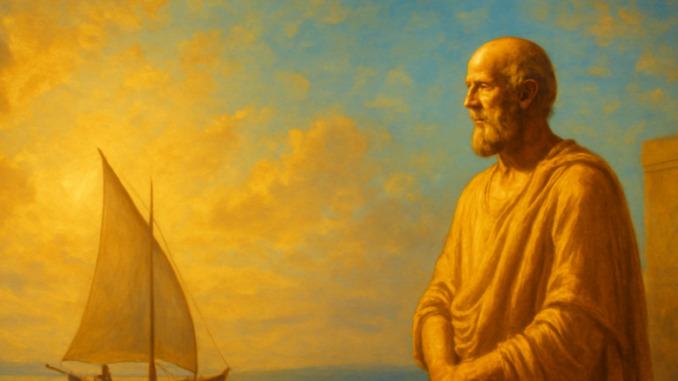
Seneca opens this letter with a vivid description of Alexandrian grain ships sailing into the harbor at Puteoli. The entire city gathers to watch the spectacle. He observes how short the journey of these ships appears in retrospect, even though it actually lasted weeks. This image serves as a springboard into his real subject: our perception of time and the span of a human life.
The ships function as a metaphor for human existence. Just as a voyage seems long when you set out but short when you look back, so it is with our lives. In youth, everything appears endless. In later years, we wonder where the decades disappeared to. Seneca argues that this is not a problem with time itself — it is a problem with how we fill it.
The Core Idea: Not Short, But Squandered
Seneca’s central argument is strikingly direct. Life is not short — we make it short. Through procrastination, through anxiety about tomorrow, through meaningless busyness, we lose the time we have been given. He compares it to someone who inherits a fortune but fritters it away on trivialities within a few years. No one would say the fortune was too small; we would say the owner lived wastefully.
Life is long enough if you invest it fully. Whoever lives each day as though it were his last has never had too little time.
This idea forms the thread running through the entire letter. Seneca urges Lucilius to examine critically where his hours actually go. How much time vanishes into social obligations that yield nothing of value? How much energy is poured into worrying about matters beyond our control? The answer to life’s brevity is not more years — it is better-lived days.
Examples from Roman Daily Life
Seneca supports his argument with relatable situations from everyday life in Rome. He describes men who postpone truly living until after retirement, only to discover they have no idea what to do with their freedom. Others chase fame and recognize too late that the applause of the crowd does not make them happier.
One particularly striking example is his comparison with a traveler so fixated on the destination that he forgets to enjoy the journey itself. When he finally arrives, he is too exhausted to appreciate where he is. Many people live exactly this way — always focused on the next milestone, never present in the now. For those who walk a Masonic path, this resonates deeply: the journey through the degrees is not merely a means to an end, but a process of growth that deserves full attention at every stage.
Practical Application for Modern Life
How do you translate this ancient wisdom into your own circumstances? Seneca offers concrete steps you can apply immediately:
First, evaluate daily where your time goes — and eliminate what contributes nothing to your well-being or growth. Second, stop procrastinating by giving important matters priority over merely urgent ones. Third, treat each day as a complete unit of life, not as a hallway leading to something better. Fourth, limit worry about the future by concentrating on what you can influence right now.
This approach does not require a radical life overhaul. It begins with small choices: declining an unnecessary meeting, completing a task immediately rather than postponing it, consciously pausing to appreciate what you have in this moment. Seneca emphasizes that even a short life, well lived, is richer than a long existence filled with emptiness. In Freemasonry, this principle echoes the symbolic teaching that the tools we are given are meant to be used — not admired from a distance or set aside for later.
The Freedom to Choose
A striking element in Letter LXXVII is Seneca’s emphasis on personal autonomy. He argues that we need not be victims of time, because we can choose how we fill it. This aligns with the Stoic conviction that external circumstances lie beyond our power, but our response to them does not.
For the modern reader, this perspective is genuinely liberating. You cannot add more hours to the day, but you can decide what you do with the hours you have. The question shifts from “How do I get more time?” to “How do I live the time I have?” It is a subtle but powerful distinction — one that resonates with the Masonic ideal of self-improvement through deliberate, conscious effort.
An Invitation to Self-Reflection
Seneca closes with an invitation to Lucilius — not merely to read passively, but to actively examine where his own time goes. Which activities would he drop if he knew this was his final year? Which relationships would he deepen? Which projects would he finally undertake?
These questions are not meant to provoke fear, but to create clarity. By facing the finite nature of life squarely, our choices gain weight. Every day becomes an opportunity to live deliberately — not out of dread of death, but out of gratitude for what we have. Within a Masonic context, this kind of honest self-examination is not merely encouraged; it is foundational. The evening reflection, the symbolic work on the rough ashlar — all of it points toward the same truth Seneca articulated centuries before the first lodge was consecrated.
Letter LXXVII offers timeless wisdom in a remarkably practical package. The shortness of life is not a fate imposed upon us — it is a consequence of how we choose to live. By pausing daily to examine how we spend our time, by ending the habit of procrastination, and by being fully present in each moment, we transform a brief life into a rich one. The question is not how many years you are granted, but what you do with today.
Copyright text & image: devrijmetselaar.nl
Texts are based on the ideas and content of the author of devrijmetselaar.nl, reviewed, corrected, and supplemented with the assistance of OpenAI. Images are created based on the ideas of the author of devrijmetselaar.nl using OpenAI/DALL-E.

Be the first to comment