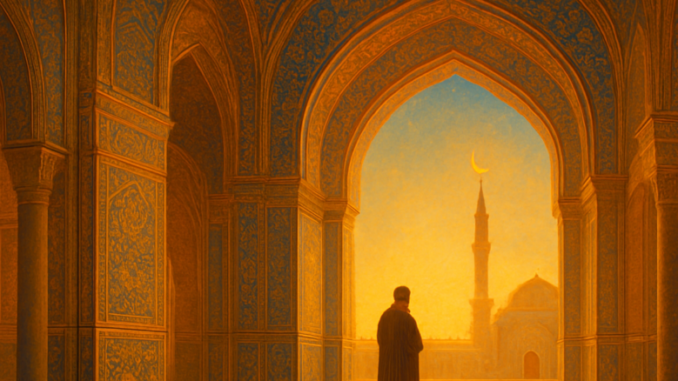
Around the year 610, in the city of Mecca, a man withdrew into silence under the cover of night. Wrapped in his cloak, he received words urging him to rise, to pray, and to surrender to deep inner reflection. These words form the seventy-third chapter of the Quran, known as Al-Muzzammil — The Enwrapped One. For fourteen centuries, this text has inspired Muslims around the world, but its themes also resonate remarkably with a spiritual journey that Freemasons know well: the shedding of outer coverings to find the light within.
A Historical Calling in the Night
Surah Al-Muzzammil belongs to the earliest Meccan revelations, a period during which the Prophet of Islam regularly retreated to the Cave of Hira on the Mountain of Light near Mecca. The name “The Enwrapped One” evokes the image of someone wrapped in a cloak or garment — cocooned in silence and solitude. Yet the opening verses call this figure to emerge from that very wrapping: rise in the night, recite, and seek closeness to the Divine.
This pattern of nocturnal withdrawal fits into a tradition far older than the seventh century. The Desert Fathers of early Christianity, the Jewish mystics who immersed themselves in the Merkabah tradition, and the Greek philosophers who practiced nightly vigils as exercises in self-discipline — all knew the power of nighttime silence. Plato described in his dialogues how the philosopher must break free from shadows to behold the true light. Symbolically, the wrapping in Al-Muzzammil is precisely such a shadow: a protective layer that must be cast off to arrive at deeper understanding.
The Heart of the Surah: Discipline and Surrender
Al-Muzzammil consists of twenty verses and contains a striking combination of themes. On one hand, it calls for rigorous personal discipline: night prayer, prolonged recitation of sacred texts, and patient endurance in the face of adversity. On the other, there is a tone of gentleness and mercy. The text acknowledges that not everyone is able to spend the entire night in wakefulness, and it makes room for what is realistically achievable. It speaks of giving to others, seeking forgiveness, and placing trust in a higher guidance.
This balance between austerity and compassion is remarkable. It calls to mind what the Roman Stoic Marcus Aurelius wrote in his Meditations about the art of rising early — not out of self-punishment, but because the work for which a human being was made is waiting. Discipline is not an end in itself; it is a means of drawing closer to what is essential.
Casting Off the Cloak: A Masonic Perspective
For Freemasons, the image of an enwrapped figure being called to rise evokes a deeply familiar ritual moment. During initiation into Freemasonry, the candidate is led blindfolded into the lodge. He finds himself in darkness, shrouded in ignorance, until the light is granted to him. But this unveiling is not a passive event. Just as in Al-Muzzammil, the seeker is asked to rise, to elevate himself, and to actively participate in his own transformation.
The true spiritual journey does not begin when the light reaches you, but when you decide to cast off the cloak of habits and certainties to seek that light.
Freemasonry holds no dogma about how the Supreme Being should be understood. What it does ask is a willingness to search. The nocturnal discipline described in Al-Muzzammil finds its echo in the Masonic conviction that self-knowledge and moral growth do not come effortlessly. They require practice, repetition, and the continual re-entering of the temple of one’s own inner self.
Night Prayer and the Chamber of Reflection
Within the Masonic tradition there exists the practice of the “Chamber of Reflection” — a small, sparsely furnished room where the candidate is left alone before his initiation. There, he writes his philosophical testament and contemplates his life up to that point. This moment of seclusion is not a punishment but a gift: it offers the opportunity to look honestly into the mirror, free from social pressure and outward appearances.
The parallel with the night prayer of Al-Muzzammil is striking. Both traditions recognize that the deepest insights do not arise in the noise of the day but in the silence of the night — or in the privacy of a secluded space. Johann Wolfgang von Goethe, himself a Freemason and one of the greatest poets in European literature, wrote about the necessity of descending into one’s own depths before ascending to higher knowledge. That descent is precisely what Al-Muzzammil describes: first the turning inward, then the rising.
Shared Values Across Religious Boundaries
It would be a mistake to see the parallels between Al-Muzzammil and Freemasonry as an attempt to fold one tradition into the other. The Quran is a sacred book for more than one and a half billion believers worldwide. Freemasonry is not a religion and does not claim to be. What both share is a deep conviction that the human being is more than outward appearance, and that inner work is essential for a life of meaning.
Both traditions emphasize the importance of silence and reflection as sources of insight. Both view discipline not as oppression but as liberation from superficiality. Both acknowledge that light can only be found by those willing to face the darkness. And both call for generosity and service to one’s fellow human beings.
What We Can Learn Today
In an age where silence is scarce and distractions are endless, the message of Al-Muzzammil is surprisingly timely. The call to rise, to cast off the cloak, and to deliberately make time for contemplation and inner growth speaks to anyone who senses that there is more to life than the surface.
For Freemasons, this surah can serve as a source of reflection that transcends cultural and religious boundaries — a reminder that the search for light is a universal human endeavor. The enwrapped figure in the Meccan night and the blindfolded candidate in the Masonic lodge share a common starting point: both are invited to shed what conceals, to rise, and to walk toward a greater truth.
Whether we find our silence in the hours before dawn, in a Chamber of Reflection, or simply in a quiet moment during the day, the principle remains the same. Growth requires stillness. Insight demands courage. And the light is always there — waiting for us to unwrap ourselves and step forward.
Al-Muzzammil and the Masonic tradition may emerge from vastly different historical and cultural contexts, yet they converge on a truth that is profoundly human: transformation begins in darkness and silence. The cloak — whether literal or symbolic — must be cast off before the inner light can be revealed. In our restless, modern world, few messages are more vital. Rise, seek, and let the work of inner refinement be the labor that gives your life its deepest purpose.
Copyright text & image: devrijmetselaar.nl
Texts are based on the ideas and content of the author of devrijmetselaar.nl, reviewed, corrected, and supplemented with the assistance of OpenAI. Images are created based on the ideas of the author of devrijmetselaar.nl using OpenAI/DALL-E.

Be the first to comment