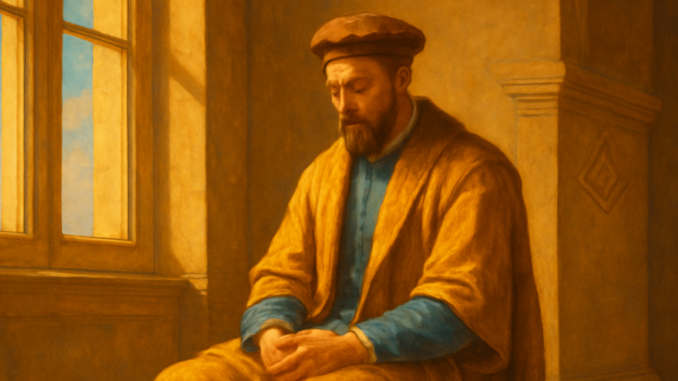
Why would a sixteenth-century nobleman dedicate an entire essay to something as ordinary as sleep? And what does that have to do with the way Freemasonry reflects on virtue, consciousness, and the limits of human self-mastery? These are the questions that arose when we revisited Essay 44 by Michel de Montaigne — not as a literary curiosity, but as a philosophical document with surprisingly deep roots.
Which Thinkers Echo Through This Essay?
Montaigne was a writer who shaped his own thoughts by entering into dialogue with the great minds of antiquity. In Essay 44, two voices resonate most clearly: Seneca and Plutarch. Neither was a dusty source for Montaigne — they were living conversation partners whose insights he tested against his own experience.
Seneca, the Stoic philosopher whom Montaigne cites across many of his essays, wrote extensively about the relationship between tranquility of mind and the ability to let go. In the Stoic tradition, sleep serves as an ultimate test of inner calm: anyone who is truly free from fear and passion can surrender to sleep even under the most uncertain circumstances.
Plutarch, the Greek biographer and moralist, offered Montaigne a different lens. In his Lives of great statesmen and generals, Plutarch collected countless anecdotes about men who fell peacefully asleep on the eve of a decisive battle. It is exactly these kinds of stories that Montaigne weaves into Essay 44. He uses them not to glorify Stoic indifference, but to pose a deeper question: what does the ability to sleep reveal about the condition of a person’s soul?
Is Sleep a Sign of Courage or Indifference?
Here we touch on a tension that is characteristic of Montaigne’s thinking. The Stoics — Seneca, Epictetus, and Marcus Aurelius chief among them — regarded emotional mastery as the highest aim. A wise person would remain unperturbed in any situation. Montaigne admired this attitude, but he did not embrace it uncritically. As a committed skeptic, deeply influenced by the Pyrrhonist tradition of Sextus Empiricus, he distrusted any doctrine that claimed absolute truth about human nature.
In Essay 44, we see that skepticism at work. Montaigne presents examples of men who slept calmly while danger loomed, but he deliberately leaves it open whether their sleep sprang from true magnanimity, from dull ignorance, or simply from a bodily constitution over which they had no control. This refusal to pass final judgment is typical of the Academic Skepticism that Montaigne captured in his famous motto: “Que sais-je?” — What do I know?
The Role of Renaissance Humanism
Montaigne wrote his Essays during an era when Renaissance humanism saturated the intellectual culture of Europe. The rediscovery of classical texts — from Aristotle to Cicero, from Plato to Stoic and Epicurean writings — gave writers like Montaigne an unparalleled arsenal of philosophical material. But humanism meant more to Montaigne than quoting ancient masters. It was a method: taking the human being as a starting point, not as an abstract concept but as a concrete, embodied, fallible creature.
Essay 44 is a beautiful example of this approach. Where a purely philosophical treatise might attempt to prove that sleep is either a virtue or a weakness, Montaigne does something different. He gathers stories, weighs them against each other, and brings them back to a single question: how do I experience this myself? That personal touchstone is what makes his work so timeless. It is not dogma — it is self-examination.
What Does This Have to Do with Freemasonry?
Freemasonry has a rich tradition of moral self-inquiry that bears a striking resemblance to Montaigne’s method. In the rituals and reflections of the lodge, one question always stands at the center: do I truly know myself? The ancient Greek maxim “Know Thyself,” inscribed at the Temple of Apollo at Delphi and cited by both Plato and Plutarch, is a cornerstone of Masonic thought. Montaigne posed exactly the same question — though in the privacy of his study rather than within the walls of a lodge.
Moreover, Freemasonry rests on the principle that personal growth does not come from adopting dogmas, but through continuous reflection, doubt, and honest self-examination. Montaigne’s skeptical approach fits seamlessly into this tradition. He did not rely on ready-made answers, but on the process of asking questions. His essay on sleep is therefore not a conclusion but an invitation — just as the ritual in the lodge is not intended to proclaim truth, but to move the participant toward deeper thought.
Montaigne’s essay on sleep is not an answer to the question of what courage is. It is a mirror that forces the reader to ask: could I truly find rest in the face of danger?
Placing This Essay in Its Historical Context
It is impossible to fully understand Essay 44 without considering the historical context of the Wars of Religion that tore France apart during Montaigne’s lifetime. Between 1562 and 1598, the country was ravaged by bloody conflicts between Catholics and Huguenots. Montaigne, himself a Catholic but deeply opposed to fanaticism, lived in a world where violence, betrayal, and sudden death were everyday realities. The question of whether a person can sleep peacefully while danger approaches was not an abstract philosophical exercise for him — it was a lived reality.
This context makes the essay all the more powerful. Montaigne did not retreat into an ivory tower. He brought the wisdom of Seneca, Plutarch, and the classical philosophers into direct conversation with the raw reality of his own time. That is precisely what Freemasonry also strives to do: not to preserve the universal insights of the philosophical tradition as museum pieces, but to keep them alive by applying them to the challenges and moral questions of the present day.
Montaigne’s Essay 44 reminds us that even the most mundane human experiences — falling asleep, surrendering control — can become profound philosophical inquiries when examined with honesty and humility. For Freemasons and seekers alike, the essay stands as a powerful invitation: not to find definitive answers about courage, virtue, or self-mastery, but to engage in the enduring, deeply personal process of asking the right questions. In the lodge and in life, the work of knowing oneself is never finished.
Copyright text & image: devrijmetselaar.nl
Texts are based on the ideas and content of the author of devrijmetselaar.nl, reviewed, corrected, and supplemented with the assistance of OpenAI. Images are created based on the ideas of the author of devrijmetselaar.nl using OpenAI/DALL-E.
Frequently Asked Questions
What is the connection between Montaigne's Essay 44 on sleep and Freemasonry?
The article examines Essay 44 as a philosophical document that explores virtue, consciousness, and human self-mastery—themes that resonate with Masonic reflection. Sleep serves as a test of inner calm and the condition of the soul, which relates to the Masonic pursuit of self-knowledge and spiritual development.
Which ancient philosophers most influenced Montaigne's thoughts on sleep?
Seneca and Plutarch were the primary philosophical voices in Essay 44. Seneca, a Stoic philosopher, viewed sleep as a test of inner freedom from fear and passion. Plutarch provided historical anecdotes of statesmen and generals who slept peacefully before decisive battles, which Montaigne used to explore what sleep reveals about the soul's condition.
Does Montaigne agree with the Stoic view that peaceful sleep demonstrates wisdom and virtue?
Montaigne admired Stoic ideals but remained skeptical. He deliberately avoided passing final judgment on whether calm sleep reflected true magnanimity, ignorance, or simply bodily constitution beyond one's control. This refusal to claim absolute truth about human nature reflects his skeptical philosophy and Academic Skepticism influenced by Sextus Empiricus.

Be the first to comment