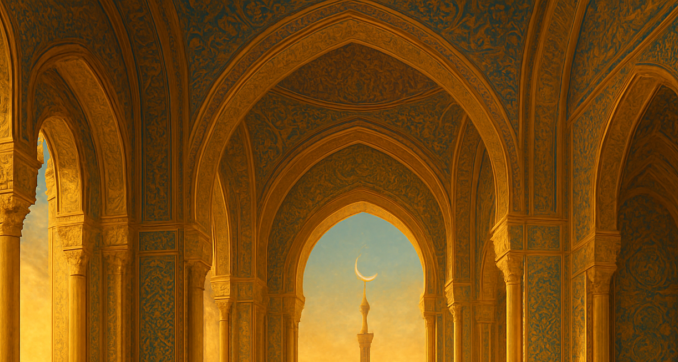
For nearly a thousand years, Noah called upon his people to turn toward the light. That is how the seventy-first chapter of the Quran tells the story of a prophet who never gave up, despite mockery and indifference. It is an ancient narrative, yet its core themes — patience, perseverance, and the courage to build when no one around you sees the point — echo through the lodge rooms of modern Freemasonry. This article traces the story from its historical roots and draws out the spiritual lessons it still offers us today.
The Historical Story: Noah in the Quran
Surah Noah is one of the shorter chapters of the Quran, consisting of just twenty-eight verses. According to Islamic tradition, it was revealed in Mecca during a period when the earliest Muslim community itself faced rejection and persecution. The surah recounts how Noah — known in Arabic as Nuh — called upon his people for nine hundred and fifty years, urging them to turn away from idolatry and toward the Creator. He addressed them by day and by night, in public and in private, yet his message was met with stubborn resistance. Ultimately, Noah turned to God with a plea for deliverance, and the great flood became the turning point.
Noah’s story is by no means unique to the Quran. In the Torah and the Old Testament, he appears as the builder of the Ark in the Book of Genesis. Mesopotamian texts, such as the Epic of Gilgamesh, contain a flood narrative with striking parallels. What sets the Quranic version apart is its emphasis on the inner struggle of the prophet himself: his loneliness, his patience, and his unwavering trust in a higher truth — even when the entire world turned its back on him.
The Spiritual Core: Seeking Light in Darkness
At the heart of Surah Noah lies an image that resonates deeply across spiritual traditions worldwide: the contrast between light and darkness. Noah urges his people to seek forgiveness, promising that if they do, the heavens will send rain and gardens and rivers will spring forth. Light here is not merely a physical phenomenon but a metaphor for insight, awakening, and moral clarity. Darkness represents ignorance, stubbornness, and the refusal to look beyond one’s own limitations.
This motif is reminiscent of what the Greek philosopher Plato described in his famous Allegory of the Cave: people chained in place, seeing only shadows on the wall while the true light burns behind them. In the Quranic telling, Noah is the one urging his fellow human beings to turn around, behold the light, and leave the cave. That they refuse does not make his story one of failure — rather, it becomes a lesson in the value of perseverance regardless of the outcome.
Noah as Builder: Parallels with Freemasonry
In the Masonic tradition, the building motif occupies a central place. The rough ashlar that must be shaped, the temple that rises within one’s own soul, the tools that are wielded not physically but spiritually — these are images every Freemason recognizes. Noah is a figure who fits perfectly within this framework. He built the Ark not because the world encouraged him, but because an inner conviction drove him. The Ark was both a physical vessel and a spiritual edifice — an expression of trust in something greater than himself.
It is no coincidence that Noah appears in certain historical Masonic texts as one of the patriarchs of the Craft. The so-called Old Charges — codes of conduct documented from the eighteenth century onward, notably by James Anderson in his Constitutions of 1723 — reference biblical builders as forerunners of the mason’s guild. In that tradition, Noah stands alongside figures such as Hiram Abiff and King Solomon. His story reminds us that building does not begin with stone and mortar, but with conviction and character.
The story of Noah teaches that true spirituality does not depend on recognition from others, but on the courage to keep building when no one else can see the plan.
Patience as Spiritual Discipline: Then and Now
The nine hundred and fifty years that Noah, according to the Quran, devoted to his calling is of course a symbolic timespan. But the message behind it is timeless and concrete: spiritual growth requires patience. In an age of instant gratification, where answers to every question are available within seconds, the story of Noah offers a counter-narrative. It reminds us that the most important changes — both in society and in the human heart — are slow processes.
The Stoic philosopher Seneca wrote that patience is the companion of wisdom. Marcus Aurelius, the Roman emperor-philosopher, emphasized in his Meditations that we cannot control events, only our reactions to them. In Freemasonry, this same awareness returns through ritual: the Entered Apprentice does not learn everything in a single evening, nor the Fellowcraft in a single year. The path toward mastery is one of repetition, reflection, and above all, patience.
What Noah’s Story Teaches Us Today
Surah Noah speaks not only to Muslims but to anyone who believes that spiritual development is a conscious choice. Several lessons stand out clearly:
Perseverance in conviction is not stubbornness — it is a form of inner strength. Building something of value requires courage, especially when those around you do not understand it. The search for light, in whatever tradition, begins with acknowledging one’s own darkness. And patience is not passivity — it is an active spiritual discipline.
Building Bridges Between Traditions
The story of Noah is one of the rare narratives that holds a prominent place in all three great monotheistic traditions — Judaism, Christianity, and Islam. This shared heritage makes it a powerful meeting point for dialogue between faiths and philosophies. Freemasonry, with its tradition of welcoming men of different beliefs under one roof and its insistence that seekers of light share more than divides them, is uniquely positioned to appreciate this universality.
Noah’s Ark has long served as a symbol of refuge, renewal, and the preservation of what is essential. In a Masonic context, it reminds us that the lodge itself can be a kind of ark — a space set apart from the storms of the profane world, where Brothers gather to work on themselves and on the bonds between them. The ark was not built for one person alone; it was built so that life, in all its diversity, could survive and flourish anew.
When we read Noah’s story through the lens of Freemasonry, we see a builder who worked in faith, endured in patience, and entrusted the outcome to a power beyond his own understanding. That is a message that transcends any single scripture — and one that every Mason can carry with him from the lodge into the world.
The story of Noah, whether read in the Quran, the Bible, or encountered in the symbolism of the lodge, is ultimately a story about the courage to build in the face of doubt. It challenges us to ask ourselves: are we willing to keep shaping the rough stone, even when no one applauds our labor? Are we patient enough to trust a process whose end we may never see? Freemasonry and the ancient wisdom traditions alike answer with a quiet affirmation — the work itself is the reward, and the light is always worth seeking.
Copyright text & image: devrijmetselaar.nl
Texts are based on the ideas and content of the author of devrijmetselaar.nl, reviewed, corrected, and supplemented with the assistance of OpenAI. Images are created based on the ideas of the author of devrijmetselaar.nl using OpenAI/DALL-E.

Be the first to comment