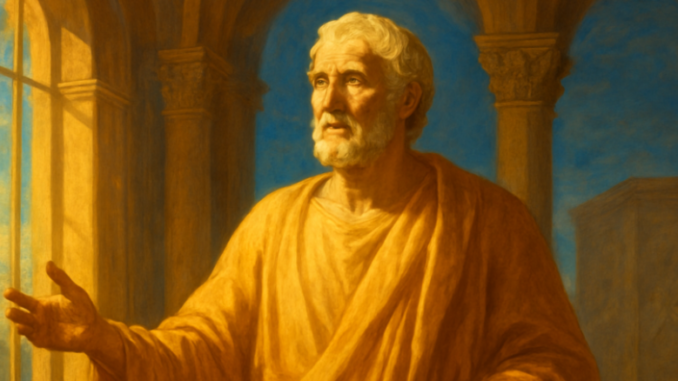
You may have experienced it yourself: an evening when a meaningful conversation left you more fulfilled than any achievement ever could. A moment when you realized that happiness doesn’t reside in what you possess, but in how you connect with the people around you. That experience runs like a golden thread through Seneca’s essay On the Happy Life, and it is the very same experience that Freemasons recognize when they gather in the lodge to work on inner growth together.
Happiness as a Shared Pursuit
Seneca wrote his essay as a personal exploration addressed to his brother Gallio. That detail alone is significant: he chose to formulate his deepest thoughts on happiness not in isolation, but in dialogue with someone close to him. For Seneca, the happy life was never a solo project. It only acquired real meaning when shared — when you tested your insights against another mind. This conviction resonates powerfully within Freemasonry, where personal development always unfolds within the context of brotherhood. You work on yourself, but never alone.
In the lodge, this takes shape through a distinctive rhythm. You listen to the experiences of your brethren, you share your own struggles, and together you discover patterns you would have missed on your own. Seneca would have recognized this dynamic. He wrote that the wise person does not flee from the world but takes a deliberate place among others, because virtue only truly takes form in relation to fellow human beings.
Virtue as a Living Practice, Not an Abstract Ideal
What makes Seneca’s approach to virtue so compelling is that he never reduces it to a checklist of rules. For him, virtue is an attitude toward life — a continuous exercise in making choices aligned with reason and with one’s own nature. He writes that the happy life springs from a mind free of fear and craving, one that finds peace within itself while remaining open to the world.
Freemasons will find this idea deeply familiar. The rituals and working methods of the lodge are not ends in themselves but tools for shaping the self. Just as Seneca presented Stoic philosophy not as dogma but as daily practice, so the Freemason regards the labor on the rough ashlar as an ongoing process. You are never finished. You don’t become a better person in a single evening. But every meeting, every moment of self-reflection, adds something to the edifice of your character.
The happy life does not emerge in isolation. It arises from a willingness to connect your inner growth with the people around you — exactly as Seneca taught and as Freemasonry puts into practice.
The Mirror of the Other
One of the most powerful passages in Seneca’s essay concerns the relationship between inner happiness and the external world. He does not criticize those who possess wealth; he criticizes those who allow wealth to possess them. The difference lies in awareness: Do you know why you do what you do? Can you step back from your possessions, your status, your habits, and look at yourself honestly?
In Freemasonry, this kind of self-reflection gains a special dimension because it happens in the presence of brethren. The lodge serves as a safe space where you can show yourself as you truly are, without a mask. That is no small thing. In everyday life, there are countless reasons to hide your vulnerability. But within the brotherhood of the lodge, honesty toward yourself is not only encouraged — it is protected. Your brethren serve as your mirror. They confront you not with judgment, but with recognition.
Freedom and Connection: No Contradiction
Imagine someone telling you that true freedom is only possible through connection with others. Your first instinct might be resistance. Freedom seems, after all, to be the opposite of being bound. But Seneca shows us that this is a false dichotomy. The person who retreats entirely into himself, cut off from every bond, is not free but imprisoned by his own limitations. Only when you find the courage to connect — to take responsibility for the community of which you are a part — do you experience the freedom that flows from a life of purpose and meaning.
Marcus Aurelius, writing a generation later in the same Stoic tradition, put it this way: what is not good for the hive is not good for the bee. That thought lives on in Freemasonry. The search for truth and light is not a solitary pilgrimage. It is a shared journey in which every brother is both student and teacher. You grow by giving, and you receive by remaining open.
The Happy Life as a Moral Compass
Seneca’s essay is not a self-help manual in the modern sense. He promises no quick results, no five steps to a better life. What he offers is something far more enduring: a moral compass. For Seneca, the happy life is one lived in accordance with one’s own virtue, in connection with the community, and with a clear awareness of what truly holds value.
You can recognize that compass in the way Freemasons approach their work. The rituals invite you to pause and reflect on fundamental questions. What is just? What is true? How do I relate to my fellow human beings? These questions are never answered once and for all. They return, each time in a different context, with new nuances. And every time you take them seriously, something shifts in your perspective. Your vision broadens. Your judgment becomes more gentle. Your connection with others deepens.
What Seneca and the Lodge Have in Common
When you place Seneca’s philosophy alongside the principles of Freemasonry, the parallels are striking. Both regard virtue as a daily exercise rather than a final destination. Both emphasize that personal growth only gains meaning in relation to others. Both warn against the temptation of outward display at the expense of inner authenticity. And both see self-reflection as the key to a conscious and meaningful life.
These are not superficial similarities. They point to a shared understanding of what it means to live well — an understanding that has endured across centuries, from the Stoic philosophers of ancient Rome to the lodges of today. The tools may differ, but the work is the same: to shape oneself honestly, courageously, and in the company of others who are committed to the same pursuit.
Seneca’s On the Happy Life reminds us that fulfillment is not found in accumulation or isolation, but in the deliberate practice of virtue within a community of like-minded seekers. For Freemasons, this ancient Stoic insight is not merely philosophical — it is lived experience. Every lodge meeting, every moment of honest self-examination shared among brethren, is a step toward the kind of happiness Seneca described: deep, durable, and rooted in connection. The rough ashlar does not shape itself. It takes a steady hand, a clear mind, and the brotherhood that makes the work worthwhile.
Copyright text & image: devrijmetselaar.nl
Texts are based on the ideas and content of the author of devrijmetselaar.nl, reviewed, corrected, and supplemented with the assistance of OpenAI. Images are created based on the ideas of the author of devrijmetselaar.nl using OpenAI/DALL-E.
Frequently Asked Questions
How does Seneca's view of happiness relate to Freemasonry?
Both Seneca and Freemasonry emphasize that happiness is not a solitary pursuit but something that unfolds within meaningful relationships and community. Seneca wrote his essay on happiness in dialogue with his brother, recognizing that insights only gain real meaning when shared with others. Similarly, Freemasons develop themselves through brotherhood in the lodge, where personal growth is always situated within a supportive community of fellow members.
What does Seneca mean by virtue as a 'living practice'?
For Seneca, virtue is not a set of rules to follow but an ongoing attitude toward life—a continuous exercise in making choices aligned with reason and one's nature. This perspective aligns with Freemasonry, where rituals and working methods serve as tools for self-development rather than ends in themselves. Both traditions recognize that becoming a better person is a lifelong process that requires deliberate practice at every meeting and moment of reflection.
Why did Seneca choose to share his thoughts on the happy life with his brother rather than keeping them private?
Seneca believed that the happy life requires dialogue and connection with others. By addressing his essay to his brother Gallio, he demonstrated his conviction that genuine happiness can only be understood and tested through relationships with fellow human beings. This reflects the Stoic belief that virtue and wisdom only truly take form in relation to others, not in isolation from the world.


Be the first to comment