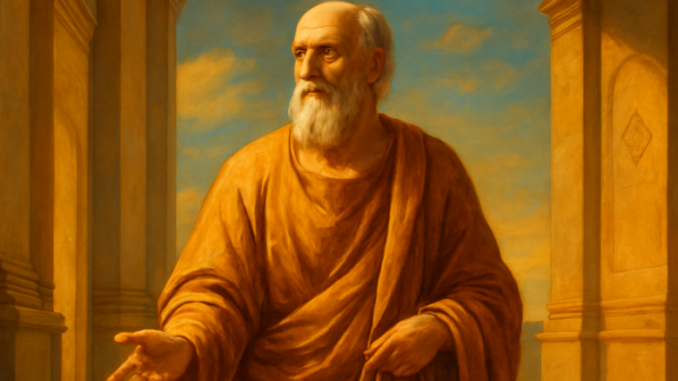
What makes a life truly happy? And why does that question still occupy our minds after two thousand years? When Lucius Annaeus Seneca wrote his essay De Vita Beata — On the Happy Life — he was not simply drawing from personal experience. He was joining a philosophical conversation that had been unfolding for centuries before him. Let us pull up a chair at that same conversation and discover which thinkers, schools, and traditions shaped his words — and why they still matter to Freemasons today.
Why Did Seneca Begin with the Stoics?
Seneca was, above all, a Stoic, and his essay on the happy life is the most direct proof of that commitment. But what did Stoicism actually mean to him? The school founded around 300 BCE by Zeno of Citium on the painted colonnade — the Stoa Poikile — in Athens taught that happiness does not depend on possessions, status, or pleasure, but on living in accordance with reason and nature. Cleanthes, Zeno’s successor, and later Chrysippus refined this idea into a comprehensive system: the cosmos is pervaded by an ordering reason, the logos, and human beings find their purpose by aligning themselves with it.
Seneca adopted this core insight, but he was no dogmatist. Where Chrysippus emphasized rigorous logic and natural philosophy, Seneca turned his attention to practical ethics. He wanted to answer the question every human being asks: How should I live? Stoicism gave him the foundation, but he built his own house upon it — one with windows that opened onto other traditions.
What Did Epicurus Have to Offer?
This is perhaps the most surprising question raised by Seneca’s essay. He mentions Epicurus — the philosopher typically seen as the Stoics’ great rival — with remarkable respect. Epicurus taught that the highest good consists of pleasure, but not the crude, bodily pleasure that his opponents attributed to him. What he meant was ataraxia: a state of inner tranquility and freedom from fear. Seneca recognized in that ideal something very close to his own conception of happiness.
In On the Happy Life, Seneca does challenge the Epicurean equation of pleasure and virtue. Yet in his Letters to Lucilius, he quotes Epicurus approvingly on numerous occasions. This willingness to look beyond the boundaries of his own school makes Seneca an eclectic thinker — someone who valued truth over labels.
Seneca demonstrates that true wisdom does not consist of blind allegiance to a single school but of the courage to seek truth wherever it may be found. This resonates deeply with Freemasonry, which calls upon its members to search for light without prejudice.
The Shadow of Plato and the Challenge of Aristotle
Behind Stoicism lies the long shadow of Plato, and Seneca was keenly aware of it. Plato’s idea that the soul is composed of different parts — and that justice arises when those parts exist in harmony — echoes through Seneca’s conviction that happiness springs from inner order. Where Plato, in the Republic, described the just soul as a miniature of the just state, Seneca saw the happy person as one in whom reason and passion are not opposed, but in whom reason holds the reins. Plato’s distinction between appearance and reality is also present in Seneca’s work: he repeatedly warns that the masses harbor a false idea of happiness, blinded by outward glitter.
Seneca also drew from Aristotle, although he rejected the Peripatetic position on one crucial point. In the Nicomachean Ethics, Aristotle argued that happiness requires virtue but also a certain measure of external goods — health, wealth, and friends. The Stoics, Seneca among them, found this dangerous. If happiness depends on circumstances, it becomes fragile. Seneca chose the Stoic position that virtue alone is sufficient for happiness, but he did so with a nuance that reveals he took Aristotle’s arguments seriously.
Seneca in the Roman Intellectual World
The Rome of Seneca’s day was a melting pot of Greek philosophy and Roman pragmatism. Marcus Tullius Cicero had made the great Greek philosophical schools accessible to a Latin audience a generation earlier. His dialogues on the highest goods and evils — De Finibus Bonorum et Malorum — are a direct forerunner of Seneca’s project. Cicero presented the positions of Stoics, Epicureans, and Academics side by side, forcing his readers to form their own judgments. Seneca went a step further: he consciously took a position, but with a rhetorical force that Cicero himself would have admired.
At the same time, Seneca wrote in an era of political turmoil. As an advisor to Emperor Nero, he stood at the heart of power and experienced the daily tension between philosophical ideals and political reality. That tension is what makes On the Happy Life so vivid. It is not an abstract treatise but a defense of a way of living in the midst of real danger. In this essay, Seneca defends himself against the charge that, as a fabulously wealthy senator, he preaches poverty. His response is refreshingly honest: the wise person possesses wealth but is not possessed by it. That distinction speaks volumes.
The Influence of the Cynics
No account of Seneca’s philosophical roots would be complete without mentioning the Cynics — the radical movement of Diogenes of Sinope and Antisthenes, which taught that convention and possessions alienate human beings from their natural state. The Stoics acknowledged the Cynics as their spiritual ancestors, and Seneca praises their fearlessness. In On the Happy Life, the Cynic rejection of false values resonates clearly, though Seneca chooses a more moderate path: not radical renunciation, but a conscious and deliberate engagement with the world.
What Does This Mean for the Freemason?
Freemasonry has always drawn from the same philosophical wells as Seneca. The emphasis on virtue as the foundation of a good life, the conviction that self-knowledge is the key to inner freedom, and the idea that a person must continually work to improve themselves — these are principles that are alive both in the Lodge and in Stoic philosophy. When Seneca insists that happiness is not found in external circumstances but in the quality of one’s inner life, he speaks a language that every Freemason understands.
His eclectic approach — drawing wisdom from multiple traditions without surrendering his own judgment — mirrors the Masonic ideal of seeking light from every possible source. Seneca reminds us that the rough ashlar is shaped not by one tool alone, but by every instrument of thought and experience we can bring to bear upon it.
Moreover, the tension Seneca experienced between philosophical ideals and the imperfections of daily life is one every Mason knows. We aspire to build a better self and a better world, yet we do so in the midst of human frailty. Seneca’s honesty about this struggle — his refusal to pretend that he had achieved perfection — makes him a model not of the finished temple, but of the work in progress.
Seneca’s On the Happy Life is far more than a Stoic manifesto. It is a synthesis of centuries of philosophical inquiry — Stoic, Epicurean, Platonic, Aristotelian, and Cynic — filtered through the mind of a man who lived in the real world and faced its contradictions head-on. For Freemasons, his work is a reminder that the pursuit of virtue, self-knowledge, and inner freedom is not the property of any single tradition, but a universal aspiration. Two thousand years later, the question he posed remains as urgent as ever: What makes a life truly happy? The answer, Seneca suggests, begins not with what we acquire, but with who we become.
Copyright text & image: devrijmetselaar.nl
Texts are based on the ideas and content of the author of devrijmetselaar.nl, reviewed, corrected, and supplemented with the assistance of OpenAI. Images are created based on the ideas of the author of devrijmetselaar.nl using OpenAI/DALL-E.
Frequently Asked Questions
What is the main focus of Seneca's essay 'De Vita Beata'?
Seneca's essay 'On the Happy Life' explores what makes a life truly happy by joining a philosophical conversation that had been developing for centuries. Rather than drawing only from personal experience, Seneca examines which thinkers, schools, and traditions shaped his understanding of happiness and why these ideas remain relevant to Freemasons today.
How did Seneca apply Stoic philosophy to his own ethical teachings?
While Seneca was committed to Stoicism and its core belief that happiness depends on living in accordance with reason and nature rather than possessions or pleasure, he was not a dogmatist. He took the Stoic foundation but built his own approach by focusing on practical ethics and answering the question of how one should live, rather than rigidly adhering to the logical systems of philosophers like Chrysippus.
Why did Seneca respect Epicurus despite being a Stoic?
Seneca recognized that Epicurus's concept of pleasure—which meant ataraxia, or inner tranquility and freedom from fear—aligned closely with his own conception of happiness. Though Seneca challenged the Epicurean equation of pleasure and virtue, he quoted Epicurus approvingly in his Letters to Lucilius, demonstrating that true wisdom comes from seeking truth wherever it may be found rather than showing blind allegiance to a single philosophical school.


Be the first to comment