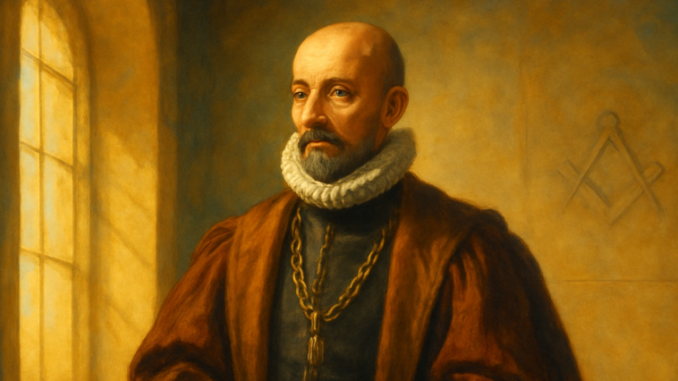
In his brief but remarkably powerful essay “On a Defective Partiality,” Michel de Montaigne holds up a mirror to one of humanity’s most persistent flaws: the tendency to judge others more harshly than we judge ourselves. This theme did not emerge in a vacuum. It is rooted deep in the classical philosophy that Montaigne studied so voraciously — from the Greek Skeptics to the Roman Stoics, from Plutarch to Seneca. The thinkers who populated his library whispered to him that true wisdom begins with examining one’s own prejudices. For the Freemason who regards himself as a rough ashlar, Montaigne’s essay opens a fascinating window onto a question that lies at the heart of the Craft: how honestly do we really look at ourselves?
The World of a Sixteenth-Century Thinker
When Montaigne began writing his Essays around 1572, France was torn apart by devastating Wars of Religion. The intellectual world was fractured between the dogmatic certainties of Catholics and Protestants alike. In this climate of violent conviction, Montaigne made a deliberate choice: he embraced doubt as a method. He retreated to his tower study in Bordeaux, surrounded by thousands of quotations from classical authors that he had inscribed on the ceiling beams. There, he developed a literary form that blended personal reflection with philosophical inquiry. His essay on partiality belongs to a series of short pieces in the first book of the Essays in which he dissects human weaknesses — not to condemn, but to understand.
Pyrrhonism: The Art of Suspending Judgment
The Greek philosopher Pyrrho of Elis founded a school of thought that profoundly influenced Montaigne. The Pyrrhonists practiced epoché — the suspension of all definitive judgment. They believed that human beings are incapable of attaining absolute truth, and that peace of mind arises from accepting this uncertainty rather than fighting it. Montaigne was so taken with this idea that he had a medal struck bearing the words “Que sais-je?” — What do I know?
This attitude echoes throughout his essay on partiality. Before we condemn another person, we must ask whether we possess sufficient knowledge — not only about them, but about ourselves. The skepticism Montaigne embraced was not cynical nihilism. It was an intellectual humility that created space for genuine humanity. An outsider observing Freemasonry might see strange rituals and mysterious symbols. The initiated Brother understands that the very awareness of one’s own ignorance is where every search for Light begins.
Seneca and the Stoic Practice of Self-Examination
Alongside the Skeptic tradition, Montaigne drew extensively from Stoicism, particularly from the letters of Seneca. This Roman statesman and philosopher emphasized the daily examination of conscience as a path to virtue. Every evening, Seneca would review his own actions: where had he fallen short? Where had he judged too hastily? This process of honest self-reflection lies at the very heart of what Montaigne addresses in his essay on partiality.
True self-knowledge does not come from pointing fingers at others, but from mustering the courage to face our own failings.
Seneca wrote to his friend Lucilius that we are inclined to see the splinter in another’s eye while ignoring the beam in our own. Montaigne takes up this theme and gives it his own twist: partiality is not merely a moral defect — it is, above all, an intellectual error. We apply double standards because we do not know ourselves well enough. For Freemasons, who are taught to work upon the rough ashlar of their own character, this insight strikes close to the bone. The working tools of the Craft — the gavel, the chisel, the gauge — are useless if wielded without honest self-appraisal.
Plutarch: The Moral Mirror
Of all the classical authors, Plutarch was perhaps Montaigne’s most beloved. The Greek biographer and moralist wrote his famous Parallel Lives, in which he consistently placed two figures side by side — one Greek, one Roman — and compared their virtues and vices. This method of comparison taught Montaigne that judgment is always relative. Plutarch demonstrated that even great men had their flaws, and that only through honest comparison can one arrive at genuine insight.
In his Moralia, Plutarch explicitly addresses the theme of self-love and how it clouds our capacity for fair judgment. Montaigne knew these texts intimately and referred to them often. His essay on partiality can be read as a personal engagement with Plutarch’s lessons: the philosopher as mirror, not as judge. This resonates powerfully within the lodge, where the mirror — sometimes literal, sometimes symbolic — serves as a tool for reflection rather than vanity.
Renaissance Humanism and the Masonic Ideal
The Renaissance humanism in which Montaigne was raised placed the human being at the center of inquiry — not as a perfect creature, but as a project in development. This vision aligns closely with the Masonic ideal of the rough ashlar that is polished through labor upon oneself. Where the uninitiated might see symbols of power or secrecy, the Freemason experiences tools for inner transformation: the compasses that set boundaries on desire, the square that symbolizes uprightness and moral rectitude.
Montaigne’s essay reminds us that this transformation must begin with honesty. The partiality we so readily attribute to others often resides within ourselves. The humanistic project of self-knowledge demands that we examine our own standards before we measure anyone else. This is not weakness — it is the highest form of intellectual courage. It is, in Masonic terms, the willingness to strike away at our own rough edges before presuming to shape anyone else’s stone.
Two Perspectives, One Insight
The classical philosopher and the modern Freemason approach the same fundamental question from different worlds. The philosopher seeks ataraxia — peace of mind through the suspension of hasty judgment. The Freemason strives for brotherhood by transcending prejudice. What they share is the conviction that wisdom begins with self-knowledge, and that self-knowledge is impossible without the willingness to acknowledge one’s own imperfections.
Montaigne built a bridge between these worlds. His essay on partiality invites us to pause and consider a deceptively simple question: do we measure ourselves by the same standard we apply to others? The answer determines not only our intellectual integrity, but also the quality of our human connections — in the lodge and beyond.
The philosophical sources that nourish Montaigne’s essay on partiality form a rich tradition of self-examination. From Pyrrho’s suspension of judgment to Seneca’s nightly review of conscience, from Plutarch’s moral comparisons to the humanist conviction that we are works in progress — these currents converge in a single, enduring insight. The hardest person to judge fairly is always oneself. For the Freemason committed to working upon the rough ashlar, Montaigne’s message is both a challenge and a gift: true moral progress is impossible without the courage to confront our own biases first. In the quiet honesty of that confrontation lies the beginning of every meaningful journey toward Light.
Copyright text & image: devrijmetselaar.nl
Texts are based on the ideas and content of the author of devrijmetselaar.nl, reviewed, corrected, and supplemented with the assistance of OpenAI. Images are created based on the ideas of the author of devrijmetselaar.nl using OpenAI/DALL-E.

Be the first to comment