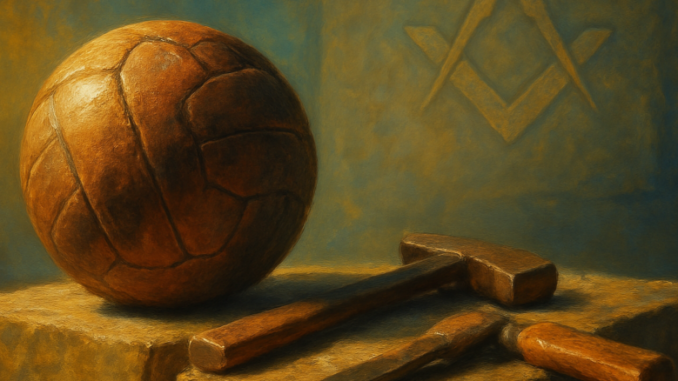
Imagine standing at the helm of an organization with millions of followers, a storied history, and sky-high expectations — and yet, nothing works. Defeat after defeat piles up, the public turns against you, and the pressure becomes unbearable. You may not recognize that feeling from the world of football, but perhaps you know it from your own life. That moment when everything seems to conspire against you and you ask yourself: where do I find the strength to carry on? That question strikes at the very heart of what Freemasonry teaches us about leadership, responsibility, and building character in times of crisis.
A Crisis That Reaches Beyond the Pitch
The recent defeat of one of the world’s most famous football clubs — an away match that painfully exposed the failures of the current leadership — has dominated the headlines. Results are falling short, the manager is under fire, and supporters are openly questioning whether this is still the right course. It is a story we know from sport, but it is really a universal human drama: what happens when leadership fails, when a community loses its direction, and when the cry for change grows louder than the will to persevere?
For anyone familiar with Freemasonry, such a situation immediately raises deeper questions. Not about tactical formations or transfer budgets, but about the very nature of leadership itself. What makes someone a good leader? And more importantly: how do you respond when you fall short?
The Builder Who Is Being Built
In Freemasonry, the concept of the “rough ashlar” is fundamental. Every human being starts as an unworked block of stone that is gradually shaped — through experience, reflection, and moral effort — into something more refined. But that process of formation is never linear. It involves cracks, fractures, and moments when the chisel slips. It is precisely those moments of failure that reveal our true character.
The Stoic philosopher Marcus Aurelius wrote in his Meditations that the obstacle on the path becomes the path itself. Adversity is not a deviation from the journey — it is the journey. This insight is far from idle philosophy. It demands radical honesty with yourself. A football manager suffering defeat after defeat faces the same existential choice as any person in a position of leadership: do I blame the circumstances, or do I dare to look in the mirror?
In the lodge, Brethren learn that self-knowledge is the foundation of every edifice. Without an honest assessment of your own shortcomings, nothing lasting can be built.
Bearing Responsibility Within a Community
What makes the crisis surrounding this football club so recognizable is the dynamic between the leader and his community. Supporters feel betrayed, players appear to be losing confidence, and the board navigates uneasily between loyalty and pragmatism. It is a microcosm of how any organization functions when its foundations begin to crumble.
Freemasonry knows this tension well. A lodge is a brotherhood in which every member bears responsibility for the whole. The Worshipful Master leads the work, but his authority does not rest on power. It rests on trust, on the ability to listen, and on the willingness to place the collective good above personal ego. Aristotle described in his Nicomachean Ethics that true leadership is a form of service: the leader exists for the community, not the other way around.
When that balance is disturbed — when a leader entrenches himself, or when a community turns against him without leaving room for dialogue — everyone loses. True leadership does not reveal itself in victories, but in the way you rise after a defeat and take responsibility for what went wrong.
The Ethics of Perseverance and Letting Go
There is a fine line between admirable perseverance and stubborn blindness. In society, we admire people who press on, who refuse to be broken by headwinds. But we also recognize the point at which holding on becomes destructive — both for the leader and for those around him. How do you determine when to keep going and when to let go?
Montaigne wrote compellingly about the need to continually test your own judgment. He warned against the deeply human tendency to cling to a position once taken — not because it is right, but because letting go feels like losing face. In Freemasonry, this principle finds expression in the ritual work: the Brother learns to subordinate his ego to a greater whole, to acknowledge with humility that wisdom sometimes means taking a step back.
What the Outside World Teaches Us About Our Inner Life
You might wonder what a football match truly has to do with the principles of Freemasonry. The answer is simpler than you might think. Freemasonry does not operate in a sealed-off world. It invites its members to apply the lessons of the lodge in daily life — in society, in the workplace, in the family. When we look at a sporting crisis, we see the same forces at work that play out in every human organization:
The tension between individual interest and collective well-being. The question of whether leadership is a right or a responsibility. The capacity to reflect honestly rather than shifting blame. And the courage to acknowledge when a different path is needed.
Goethe, himself a Freemason, understood that life is a continuous process of becoming. No single result, no single defeat, defines who you are. What defines you is how you respond to what life places before you. In his Faust, he shows that human beings find meaning only when they stop searching for quick fixes and surrender to the slow, sometimes painful work of genuine transformation.
The crises we witness in football — and in every sphere of public life — are mirrors held up to our own struggles with leadership, responsibility, and growth. Freemasonry does not promise easy answers, but it offers a framework for navigating these challenges with integrity. The rough ashlar does not become a perfect cube overnight. It is shaped blow by blow, setback by setback, through the patient and honest labor of a lifetime. Whether you lead a lodge, a team, or simply your own life, the lesson is the same: defeat is not the end of the story. It is the chapter where character is forged.
Copyright text & image: devrijmetselaar.nl
Texts are based on the ideas and content of the author of devrijmetselaar.nl, reviewed, corrected, and supplemented with the assistance of OpenAI. Images are created based on the ideas of the author of devrijmetselaar.nl using OpenAI/DALL-E.
Frequently Asked Questions
What is the concept of the 'rough ashlar' in Freemasonry and how does it relate to leadership?
The 'rough ashlar' is a fundamental Masonic concept representing every human being as an unworked block of stone that is gradually shaped through experience, reflection, and moral effort. It teaches that leadership development is not linear and involves cracks, fractures, and moments of failure. These difficult moments are essential to the process, as they reveal true character and are integral to becoming a refined, effective leader.
How does Freemasonry teach us to respond to failure and crisis?
Freemasonry emphasizes radical self-honesty and the pursuit of self-knowledge as the foundation of leadership. Rather than blaming external circumstances, Masonic teachings encourage leaders to look inward and take responsibility for their shortcomings. The article references Marcus Aurelius's Stoic philosophy that 'the obstacle on the path becomes the path itself,' suggesting that adversity and failure are not deviations from the journey but integral parts of it.
What universal lessons can we learn from a football crisis according to Freemasonry?
While a football crisis appears to be about tactics and results, it represents a universal human drama about what happens when leadership fails and communities lose direction. Freemasonry teaches that such crises raise deeper questions about the nature of leadership itself and character-building. The key lesson is that how leaders respond to failure—with honesty, reflection, and moral effort—defines their true character and ability to lead effectively.


Be the first to comment