Railway tracks stretching to the horizon symbolizing Masonic self-reflection
Personal Development & Leadership

Accusation and Denial: What This Reveals About Character

A railway line. At first glance, nothing more than steel and gravel — a functional connection between two points. But when that line becomes the stage for accusations and denials, when organizations point fingers and deflect blame, something far deeper is revealed. Not about tracks, but about the human soul. About how we respond when our character is truly put to the test. The Railway as a Mirror of the Soul Recent accusations of sabotage on railway lines — and the emphatic denials that followed — touch on something universal. The moment a person or group is accused, a choice presents itself: how do I respond? That choice is a window into personality, into the character that lies beneath the surface. The railway itself, stretching across the landscape, becomes an unexpected mirror. In Freemasonry, we speak of the rough ashlar — the unworked stone that, through dedicated labor, is shaped into a perfect cube. That shaping does not happen in times of comfort but precisely under pressure. When the chisel strikes, when the hammer falls, only then does the true quality of the material reveal itself. An accusation is such a hammer blow. Not pleasant, but profoundly revealing. The Trial […]
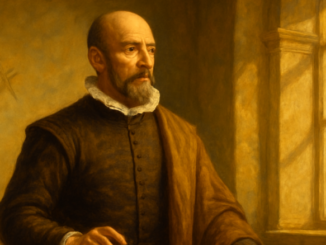
Ancient Stoic philosopher reflecting in contemplation within a symbolic lodge
Lucius Annaeus Seneca – Letters to Lucilius

Seneca on Simplicity and Fidelity: The Philosophical Roots

Can anyone truly practice philosophy when their life contradicts their words? Lucius Annaeus Seneca poses this question with striking sharpness in his twentieth letter to Lucilius. It is a question that has echoed through the centuries and still reverberates today in the silence of the Masonic lodge, where the tension between professing and practicing lies at the very heart of the work. Let us explore the philosophical sources Seneca drew upon when he composed this remarkable letter. The Paradox of the Talking Philosopher Seneca opens his letter with a challenge that is as simple as it is unsettling: let your actions match your words. The demand sounds self-evident, and that is precisely what makes it so treacherous. The Stoic tradition from which Seneca emerged had always wrestled with the gap between theory and practice. Zeno of Citium, the founder of the Stoa around 300 BCE, was already criticized by opponents who argued that his strict doctrines were impossible to live by. Seneca acknowledges this tension openly. He was himself a wealthy man at the court of Emperor Nero — a position that was difficult to reconcile with his preaching of sobriety. Yet this is not hypocrisy in the simple sense […]

Open book with mirror and rough ashlar stone symbolising Masonic self-reflection
Michel de Montaigne – Content & Summary

Montaigne on Custom: What Our Habits Reveal About Us

A spoon. A simple piece of cutlery we raise to our mouths without a second thought. But what if you grew up in a culture where eating with your hands was the only respectable way to dine? In his twenty-third essay, Michel de Montaigne invites us to pause and reflect on such everyday habits — and to discover what they reveal about the human condition. In ‘Of Custom,’ he unfolds a rich collection of examples that compels us to question everything we consider normal. The Core Idea of the Essay In this essay, Montaigne examines the vast diversity of human customs and habits — from eating practices to funeral rites, from dress codes to forms of greeting. His central thesis is as simple as it is unsettling: what we experience as natural and self-evident is almost always the product of habit and upbringing. The power of custom is so great that we are barely able to look at it critically. Montaigne draws from classical sources such as Herodotus, Pliny, and Seneca, but also from travel accounts of his own time about newly discovered peoples in the Americas and Africa. He places the customs of these distant cultures alongside those of […]

Open book of Montaigne's Essays with symbolic light representing custom and law
Michel de Montaigne – Content & Summary

Montaigne on Custom: Why Laws Don’t Change Easily

What makes us consider certain customs perfectly natural while other peoples do the exact opposite? And why is it so difficult to change laws, even when they are clearly flawed? Michel de Montaigne posed these questions more than four centuries ago, and his answers remain strikingly relevant today. In this twenty-second essay from his first book, the French philosopher examines the extraordinary power that custom holds over our thoughts and actions — a theme that resonates deeply with anyone who values self-examination and the role of ritual in shaping human life. The Core of the Essay: Custom as Tyrant Montaigne opens with a deceptively simple observation: custom determines nearly everything we consider normal. What we eat, how we sleep, the clothes we wear, the way we bury our dead — all of this varies radically from culture to culture. Yet people everywhere experience their own practices as the natural, even the only correct way to live. Custom, Montaigne argues, is a tyrannical mistress who takes possession of us by stealth. The essay weaves together two interconnected themes. The first explores how custom clouds our judgment and blinds us to the arbitrariness of our own practices. The second applies this insight […]

Ancient Greek temple columns symbolizing Socratic philosophy and Freemasonry
Plato – Freemasonry & Connection

Socrates’ Apology and Freemasonry: Two Paths to Truth

When a philosopher stood before his judges in 399 BC and chose death over abandoning his pursuit of truth, he touched something universal. Plato’s account of Socrates’ Apology is far more than the record of a trial. It is a manifesto on the value of self-examination, the courage to swim against the current, and an unwavering commitment to inner truth. For anyone familiar with the Masonic tradition, these themes strike a remarkably familiar chord. Both paths — that of Socrates and that of Freemasonry — lead toward the same destination: a person who knows themselves and lives accordingly. The Philosopher Before His Accusers In the Apology, Socrates defends himself against charges of impiety and corrupting the youth of Athens. His defense is no plea for mercy — it is a powerful articulation of his life’s mission. He explains that the Oracle at Delphi declared him the wisest of all people, not because he knew everything, but because he alone recognized the extent of his own ignorance. This paradox lies at the very heart of his philosophy: true wisdom begins with the awareness of how little one actually knows. To an outsider, this may seem bewildering. Why would anyone dedicate their […]

Hourglass in a Masonic lodge symbolizing Seneca's philosophy of time
Lucius Annaeus Seneca – Letters to Lucilius

Seneca’s First Letter: The Philosophy of Time in Freemasonry

A candle flickers in the early morning as a Freemason opens his journal. Before him lies a translation of Seneca’s letters, turned to the very first one. He reads words written nearly two thousand years ago and feels an uncanny recognition: time slipping away unnoticed, the urgent need to claim every moment. In the stillness of the lodge, where the hourglass stands prominently displayed, these ancient words take on an unexpected immediacy. The Stoic Roots of Time Awareness Lucius Annaeus Seneca wrote his first letter to Lucilius around 63 AD, during a period when he was withdrawing from political life at the court of Emperor Nero. That this letter on the use of time opens his entire correspondence is no accident. Seneca immediately lays the foundation of Stoic philosophy as a way of life: the realization that time is our only true possession, and simultaneously our most vulnerable one. The Stoic school, founded by Zeno of Citium around 300 BC, regarded time as an ethical category. Where other philosophical traditions focused on knowledge or happiness as the highest good, the Stoics saw virtuous action in the here and now as the essence of a life well lived. Seneca inherits this […]