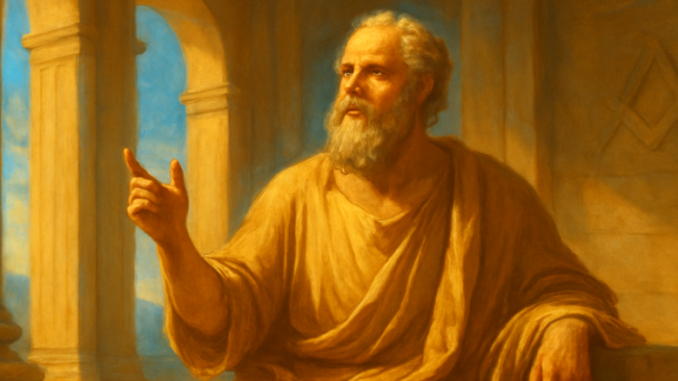
When a philosopher stood before his judges in 399 BC and chose death over abandoning his pursuit of truth, he touched something universal. Plato’s account of Socrates’ Apology is far more than the record of a trial. It is a manifesto on the value of self-examination, the courage to swim against the current, and an unwavering commitment to inner truth. For anyone familiar with the Masonic tradition, these themes strike a remarkably familiar chord. Both paths — that of Socrates and that of Freemasonry — lead toward the same destination: a person who knows themselves and lives accordingly.
The Philosopher Before His Accusers
In the Apology, Socrates defends himself against charges of impiety and corrupting the youth of Athens. His defense is no plea for mercy — it is a powerful articulation of his life’s mission. He explains that the Oracle at Delphi declared him the wisest of all people, not because he knew everything, but because he alone recognized the extent of his own ignorance. This paradox lies at the very heart of his philosophy: true wisdom begins with the awareness of how little one actually knows.
To an outsider, this may seem bewildering. Why would anyone dedicate their life to questioning fellow citizens, confronting them with their unexamined assumptions and false certainties? Why would Socrates accept a death sentence rather than give up this work? From his perspective, the answer is clear: the unexamined life is not worth living. This statement — perhaps the most quoted line in all of Western philosophy — captures everything that drove him.
The Freemason and the Unexamined Life
Anyone who enters Freemasonry begins symbolically as a rough stone. The work that follows — generation after generation — revolves around refining that stone through self-reflection, moral practice, and fraternal correction. Just as Socrates questioned his fellow Athenians, the work of the lodge invites Brethren to test their own convictions. The rituals serve as mirrors, not as dogma.
Where Socrates engaged in dialogue in the marketplace of Athens, the Freemason finds his workshop in the privacy of the lodge. Yet the movement is identical: from darkness toward light, from assumption toward insight, from superficiality toward depth. The search for truth requires, in both traditions, a willingness to let go of cherished beliefs when they fail to withstand critical scrutiny.
Both Socrates and the Freemason recognize that genuine growth begins with the courage to question yourself — not with the ambition to convince others.
Two Perspectives on Virtue and Character
In the Apology, Socrates insists that care for the soul matters more than wealth, fame, or physical pleasures. He compares himself to a gadfly that stings the sluggish Athenian state into wakefulness. His mission, he claims, is divinely ordained. He cannot help but urge people to tend to their souls, to choose virtue over comfort.
The Masonic tradition shares a strikingly similar hierarchy of values. Its emphasis on inner growth and moral perfection mirrors Socrates’ conviction that character is the highest good. Where Athenian philosophy speaks of arete — the excellence of the soul — Freemasonry speaks of building the inner temple. Both traditions view the human being as a work in progress: never finished, always evolving.
What They Share: The Heart of the Connection
Despite a gap of more than two thousand years, the philosophy of Socrates and the Masonic tradition share a remarkable set of common values:
Self-reflection as the foundation of wisdom and growth. Both traditions hold that the journey inward is the most important journey one can undertake. Without honest self-examination, no meaningful progress is possible.
The pursuit of truth as a lifelong endeavor, not a final destination. Neither Socrates nor the Masonic tradition promises ultimate answers. Instead, both frame the search itself as the purpose — an ongoing commitment rather than a fixed conclusion.
Moral integrity over social approval. Socrates chose death over compromise. The Masonic tradition similarly calls upon its members to uphold their principles, even when doing so brings no external reward or recognition.
Fraternal connection through a shared striving toward light. The Socratic dialogue was never a solitary exercise — it required others. Likewise, the lodge exists because the work of self-improvement is strengthened through brotherhood and mutual accountability.
The recognition that true knowledge begins with an awareness of one’s own limitations. This is perhaps the deepest point of convergence. Socratic humility and the Masonic acknowledgment that there is always more to learn spring from the same wellspring.
These parallels are not coincidental. Freemasonry emerged during a period when the rediscovery of classical philosophy was transforming Europe. Thinkers like Plato, Aristotle, and Socrates were being unearthed and integrated into new frameworks of meaning. The Masonic tradition drew consciously from these sources — not to copy them, but to weave their insights into its own rituals and symbols.
The Lesson for Today
What does this comparison teach us? Both Socrates and the Freemason remind us that easy answers are rarely the right ones. In an age when information is abundant but wisdom scarce, the call to self-examination remains as urgent as ever. The courage to question your own beliefs, the understanding that growth can be painful, the dedication to something greater than personal comfort — these are values that do not age.
Socrates died for his principles. The Freemason is thankfully not asked to do the same, but the symbolic death and rebirth within the rituals point toward the same truth: to truly live, one must be willing to let go of the old self. The unexamined life is indeed not worth living — not as a punishment, but as an invitation to a deeper existence.
The Apology of Socrates and the Masonic tradition speak from different ages, yet their message resonates across the centuries. Both invite us to live a life of conscious inquiry, moral courage, and continual refinement. For those who know both paths, the connection is unmistakable — not as a historical curiosity, but as living inspiration for anyone who chooses light over darkness, truth over convenience, and growth over stagnation.
Copyright text & image: devrijmetselaar.nl
Texts are based on the ideas and content of the author of devrijmetselaar.nl, reviewed, corrected, and supplemented with the assistance of OpenAI. Images are created based on the ideas of the author of devrijmetselaar.nl using OpenAI/DALL-E.
Frequently Asked Questions
What is the connection between Socrates' philosophy and Freemasonry?
Both Socrates and Freemasonry share a fundamental commitment to self-examination and the pursuit of truth. Socrates believed that true wisdom begins with recognizing one's own ignorance, while Freemasonry symbolically begins with the candidate as a rough stone that must be refined through self-reflection and moral practice. Both traditions emphasize the journey from darkness toward light and from superficial understanding to deeper insight.
What did Socrates mean by 'the unexamined life is not worth living'?
This statement reflects Socrates' belief that a meaningful life requires constant self-questioning and critical examination of one's beliefs and assumptions. Rather than accepting conventional wisdom without scrutiny, Socrates dedicated his life to questioning people and challenging their unexamined certainties. He valued this pursuit of truth so deeply that he chose death rather than abandon it.
How do Masonic rituals relate to Socratic philosophy?
Masonic rituals function as mirrors for self-reflection rather than as dogmatic rules, much like Socrates' method of dialogue in the Athenian marketplace. While Socrates engaged in public questioning, Freemasons conduct their work of self-examination within the lodge. Both use their respective methods to invite individuals to test their convictions, question their assumptions, and pursue genuine personal growth through critical thinking and fraternal engagement.

Be the first to comment