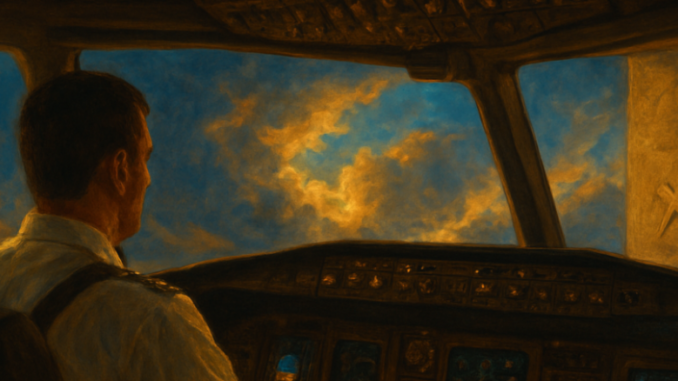
When an aircraft suddenly drops thousands of feet, the crew faces the ultimate test — not just of technical skill and training, but of inner trust. A recent incident in which a plane made an unexpected dive and landed safely was described by experts as a tribute to both machine and human capability. For the Freemason, this event raises a deeper question: what does trust mean when the ground beneath your feet disappears? And how does that relate to the spiritual journey every person undertakes?
The Pilot: Trust in the Visible
For a pilot, trust is never abstract. It is rooted in measurable quantities — instruments, checklists, years of rigorous training. When an emergency strikes, the pilot falls back on protocols rehearsed down to the smallest detail. There is no room for doubt, no moment for philosophical reflection. The pilot’s trust is horizontal in nature: directed toward colleagues in the cockpit, toward air traffic control, toward the engineers who designed the aircraft.
This kind of trust is indispensable in crisis situations. It enables people to think clearly under extreme pressure and make the right decisions. The pilot does not rely on hope or luck but on proven methods and collective expertise. It is a trust that draws its strength from repetition — from knowing something works because it has worked thousands of times before.
The Freemason: Trust in the Invisible
The Freemason knows a different form of trust. Where the pilot relies on instruments, the Mason seeks support in something that cannot be measured. In the Masonic tradition, one speaks of the Great Architect of the Universe — a principle that transcends human perception. This is not religion in the conventional sense, but rather an acknowledgment that something greater exists beyond what any individual can fully comprehend.
The Freemason’s trust is vertical: directed upward, toward an ordering principle, toward the invisible architecture of existence. This trust is not proven by instruments but cultivated through ritual, reflection, and brotherhood. Where the pilot falls back on protocols, the Freemason draws on ancient symbols passed down from generation to generation.
Two Worlds, One Foundation
At first glance, the pilot and the Freemason seem worlds apart. One operates in a cockpit filled with screens and switches, the other in a lodge adorned with ancient symbols. Yet they share something fundamental: both must be willing to let go in order to act. The pilot releases personal fears to surrender fully to training. The Freemason lets go of ego to create space for inner growth.
Trust is not the absence of uncertainty — it is the willingness to act despite uncertainty.
This letting go is not weakness but strength. It takes courage to acknowledge that you cannot control everything. In aviation as in Freemasonry, the same truth holds: those who cling too tightly lose their flexibility. Those who dare to trust find their balance.
The Test of the Moment
A dive lasts only seconds, but it feels like an eternity. In those moments, everything a person believes is put to the test. For the pilot, this is the moment when all training must pay off. For the passenger, it is a confrontation with mortality — a moment when spiritual questions become suddenly and urgently real.
The Stoic philosopher Marcus Aurelius wrote about the necessity of living each moment as though it could be your last — not out of fear, but out of respect for the preciousness of existence. The Freemason recognizes this sentiment. In Masonic ritual, the brother is reminded of life’s finitude — not to discourage him, but to awaken him to what truly matters.
The Real Tribute Goes to the Human Spirit
Experts praised the aircraft that survived the dive. But the real tribute belongs to the people involved. To the engineers who poured generations of knowledge into steel and aluminum. To the pilots who mastered their fear and took action. To every person who, in moments of crisis, discovers that deep within there exists a wellspring of strength.
A Freemason would say that this wellspring is always present, but we tend to forget it amid the noise of everyday life. Sometimes it takes a shock — a sudden dive in our own lives — to remind us of what is truly valuable. The question is never whether you will fall, but whether you have the trust to rise again.
What This Teaches Us
The comparison between pilot and Freemason reveals that trust takes many forms. Horizontal trust — in fellow human beings and systems. Vertical trust — in something that transcends us. Both are necessary to remain whole in a world that sometimes spins and plunges without warning.
- Trust in others makes cooperation possible.
- Trust in something higher gives direction to personal growth.
- Trust in yourself arises from practicing both.
Freemasonry does not offer ready-made answers, but it does provide a framework for exploring these questions. In the stillness of the lodge, surrounded by brothers engaged in the same search, one learns that trust is not a destination but a path — a path that can only be walked by daring to take each step anew.
An aircraft that survives a dive reminds us how precious and fragile life truly is. For the Freemason, this is not cause for fear but for contemplation. It invites us to examine where our own trust rests: in the instruments around us, in the brothers beside us, or in that invisible principle that connects us all. Perhaps the answer is: in all three at once.
Copyright text & image: devrijmetselaar.nl
Texts are based on the ideas and content of the author of devrijmetselaar.nl, reviewed, corrected, and supplemented with the assistance of OpenAI. Images are created based on the ideas of the author of devrijmetselaar.nl using OpenAI/DALL-E.

Be the first to comment