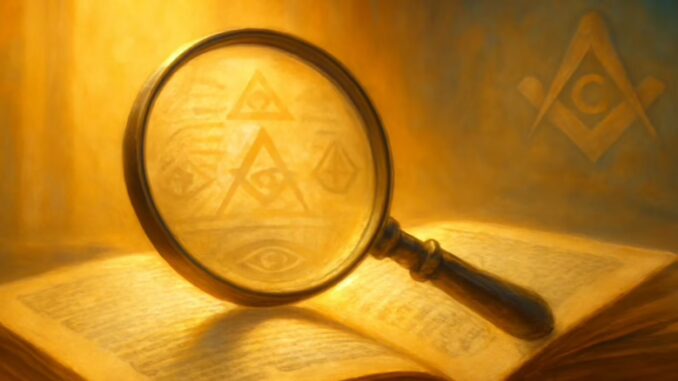
You’ve probably had a conversation where someone said something that sounded perfectly innocent on the surface — yet you sensed a deeper layer beneath the words. A subtle nod to something unspoken. A reference only you could recognize. That is the essence of what we call allusive meaning. This ability to communicate through indirect reference — through symbols, gestures, and carefully chosen words — opens up a world of subtle exchange that reaches far beyond the literal. In Freemasonry, this hidden language plays a central and defining role.
What Does “Allusive” Actually Mean?
The word “allusive” derives from the Latin alludere, which literally means “to play toward something.” An allusive expression plays with meaning without stating it directly. It’s an indirect reference, a hint that only comes alive when the receiver recognizes the underlying layer. Think of a smile that says more than a thousand words, or a hand gesture that evokes a shared memory.
In everyday language, we make allusive remarks more often than we realize. When someone says “that was a titanic effort,” they’re indirectly referencing the famous maritime disaster without explicitly naming it. The power of allusive meaning lies in the shared knowledge between speaker and listener. It creates a bond of mutual understanding — an unspoken agreement that both parties are operating on the same wavelength.
Allusive Symbolism in Freemasonry
In Freemasonry, allusive meaning is elevated to an art form. The entire symbolic language of the lodge is built from references that remain enigmatic to outsiders but open up a rich world of meaning for those who have been initiated. Consider the square and compasses. At first glance, they are simply the tools of a builder. But for those who understand the context, they allude to ethical principles: measuring your conduct, building your character, striving for moral uprightness.
This mode of communication is not about secrecy for its own sake. It is an ancient tradition in which wisdom is transmitted through images that provoke reflection. The symbols compel you to seek meaning for yourself, to actively participate in the process of understanding. That is precisely what makes the experience so deeply personal and unforgettable.
Why Indirect References Are So Powerful
You might wonder why we don’t simply say what we mean. Why all the indirection? The answer lies in the depth of human experience. Some insights cannot be captured in literal language. They must be felt, experienced, and slowly discovered. An allusive approach invites contemplation rather than mere consumption of information.
The symbol speaks to those who are willing to listen. It remains silent for those who only want to hear what they already know.
This idea goes to the heart of allusive communication. It requires an active posture from the receiver. You can look at a symbol and see a simple image, or you can open yourself to the layers of meaning hidden within it. The choice is entirely yours — and that freedom of interpretation is part of what gives Masonic symbolism its enduring power.
Recognition as the Key to Allusive Meaning
Imagine walking into a room where familiar symbols greet you. A black-and-white checkered floor. A burning candle. An open book. For someone who lacks the context, these are merely decorative elements. But for those who understand the language, they tell a story about duality, light, and the search for wisdom.
That moment of recognition creates a remarkable sense of connection. You share something with others that doesn’t need to be put into words. It is a silent acknowledgment of shared values and experiences. In a world where everything is often spelled out and over-explained, there is something genuinely refreshing about communication that leaves room for the unspoken.
The Art of Reading Between the Lines
The ability to recognize allusive meaning is a skill that can be cultivated. It requires attention, curiosity, and a willingness to look beyond the obvious. In Freemasonry, this ability is consciously developed. Every meeting, every ritual, every symbol is an invitation to reflect.
Here are a few practices that can sharpen your sensitivity to allusive meaning:
- Pay attention to repetition: Symbols that recur frequently often carry a core message worth investigating.
- Ask yourself: What could this mean for me personally? Meaning is not one-size-fits-all.
- Stay open to multiple interpretations: Symbols are rarely unambiguous — their richness lies in their multiplicity.
- Share your insights with others: Conversation often brings new layers of meaning to the surface that you might never have discovered alone.
Living Allusively: An Invitation
What would happen if you carried this way of seeing into your daily life? What if you looked for hidden references in ordinary objects and everyday situations? The sun rising as a symbol of new beginnings. The threshold you cross as a marker of transition. The breaking of bread as a sign of community.
The world around you is rich with allusive meaning — if you are willing to look. It requires only a shift in attention. From consuming to contemplating. From rushing to wondering. Within that shift lies an ancient insight that surfaces in every wisdom tradition: meaning is not given — it is found by those who seek.
The allusive meaning of symbols opens a door to deeper communication and self-reflection. In Freemasonry, this language has been cherished for centuries as a path toward wisdom. But you don’t need to be a member of any organization to appreciate the art of allusion. Start today. Look around you. Ask yourself what the things you see might be trying to say. And if you ever encounter a symbol that stays with you — that you can’t quite shake — know this: there is always more to discover.
Copyright text & image: devrijmetselaar.nl
Texts are based on the ideas and content of the author of devrijmetselaar.nl, reviewed, corrected, and supplemented with the assistance of OpenAI. Images are created based on the ideas of the author of devrijmetselaar.nl using OpenAI/DALL-E.
Frequently Asked Questions
What does 'allusive meaning' mean in Freemasonry?
Allusive meaning refers to communication through indirect references, symbols, and carefully chosen words rather than explicit statements. In Freemasonry, this subtle language allows members to exchange deeper layers of meaning that resonate with shared knowledge and understanding. It creates a bond between those initiated into the tradition, opening up a rich world of symbolism that invites personal reflection and contemplation.
Why does Freemasonry use symbols instead of just stating things directly?
Symbols in Freemasonry invite active participation and deeper understanding rather than passive consumption of information. Some profound insights about ethics, character, and morality cannot be fully captured in literal language—they must be felt and discovered through reflection. This approach makes the learning experience deeply personal and unforgettable, as members engage in meaningful contemplation of their own.
How do the square and compasses work as allusive symbols in Freemasonry?
While the square and compasses appear to be simple builder's tools on the surface, they allude to deeper ethical principles for those who understand their context. The square symbolizes measuring and straightening one's conduct, while the compasses represent drawing boundaries and building character with precision. Together, they communicate the Masonic ideals of moral uprightness and self-improvement through indirect, meaningful reference.
Is the allusive language in Freemasonry meant to keep secrets from outsiders?
The symbolic language of Freemasonry is not about secrecy for its own sake, but rather an ancient tradition of transmitting wisdom through images that provoke reflection and personal discovery. This approach respects the natural human desire to seek and understand meaning for oneself. The symbols remain enigmatic to those unfamiliar with Masonic teaching, but they open up a profound world of understanding for initiated members who are willing to engage in deep contemplation.

Be the first to comment