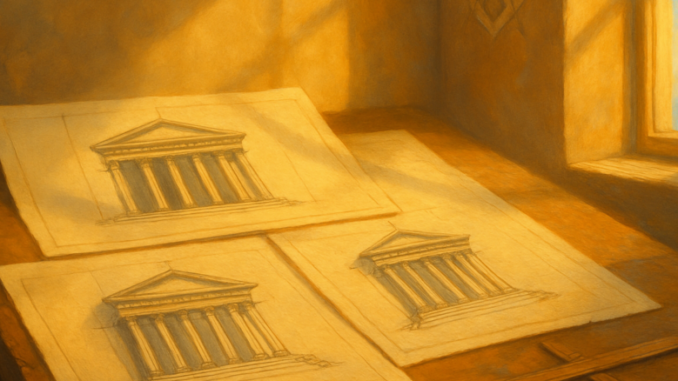
When Freemasons speak of “the temple,” they rarely mean the same thing. One refers to a biblical structure erected thousands of years ago. Another speaks of a collective ideal that encompasses all of humanity. And yet another points inward, toward something only he can build. Three temples, three perspectives — and yet they seem inseparably linked. So what exactly is the difference? And more importantly, what does that difference tell us about the journey every seeker undertakes?
Solomon’s Temple: The Historical Foundation
The first temple at the heart of Masonic symbolism is Solomon’s Temple. According to biblical tradition, this structure was built in tenth-century Jerusalem, and it serves as the backdrop against which the ritual work of Freemasonry unfolds. Here, stonemasons, architects, and craftsmen worked together on something greater than themselves. Solomon’s Temple represents the external, the visible, the tangible result of human cooperation.
For those outside the Craft, this temple is often the most recognizable symbol. It is a story of stone, cedarwood, and gold — of King Solomon who sought wisdom and the master builder Hiram who applied his skill. From this perspective, the temple is treated as a historical given, a place that once existed and now serves as a metaphor for ordered, purposeful building. It is the temple viewed from the outside in: first the building, then the meaning.
The Temple of Humanity: A Collective Ideal
The second temple extends far beyond the boundaries of stone and mortar. The Temple of Humanity is not a building you can visit but an ideal you can pursue. It represents the vision of a world in which people live in harmony, where differences are embraced, and where brotherhood is the highest law. This temple is not raised by a handful of master builders — it is constructed by every generation that contributes to progress, tolerance, and understanding.
While Solomon’s Temple has a specific history, the Temple of Humanity is timeless and universal. A seventeenth-century philosopher writing about peace among nations contributed to it just as much as a contemporary thinker advocating for dialogue. Freemasons see themselves as laborers on this greater structure. Every lodge meeting, every gathering, every fraternal handshake symbolically adds a stone to this ideal whole.
The Temple of Humanity is not a dream we will ever complete, but a direction we can always choose.
The Temple of Perfection: The Inner Building Site
The third temple is perhaps the most personal and, at the same time, the most demanding. The Temple of Perfection refers to the inner work that every Freemason performs upon himself. There is no collective effort here, no historical precedent to lean on. This temple you build alone, with tools you must learn to wield yourself: self-reflection, honesty, and the courage to confront your own shortcomings.
The rough ashlar that must be shaped into a perfect cube is the best-known symbol of this inner process. Perfection here does not mean flawlessness — that is unattainable. It refers to the continuous movement toward improvement, the chipping away of rough edges, the smoothing of imperfections in one’s own character. This temple is never finished, and that is precisely the point. The journey itself is the building.
What the Three Temples Share
On the surface, these three temples seem entirely different. One is tangible and historical, the second collective and idealistic, the third individual and introspective. Yet they share a fundamental core: all three are about building. About creating something of value from raw materials. About the willingness to labor on something greater than the present moment.
Solomon’s Temple teaches us cooperation and craftsmanship. The Temple of Humanity teaches us responsibility for the whole. The Temple of Perfection teaches us honesty with ourselves.
There is also a deeper connection at work. Those who do not work on themselves can hardly contribute to humanity. Those who ignore the lessons of the past build on shifting sand. The three temples do not form a hierarchy but a triangle, in which each corner supports the other two.
Two Perspectives on One Symbolism
For those outside Freemasonry, this distinction can be confusing. Are we talking about a building, about society, or about personal growth? The answer is: all three at once. The power of symbolism lies precisely in its multiplicity of meaning. A symbol that carries only one interpretation is not a symbol — it is merely a sign.
The Freemason learns to recognize and appreciate these different layers. He understands that Solomon’s Temple is not just a story about stonemasons in a distant past but also a mirror he holds up to himself. What am I building? With whom am I building? And why? These questions resonate at every level of the temple symbolism.
The difference between the three temples is ultimately a matter of perspective. Solomon’s Temple looks outward and toward the past. The Temple of Humanity looks outward and toward the future. The Temple of Perfection looks inward and toward the present moment. Together, they form a complete orientation for anyone seeking meaning. Perhaps the most important question is not which temple is the right one, but whether we can find the courage to keep building all three.
Copyright text & image: devrijmetselaar.nl
Texts are based on the ideas and content of the author of devrijmetselaar.nl, reviewed, corrected, and supplemented with the assistance of OpenAI. Images are created based on the ideas of the author of devrijmetselaar.nl using OpenAI/DALL-E.
Frequently Asked Questions
What is Solomon's Temple and why is it important to Freemasonry?
Solomon's Temple is a biblical structure built in tenth-century Jerusalem that serves as the historical and symbolic foundation of Masonic ritual work. It represents the tangible result of human cooperation and craftsmanship, where stonemasons, architects, and builders worked together on something greater than themselves. This temple grounds Freemasonry in a rich historical tradition of purposeful building and skilled labor.
What does the Temple of Humanity mean in Freemasonry?
The Temple of Humanity is an ideal rather than a physical structure—a vision of a world where people live in harmony, embrace differences, and practice brotherhood as the highest law. Every generation contributes to this temple through acts of progress, tolerance, and understanding, and Freemasons see themselves as active laborers building toward this collective vision. It represents a timeless goal that transcends any single historical period or culture.
What is the Temple of Perfection and how do Freemasons work on it?
The Temple of Perfection is the inner spiritual work that each Freemason performs on himself through self-reflection, honesty, and personal growth. Symbolized by the rough ashlar being shaped into a perfect cube, this temple requires individual effort and courage to confront one's own shortcomings. It is the most personal of the three temples and represents the lifelong journey of self-improvement that lies at the heart of Masonic practice.
How are the three temples connected in a Freemason's journey?
The three temples represent an interconnected progression: from the historical foundation of Solomon's Temple, to the collective ideal of the Temple of Humanity, to the personal inner work of the Temple of Perfection. Together, they illustrate that Freemasonry encompasses learning from the past, contributing to a better world, and continuously improving oneself. This journey shows how external history, universal ideals, and personal growth are inseparably linked in the Masonic experience.

Be the first to comment