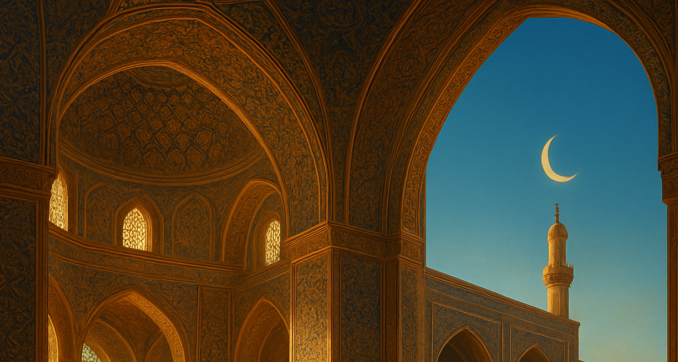
Why do mountains fascinate us so deeply? From Sinai to Olympus, from the Himalayas to the symbolic peaks found in sacred texts — wherever human beings search for meaning, they look upward. In the fifty-second surah of the Quran, known as At-Tur (The Mountain), we find a powerful meditation on truth, responsibility, and the pursuit of higher understanding. For a Freemason, this resonates with a familiar journey: the climb from darkness to light, from roughness to refinement.
What Makes At-Tur Such a Remarkable Surah?
At-Tur opens with an oath sworn upon the mountain itself, a parchment inscribed with writing, and the “much-frequented house.” These are not arbitrary images. In Islamic tradition, the mountain refers to Mount Sinai, where revelation took place according to both the Quran and the Bible. The written parchment symbolizes knowledge that is recorded and transmitted across generations. The much-frequented house refers to a celestial sanctuary — a place of spiritual gathering. Together, they form a threefold portal: earth, word, and heaven united in a single opening.
The surah goes on to address judgment, the rewards awaiting the righteous, and the consequences for those who deny the truth. But the tone is not threatening — it reads more as an invitation to reflection. Who are you? Where do you stand? And perhaps more importantly: where do you want to go?
Why Does the Mountain Speak to the Freemason?
The mountain is a place of transformation in virtually every spiritual tradition. Moses received the Law on Sinai. Zarathustra withdrew into the mountains for his revelations. In Freemasonry, we know the symbolic ascent from Entered Apprentice to Master Mason — an upward movement that represents inner growth. The mountain compels us toward silence, toward separation from the everyday, toward honest confrontation with ourselves.
The mountain is not a destination but a mirror: the higher you climb, the more clearly you see yourself.
This is precisely what the Freemason experiences in ritual. It is not a race to the summit but an inward journey where each step yields new insight. At-Tur emphasizes that this journey is not without obligation. Something is asked of us: honesty, courage, and the willingness to let our actions be weighed.
What Does At-Tur Teach Us About Responsibility?
A striking verse in this surah states that every person is held accountable for what they have earned. This is not an abstract theological concept but an existential truth recognized across the ages. Aristotle spoke about the formation of character through conscious choices. Seneca emphasized that our actions reveal our true selves. And in Freemasonry, we find this reflected in the symbolism of building: you are not merely constructing an outer temple but, above all, the temple within.
At-Tur confronts the reader with a direct question: what have you built? Not with stones, but with intentions, actions, and relationships. This aligns seamlessly with the Masonic ideal of the rough ashlar shaped into a perfect cube. The raw material is already there — the question is what we choose to do with it.
How Do Knowledge and Revelation Relate to Each Other?
The surah also contains a fascinating reflection on knowledge. It speaks of poets and soothsayers who base their words on conjecture, as opposed to revelation, which is presented as trustworthy. Here we touch upon a tension that lives within Freemasonry as well: the relationship between reason and mystery, between what we can comprehend and what transcends us.
Enlightenment philosophers such as Voltaire and Montaigne grappled with similar questions. How do you combine critical thinking with reverence for the unknowable? Freemasonry offers a distinctive path through this dilemma: it demands no specific creed but invites a continuous search. The Great Architect of the Universe is not a definition — it is a question that remains open.
What Does Brotherhood Mean at the Summit?
In At-Tur, the righteous are described as dwelling in gardens and bliss, surrounded by their descendants and loved ones. This image of community following the individual journey is deeply moving. You may climb the mountain alone, but the fruit of that climb is shared with others. Here, the Masonic concept of brotherhood resonates strongly: personal work does not exist apart from the community. On the contrary — it is precisely by improving yourself that you contribute to the greater whole.
The mountain serves as a place of reception, where wisdom is given. It is a place of trial, where character is forged. And it is a place of outlook, where perspective is born.
What Do We Take Away from This Spiritual Climb?
At-Tur is not a distant text about judgment and reward. It is an invitation to movement, to ascent, to embracing the responsibility that comes with awareness. For the Freemason, it echoes a familiar refrain: the work is never finished, the stone calls for continuous shaping, and the light is not a final destination but a direction.
Perhaps that is the deepest lesson of this surah: the mountain does not ask you to arrive — it asks you to keep climbing.
Surah At-Tur reminds us that spiritual growth is not passive waiting but an active ascent. Whether you are a Muslim, a Freemason, or simply a seeker of meaning, the mountain stands open for everyone. What matters is not the tradition from which you set out, but the sincerity with which you undertake the journey. In that sense, all mountains are ultimately the same mountain: an invitation to rise above yourself.
Copyright text & image: devrijmetselaar.nl
Texts are based on the ideas and content of the author of devrijmetselaar.nl, reviewed, corrected, and supplemented with the assistance of OpenAI. Images are created based on the ideas of the author of devrijmetselaar.nl using OpenAI/DALL-E.

Be the first to comment