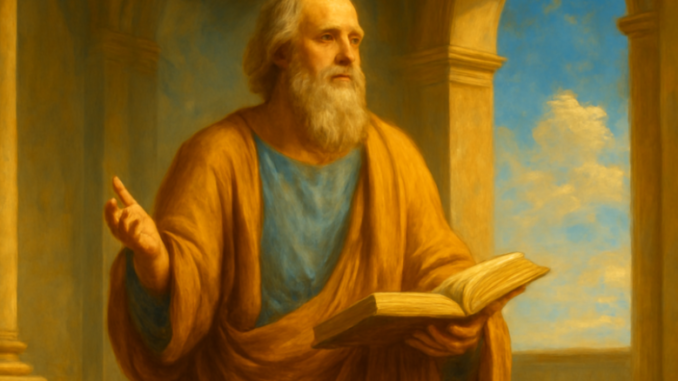
Imagine walking through a park when an ancient oak catches your eye. Something about that tree moves you, though you can’t quite explain what. These moments of beauty — fleeting yet profound — are exactly the starting point of one of Plato’s most poetic dialogues: the Phaedrus. In this remarkable work, the Greek philosopher explores how beauty stirs the soul and propels us toward inner growth. For anyone engaged in self-knowledge and personal development — and for Freemasons in particular — this ancient text offers surprisingly practical wisdom.
The Setting: Philosophy in Nature
The Phaedrus takes place outside the city walls of Athens, along the banks of the river Ilissos. Socrates and his young companion Phaedrus seek shade beneath a plane tree. This rural setting is no accident. Plato deliberately places the conversation in nature to show how beauty surrounds us everywhere and has the power to open the mind. Phaedrus has just heard a speech about love and wants to share it with Socrates. What follows is a profound investigation into the nature of the soul, the workings of love, and the power of true eloquence.
The Soul as a Winged Chariot
The most famous image from the Phaedrus is that of the soul as a winged chariot. Plato describes the human soul as a charioteer driving two horses. One horse is noble and obedient; the other is unruly and driven by appetite. The charioteer represents reason, the noble horse stands for spirited ambition and courage, and the difficult horse symbolizes bodily desires.
This allegory makes immediately clear why self-knowledge matters so deeply. If you don’t know which horse is pulling in which direction, you lose control of your own course in life. The wings of the soul grow when we pursue beauty and truth. They wither when we surrender to baser instincts. In practical terms, every choice you make either feeds your growth or feeds your stagnation.
Beauty is not mere decoration for life — it is the spark that reminds the soul of its origin and inspires it to ascend.
Beauty as a Path to Remembrance
Plato connects beauty to his Theory of Forms. Before the soul was born into a body, it dwelled in a heavenly realm where it beheld perfect forms: the Good, the True, the Beautiful. When we encounter earthly beauty — a striking face, a work of art, a sunset — the soul is reminded of that divine origin. Plato calls this anamnesis, or recollection.
When something beautiful moves you, it is not a superficial emotion. It is a signal from your deeper self that you are on the right path. And this experience can be actively sought out. Visit a museum, listen attentively to music, or pause to appreciate the beauty in your daily surroundings. Each of these moments can serve as a small reminder of what truly matters.
The Art of Speaking and Listening
A substantial portion of the Phaedrus is devoted to rhetoric — the art of persuasion. Plato draws a sharp distinction between false and true eloquence. False rhetoric manipulates and deceives. True eloquence, by contrast, understands the soul of the listener and guides it toward truth. A good speaker first understands himself and his subject, and then adapts his words to suit the person he is addressing.
This principle is immediately applicable. Whether you’re having a conversation with a colleague, giving a presentation, or broaching a difficult topic with someone close to you, ask yourself: are my words designed to convince, or to illuminate? The difference lies in your intention. Do you want to win, or do you want to connect?
Practical Applications for Today
The insights from the Phaedrus are not abstract philosophy destined for a dusty shelf. They offer concrete guidance for anyone committed to personal development:
Know your horses. Regularly examine which drives and ambitions are steering you. Journaling and meditation are powerful tools for this kind of self-inquiry.
Seek beauty intentionally. Set aside moments in your week to experience something beautiful, free from distraction. Let it be a deliberate practice.
Practice true eloquence. Listen first, understand the other person, and then speak with the intention of connecting rather than conquering.
Nourish your wings. Choose at least one activity each day that brings you closer to truth or beauty — reading, contemplation, creative work, or meaningful conversation.
The Phaedrus and the Masonic Path
The image of the winged soul resonates powerfully with Masonic symbolism. The rough ashlar that is shaped into a perfect cube, the winding staircase that leads upward, the perpetual search for Light — all of these symbols point toward the same process Plato describes. We begin as unworked material, full of contradictory forces. Through deliberate work on virtue and self-knowledge, we ascend to a higher level of being.
The Phaedrus also makes clear that this journey does not happen in isolation. The dialogue between Socrates and Phaedrus serves as a model for fraternal exchange. By thinking and speaking together, both participants arrive at insights neither could have reached alone. This is precisely what happens in a Lodge: Brothers meet, share insights, challenge one another, and help each other grow. The Masonic Lodge, like the riverbank in the Phaedrus, becomes a space where truth can be pursued in fellowship.
Beauty as a Compass
The Freemason works with tools that provide direction. The compasses and the square are symbols of measure and balance. Plato would say that beauty serves a similar function — it is a compass of its own kind. Where you experience beauty, there lies a trail toward truth. Follow that trail. It leads not only to a richer life but also to a deeper understanding of yourself and your fellow human beings.
The Phaedrus is far more than a philosophical text from antiquity. It is a practical guide for anyone serious about personal growth and the examined life. Plato shows us that beauty is not a luxury but an essential nourishment for the soul. By consciously choosing what is beautiful, true, and good, you feed your wings and begin to rise. Start today: notice what moves you, investigate why, and let that experience guide your direction. For the Freemason, this is not new counsel — it is the very essence of the Craft, expressed in the timeless language of philosophy.
Copyright text & image: devrijmetselaar.nl
Texts are based on the ideas and content of the author of devrijmetselaar.nl, reviewed, corrected, and supplemented with the assistance of OpenAI. Images are created based on the ideas of the author of devrijmetselaar.nl using OpenAI/DALL-E.
Frequently Asked Questions
What is the main theme of Plato's Phaedrus dialogue?
The Phaedrus explores how beauty stirs the soul and propels us toward inner growth and self-knowledge. Through conversations between Socrates and Phaedrus, the dialogue investigates the nature of the soul, love, and true eloquence, using nature and beauty as catalysts for philosophical understanding.
What does the allegory of the soul as a winged chariot mean?
Plato describes the soul as a chariot driven by reason (the charioteer) with two horses: a noble, obedient horse representing spirited ambition and courage, and an unruly horse symbolizing bodily desires. This allegory illustrates the importance of self-knowledge and controlling which impulses guide our lives. Our choices either feed our growth or our stagnation.
What is anamnesis and how does it relate to beauty?
Anamnesis, or recollection, is Plato's concept that when we encounter earthly beauty—whether a face, artwork, or sunset—the soul is reminded of the divine forms it once beheld in a heavenly realm before birth. Beauty is thus not superficial decoration but a meaningful signal that awakens the soul's memory of its higher origin and inspires it to ascend.


Be the first to comment