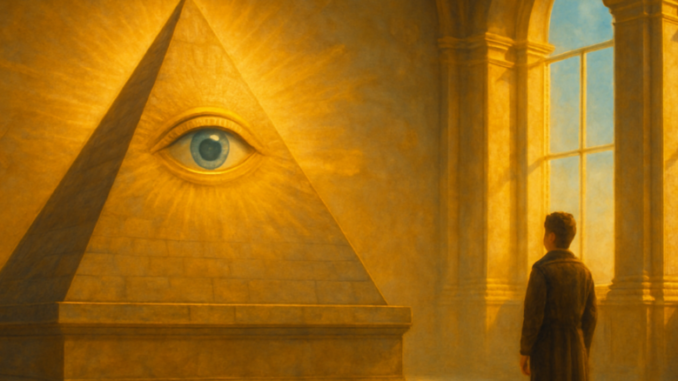
In 1785, the Elector of Bavaria, Karl Theodor, outlawed a secret society that had existed for only nine years. What started as a small circle of academics in Ingolstadt ended with raids, confiscated documents, and a wave of pamphlets that shook all of Europe. How did an intellectual fellowship grow so quickly into a perceived threat to both throne and altar? And what can the rise and fall of the Illuminati teach us today about the tension between spiritual development and worldly power?
The Rapid Rise of an Enlightenment Society
Adam Weishaupt, a professor of canon law at the University of Ingolstadt, founded the Order of the Perfectibilists in 1776. He later renamed the group the Illuminati — the enlightened ones. Weishaupt was captivated by the ideals of the Enlightenment: critical thinking, religious tolerance, and moral self-improvement. He saw secret societies as a vehicle for spreading these values without directly confronting those in power.
Growth was modest at first. Weishaupt recruited students and fellow academics, but the real expansion came when Baron Adolph von Knigge joined in 1780. Von Knigge was an experienced Freemason with an extensive network of contacts. He restructured the order and connected it to existing Masonic lodges. Within a few years, membership grew from a few dozen to an estimated two thousand members spread across the Holy Roman Empire.
What Did the Illuminati Teach Their Members?
The Illuminati’s degree system was ingeniously constructed. New members began as novices and worked their way upward through several levels of initiation. Each level revealed more of the philosophy behind the society. At its core lay self-knowledge, moral discipline, and the pursuit of personal perfection. Members were required to write monthly reports on their progress and shortcomings — a practice reminiscent of the self-examination exercises found in Masonic lodges.
The spiritual dimension was unmistakable. Weishaupt believed that inner enlightenment would lead to outward improvement. A person who truly knew himself and mastered his passions would become a better citizen. This idea resonates with many esoteric traditions, from Stoic philosophy to the mystical currents within various world religions. It was never about dogma — it was about practical wisdom applied to daily life.
Yet crucially, the Illuminati were not banned because of their spiritual teachings. They were banned because of the political conclusions the authorities drew from those teachings.
The Collision with Church and State
Eighteenth-century Bavaria was deeply conservative and staunchly Catholic. The Jesuit order had been suppressed by the Pope in 1773, but Jesuit influence still lingered everywhere. Weishaupt himself had been educated at a Jesuit school, and his order was partly a reaction against what he experienced as intellectual narrow-mindedness. The Illuminati attracted reform-minded civil servants, physicians, and lawyers — people who wanted change, but not revolution.
Trouble began in 1784. Defectors’ letters and internal conflicts led to leaks. Documents fell into the hands of the authorities. Elector Karl Theodor issued an initial decree banning all unauthorized societies. A year later, a specific ban on the Illuminati followed, accompanied by searches of prominent members’ homes. The confiscations yielded archives that were subsequently published to discredit the society in the eyes of the public.
The formal charges leveled against the Illuminati included undermining the monarchy and the authority of the Church, spreading atheism and religious criticism, infiltrating government institutions and universities, and conducting secret propaganda against the established order.
Whether these accusations were entirely justified remains a matter of historical debate. The published documents did indeed contain criticism of kings and popes, but they also placed considerable emphasis on gradual reform rather than overthrow. For the Bavarian government, however, this nuance made little difference. The society was declared dangerous and had to be eliminated.
The Aftermath and the Birth of Conspiracy Myths
After 1785, members scattered across Europe. Some continued their activities within other societies, including Masonic lodges. Weishaupt himself fled to Gotha, where he found protection under Duke Ernst II. He went on to write defenses of his order and philosophical works, but the Illuminati as an organization ceased to exist. The ban was effective.
Myth-making began almost immediately. Shortly after the French Revolution, books appeared claiming the Illuminati had orchestrated the upheaval. The Scottish physicist John Robison and the French priest Augustin Barruel published influential works that popularized this idea. There is no historical evidence for a direct role, but the theory took on a life of its own — one that persists to this day, feeding countless conspiracy narratives and pop-culture fantasies.
Lessons for Spiritual Seekers Today
The story of the Illuminati illustrates a tension that remains deeply relevant: how should inner development relate to engagement with the wider world? Freemasonry has drawn clear lessons from this episode. Modern lodges deliberately refrain from political activity as organizations, even though individual members are of course free to hold and express their own views. The emphasis remains on personal growth, brotherhood, and the cultivation of virtue.
At the same time, the Illuminati’s story reminds us that spiritual traditions never exist in a vacuum. The Illuminati were children of the Enlightenment, just as Freemasonry has roots in the guild traditions and natural philosophy of the seventeenth century. Anyone who joins a lodge today enters a living tradition — one that is in constant dialogue with the world around it, without being absorbed by it.
The ban on the Illuminati in 1785 was the result of a collision between Enlightenment ideals and a conservative government that felt its authority under threat. The society vanished as an organization, but the ideas behind it — self-knowledge as a path to improvement, critical thinking as a virtue — lived on. They found expression in Masonic lodges, in philosophical movements, and in the broader culture of the modern world. In that sense, the Illuminati did not truly disappear. They simply changed form.
The downfall of the Illuminati serves as a powerful reminder that the pursuit of enlightenment — whether personal or collective — always exists within a social and political context. For Freemasons and spiritual seekers alike, the lesson is clear: inner transformation is a noble goal, but the way it is pursued and organized matters enormously. The Illuminati’s story is not just a chapter in the history of secret societies. It is a meditation on the delicate balance between seeking the light and navigating the world as it is.
Copyright text & image: devrijmetselaar.nl
Texts are based on the ideas and content of the author of devrijmetselaar.nl, reviewed, corrected, and supplemented with the assistance of OpenAI. Images are created based on the ideas of the author of devrijmetselaar.nl using OpenAI/DALL-E.




Be the first to comment